


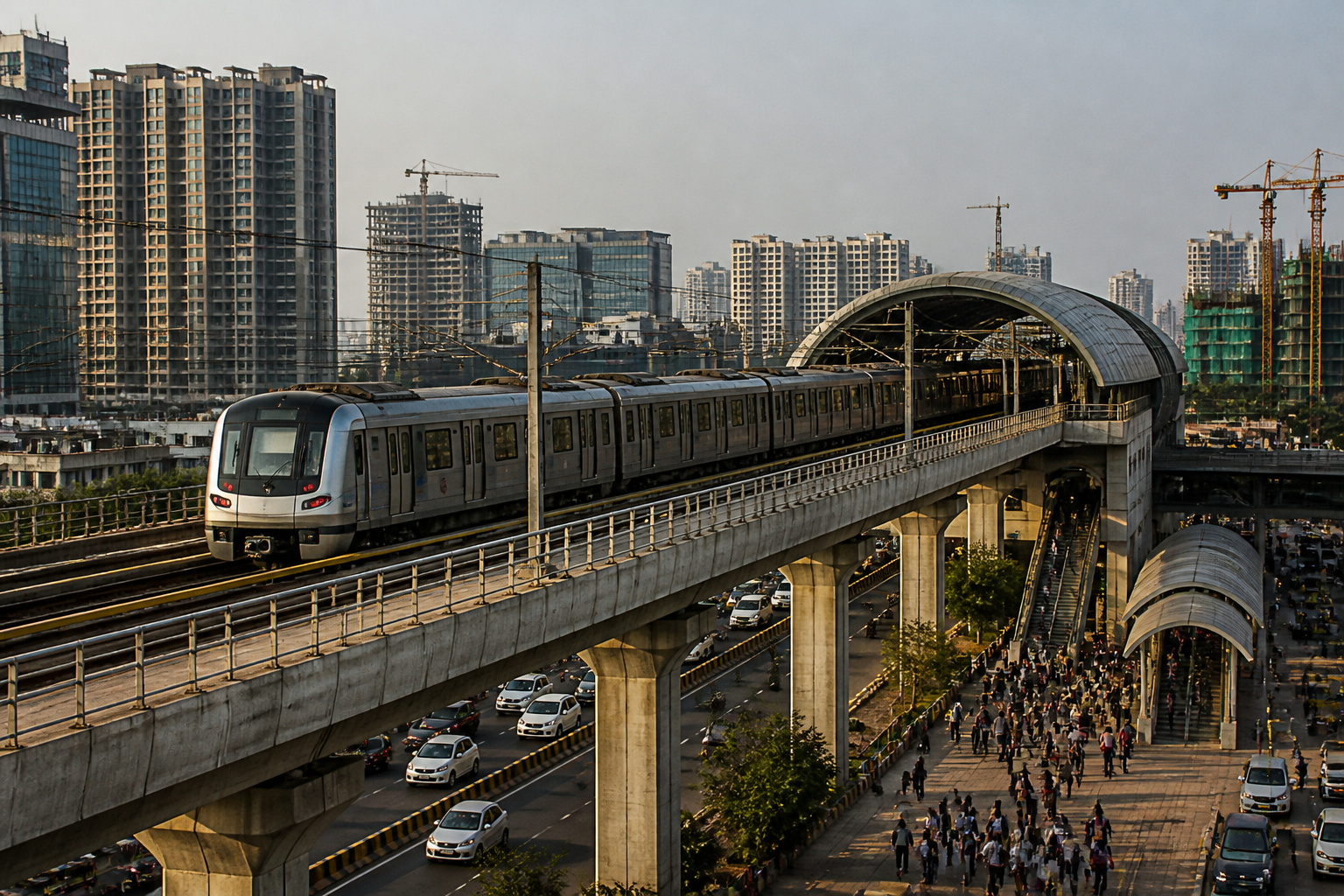
Haryana’s metro expansion has moved beyond isolated project announcements, with the state advancing a Ballabgarh–Palwal extension, reviewing new Namo Bharat corridors and building out Gurugram’s long-delayed urban rail network. The approvals and proposals indicate a more connected regional transport strategy, but they also show that different corridors remain at different stages of feasibility, approval, design and construction.
The most immediate development is the Haryana government’s approval of the final feasibility report for the Metro extension between Ballabgarh in Faridabad and Palwal. The detailed project report has now been sent to the Union Ministry of Housing and Urban Affairs. That movement is important because it takes the corridor from feasibility assessment into a stage where central-level consideration can begin, although the source does not establish that construction approval or funding has been granted.
The same review also placed the proposed 35.25-km Metro line between Gurugram Sector 56 and Panchgaon before the state government for final approval. The line is planned with 28 stations and would connect with the Namo Bharat Regional Rapid Transit System network. In transport terms, that proposed interchange is significant because it would place a city Metro corridor within a larger regional rail framework. However, the project remains subject to the state’s final approval, making it less advanced than the Ballabgarh–Palwal extension.
Both developments were reviewed at the 66th board meeting of the Haryana Mass Rapid Transport Corporation, chaired by Chief Secretary Anurag Rastogi. HMRTC Managing Director Ajay Kumar also briefed the board on two proposed Namo Bharat corridors. The meeting therefore covered not one project but a portfolio of corridors that could reshape connections between Delhi, Gurugram, Faridabad, Palwal, Panipat, Karnal and the wider National Capital Region.
That portfolio approach is the central feature of Haryana’s current transport push. The 136.3-km Delhi–Panipat–Karnal Namo Bharat corridor is estimated to cost Rs 33,051.15 crore and is planned with 17 stations, with provision for four additional stations. It is intended to connect Delhi with the industrial hubs of Panipat and Karnal. The corridor’s length and estimated cost place it in a different category from a city Metro extension: it is a regional link whose stated purpose is to connect major urban and industrial centres.
A second regional proposal, the Gurugram–Faridabad–Noida–Greater Noida Namo Bharat corridor, is still under consideration. Officials have finalised the alignments and station locations for its Gurugram and Faridabad sections at the state level. The detailed project report has been sent to the concerned development authorities for comments. This stage illustrates the administrative complexity of cross-city infrastructure: even after state-level alignment work, the project must pass through comments and coordination involving multiple development authorities.
The proposed regional corridors are being discussed alongside a substantial expansion of Gurugram’s existing Metro network. Gurugram’s urban rail system had not received major extensions beyond HUDA City Centre, now known as Millennium City Centre, in more than a decade. Gurugram Metro Rail Limited is now executing the 28.5-km Millennium City Centre–Cyber City corridor, approved at Rs 5,452 crore.
The corridor is planned as an elevated line with 27 stations, connecting Old and New Gurugram through Palam Vihar, Sector 9 and Udyog Vihar. A 1.85-km spur from Basai village to the Dwarka Expressway is also planned. These details show that the city-level expansion is intended to connect established employment areas and residential districts rather than simply add a short extension to the existing network.
Implementation has also moved into procurement on at least one section. GMRL recently invited bids for a Rs 1,662-crore civil construction package covering the stretch between Sector 9 and the Cyber City Metro station. A tender, however, is not the same as an operational line. The projects remain dependent on subsequent construction, systems installation, testing and opening milestones, none of which are established in the supplied material for this package.
Other proposed Gurugram links include a 31-km corridor connecting Sector 45 to Bata Chowk and an 11.15-km stretch between Millennium City Centre and Gurugram railway station. Together with the Millennium City Centre–Cyber City corridor, these proposals indicate an attempt to create a more extensive internal network. Their inclusion in the wider project pipeline also means that the final shape of Gurugram’s Metro system will depend on which proposals secure approvals and progress beyond planning.
The case for expansion is supported by recent ridership and revenue figures from Gurugram Rapid Metro. Between April and August, the system carried 88.81 lakh passengers, up from 79.57 lakh during the same period a year earlier. That represents an 11.62% increase. HMRTC’s operational revenue for the same period rose by 11.64%, reaching Rs 18.6 crore compared with Rs 16.66 crore in the previous year.
The revenue figures also show that the financial performance of an urban rail system is not limited to ticket sales. Non-fare revenue increased by 64.34%. Rental income from station spaces reached Rs 3.5 crore, while the e-auction of advertising rights generated Rs 23.14 crore. These figures offer a limited but relevant view of how station assets and advertising can supplement fare income. They do not, by themselves, establish that the system is financially self-sustaining or that the same revenue pattern will apply to future corridors.
The administrative structure emerging from the approvals is layered. HMRTC is reviewing and advancing proposals; GMRL is executing the approved Gurugram corridor; the Union Ministry of Housing and Urban Affairs will receive the Ballabgarh–Palwal DPR; and development authorities are being asked to comment on the proposed regional corridor linking Gurugram, Faridabad and the Noida region. Each institution has a separate role, and the movement of a project from one authority to another is part of the infrastructure process rather than a final construction commitment.
This is particularly important for corridors that cross municipal, district or state-linked planning jurisdictions. The Gurugram–Faridabad–Noida–Greater Noida proposal cannot be assessed only through the lens of one city because its alignments and station locations have implications for several urban authorities. The supplied material confirms that state-level work has been completed for the Gurugram and Faridabad sections, but it does not establish the final inter-authority agreement, financing structure, construction schedule or approval status for the complete corridor.
The same distinction applies to the Delhi–Panipat–Karnal proposal. Its 136.3-km length, estimated Rs 33,051.15-crore cost and planned station network provide the scale of the project, while its stated connection to industrial hubs provides the economic rationale presented in the report. The source does not provide projected ridership, land acquisition requirements, construction timelines or a funding breakdown. Those details will be essential for assessing how the proposal moves from a regional transport concept to a deliverable line.
The evidence therefore points to two parallel developments. First, Haryana is rebuilding momentum in urban Metro expansion after a period in which Gurugram’s network saw no major extension beyond Millennium City Centre for more than a decade. Second, the state is considering a regional rail structure that could connect city Metro systems with longer-distance Namo Bharat corridors. The success of that model will depend not only on announcing connected routes but on coordinating station locations, approvals, procurement and implementation across institutions.
For residents, the immediate significance is that several areas have entered different phases of transport planning: Palwal has a feasibility report moving to the Union ministry, Gurugram Sector 56–Panchgaon is awaiting final state approval, the Gurugram Metro expansion is under execution, and other corridors remain proposals or are under consideration. These distinctions matter because they determine how close each project is to construction and eventual passenger service.
What the current evidence confirms is a broad expansion push supported by rising Rapid Metro ridership and a growing pipeline of city and regional corridors. What remains unresolved is the delivery timetable, the funding and approval path for the proposed lines, and whether the various networks will ultimately operate as a coordinated regional system. The next milestones to watch are the Union ministry’s consideration of the Ballabgarh–Palwal DPR, final state approval for the Sector 56–Panchgaon line, comments from development authorities on the Gurugram–Faridabad–Noida–Greater Noida proposal and progress on GMRL’s construction tenders.
