


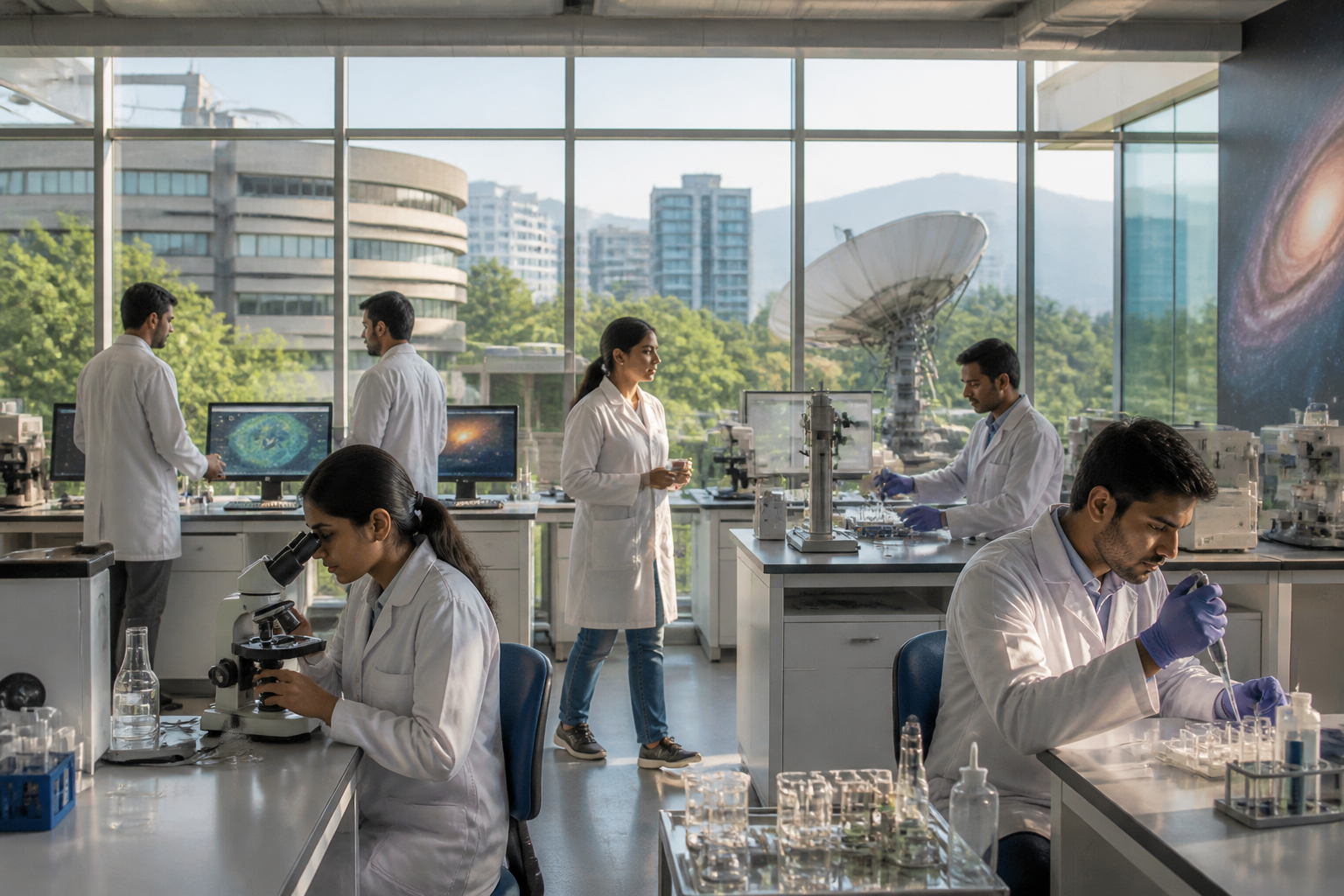
The inclusion of 92 scientists affiliated with Pune-based institutions in the 2026 Stanford-Elsevier list places the city’s research ecosystem in the spotlight. The ranking is not a measure of the city’s entire scientific capacity, but it does provide a useful, citation-based snapshot of the international visibility achieved by researchers working across Pune’s universities, laboratories, hospitals and specialist institutes.
That distinction matters because Pune’s scientific identity is distributed across a network rather than concentrated in one institution. The scientists on the list are affiliated with Savitribai Phule Pune University, Symbiosis International University, CSIR-National Chemical Laboratory, the Inter-University Centre for Astronomy and Astrophysics, the Indian Institute of Science Education and Research Pune, the Defence Institute of Advanced Technology, Bharati Vidyapeeth and Dr D Y Patil institutions. Researchers from the National Institute of Virology, Agharkar Research Institute, the Indian Institute of Tropical Meteorology, Vishwakarma Institute of Technology, Armed Forces Medical College, the College of Engineering Pune, KEM Hospital and the Pulmocare Research and Education Foundation also feature.
The institutional spread is the most important urban fact in the announcement. A city’s research capacity is shaped not only by individual scientists but also by the presence of organisations that recruit researchers, maintain laboratories, train students, support specialised fields and create opportunities for collaboration. The list shows that Pune’s research activity is located across public universities, national laboratories, private and deemed universities, defence institutions, hospitals and independent research foundations.
## What the Pune research ecosystem reveals
The numbers show a broad institutional base. Savitribai Phule Pune University accounts for 18 scientists in the list, while Symbiosis International University has 23. CSIR-National Chemical Laboratory has nine, IUCAA seven, Dr D Y Patil institutions eight, Bharati Vidyapeeth six, IISER Pune five and DIAT four. These figures should not be read as a league table between institutions because the ranking is based on individual researchers and citation-based indicators. They do, however, indicate that global research visibility is emerging from multiple parts of Pune’s knowledge infrastructure.
The disciplinary range is equally significant. The list includes work in astronomy, physics, medicine, engineering, climate science and biotechnology, while the account of the ranking also refers to chemistry, materials science, artificial intelligence, public health and other areas. This breadth makes the announcement more than a success story about one scientific field. It presents Pune as a city where fundamental research, applied science, medical research and technology-oriented work coexist within the same metropolitan environment.
The 2026 single-year list reflects scientific impact based on research and citations during 2025. Its methodology uses citation-based indicators and a composite citation score drawn from the Stanford-Elsevier global database of scientific researchers. That methodology gives the ranking a defined basis, but it also establishes its limits. Citation performance captures one dimension of research influence; it does not, from the information available, measure laboratory capacity, research funding, student access, commercialisation, public benefit or the quality of the urban environment in which institutions operate.
The ranking should therefore be understood as a signal of visibility rather than a complete audit of Pune’s scientific system. It confirms that researchers connected to the city were cited sufficiently to appear in a global top-two-per-cent database. It does not by itself establish how evenly research opportunities are distributed across institutions, how many collaborations exist between them or whether the city is retaining its most productive researchers over time.
One of the clearest examples in the list is Sundeep Salvi, founder of the Pulmocare Research and Education Foundation. He is ranked 41st globally in the Respiratory System subfield, which has 71,926 researchers, and is identified as the highest-ranked Indian scientist in that subfield in the 2026 single-year ranking. His field connects scientific recognition with a health concern that is directly relevant to urban populations, although the supplied information does not quantify the practical impact of his research or describe how it has influenced public policy or clinical outcomes.
The list also includes the late T Padmanabhan of IUCAA, described as one of India’s best-known theoretical physicists and cosmologists. Other named researchers include Sujit K Ghosh of IISER Pune, Bhushan Patwardhan of SPPU, Varun Sahni of IUCAA, Kandasubramanian Balasubramanian of DIAT, Dattatray J Late of CSIR-NCL, Surhud More of IUCAA and Angshuman Nag of IISER Pune. In biomedical research, Chittaranjan S Yajnik of KEM Hospital is recognised for work focused on diabetes, nutrition and metabolic disease.
## Why institutional diversity matters
For an urban economy, a research institution is more than a campus. It is a source of specialised employment, advanced training and institutional knowledge. The source material does not provide employment or investment figures for Pune’s research sector, so the economic scale of this ecosystem cannot be calculated from the ranking. What can be established is that the city hosts a wide range of organisations capable of producing research that is visible in an international citation database.
That institutional diversity can create a stronger base for scientific work than a city dependent on one discipline or one organisation. Pune’s list includes astronomy and cosmology alongside chemical research, engineering, medicine, climate science, biotechnology and public health. The presence of national laboratories, universities, hospitals and defence institutions suggests that the city’s research landscape is structurally varied, even though the source does not provide evidence on the extent of formal collaboration between them.
This is also where the ranking becomes relevant to urban governance. Research ecosystems depend on the physical and administrative conditions of cities: access to campuses, laboratories, hospitals and transport; the availability of suitable land and buildings; reliable utilities; institutional autonomy; and the ability to attract and retain researchers. None of these factors is measured in the Stanford-Elsevier list as described in the report. The announcement therefore highlights an outcome without establishing which urban or policy conditions produced it.
That gap is important for future reporting. A city can be globally visible for its researchers while still lacking a consolidated strategy for connecting institutions. The current source does not say whether Pune has a city-level research policy, a shared laboratory network, common data infrastructure or a formal mechanism for coordinating universities with hospitals, government agencies and industry. It also does not establish whether the scientists on the list work together or operate largely within separate institutional systems.
## The limits of a global ranking
Citation-based rankings are useful because they apply a common indicator across researchers and fields. The 2026 single-year list offers a way to identify researchers whose work during 2025 achieved high citation impact relative to the database. It also allows Pune’s institutions to be seen within a global research frame rather than only through national reputation.
At the same time, the result should not be treated as a comprehensive ranking of Pune’s institutions. The reported numbers count scientists affiliated with institutions in the city, not the total number of researchers, laboratories or research projects operating there. Nor does the report provide a comparison with other Indian cities, the previous year’s figure or the proportion of Pune-based scientists who appear in each discipline. Without those figures, the announcement can establish scale within the 2026 list but not a trend over time.
The presence of 92 scientists is nevertheless a meaningful indicator of breadth. The total is spread across institutions whose mandates differ substantially. IUCAA’s work in astronomy and cosmology, NCL’s chemical research, medical work at KEM Hospital, climate-related research associated with the Indian Institute of Tropical Meteorology and research at defence and engineering institutions all occupy different parts of the scientific system. Their appearance in one city-level account shows how research capacity can accumulate through institutional variety.
The statement from Sundeep Salvi makes this interpretation explicit. He described the result as evidence of the “extraordinary breadth and global reach” of research in Pune and said the achievement belonged to the city’s scientific ecosystem rather than one institution. He also pointed to contributions in fundamental physics and astronomy, chemistry, materials science, artificial intelligence, climate science, medicine and public health. These claims are presented as his assessment of the data, while the ranking itself supplies the underlying list and citation-based measure.
## The larger urban question
Pune’s research ranking raises a question that a citation count alone cannot answer: how does a city convert dispersed scientific excellence into a durable public and economic asset? The supplied information confirms international visibility, institutional spread and disciplinary diversity. It does not show how research moves between laboratories, hospitals, companies, public agencies and communities.
That question is especially relevant because several fields represented in the list have direct connections to urban life. Climate science relates to environmental conditions and resilience. Public health, respiratory research, diabetes and nutrition relate to the health burdens experienced by city residents. Engineering, materials science and artificial intelligence can influence the systems through which cities are designed and managed. The report does not claim that the listed research has produced specific urban interventions, so those connections should be treated as areas for examination rather than established outcomes.
The city’s challenge, as far as this evidence allows, is not to prove that Pune has scientific talent. The list already documents a significant level of global recognition. The more difficult task is to understand the institutional arrangements that sustain that talent: how researchers are supported, how young scientists enter the system, how facilities are shared, how research is translated into practice and how the city’s planning decisions affect scientific work.
The 2026 Stanford-Elsevier list confirms that Pune’s research ecosystem has substantial visibility across many disciplines. It does not settle whether that ecosystem is integrated, adequately supported or connected to the city’s wider needs. Those are the questions that the ranking makes possible, but does not itself answer.
