


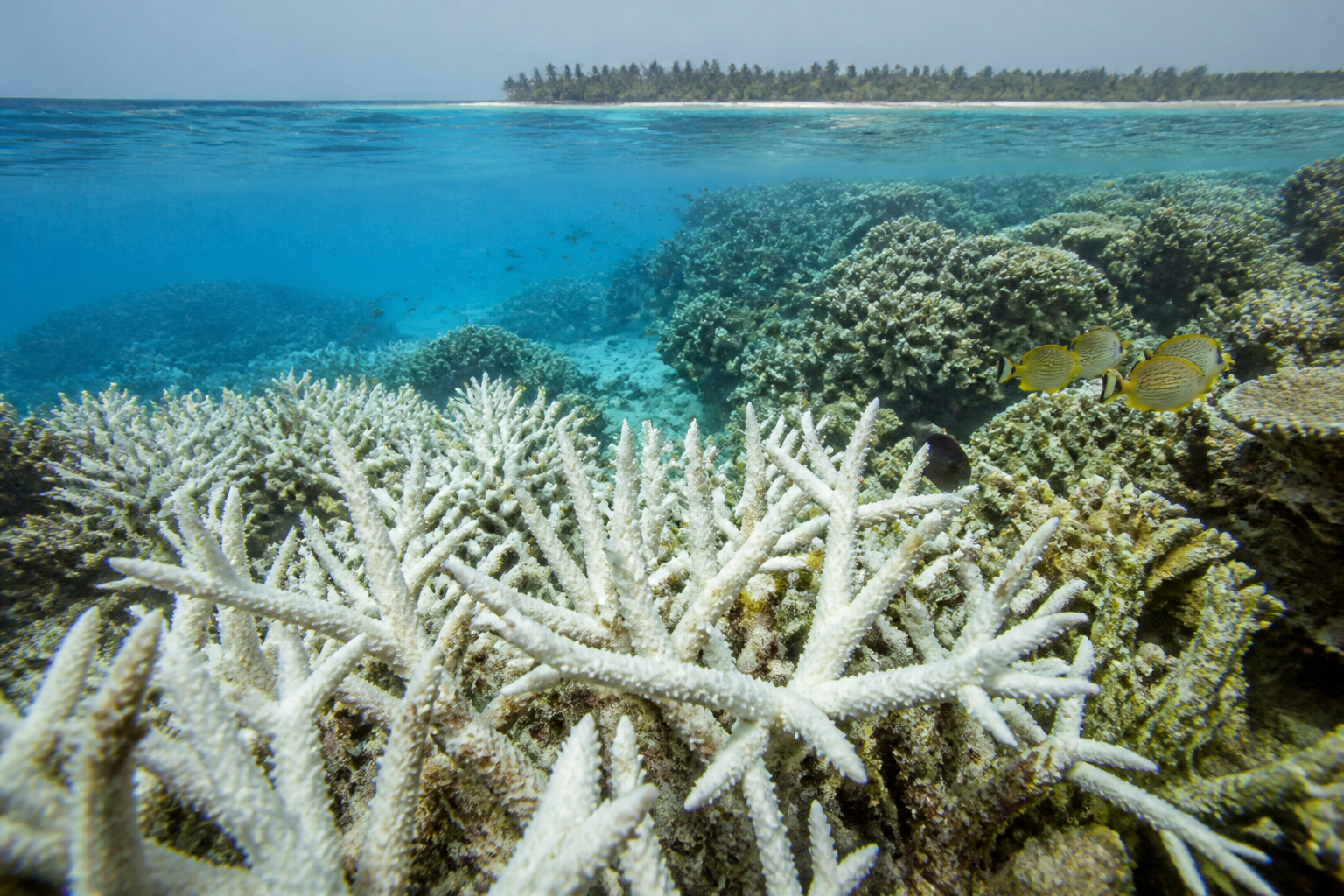
Coral bleaching could intensify across Indian waters from April to May next year as an El Nino phase raises sea-surface temperatures, placing reefs in Lakshadweep, the Andaman and Nicobar archipelagos, the Gulf of Mannar and the Gulf of Kachchh under fresh ecological stress. The warning, reported by the Times of India and attributed to scientists from the Central Marine Fisheries Research Institute and the Fisheries Survey of India, also exposes a governance problem: a climate-driven event may not be preventable, but local activities can determine how much additional stress reefs face while they recover.
The forecast is not for a single reef or coastline. Coral formations occur across several island and coastal systems, with additional patchy formations found in other locations. That geographic spread matters because reefs are not only marine habitats. They support wider ecosystems and are closely connected to fishing, tourism and the condition of coastal environments. Damage in one location may therefore be locally concentrated, but the management challenge is distributed across different administrative and economic settings.
According to Grinson George, director of the Central Marine Fisheries Research Institute, bleaching is expected to begin around the end of March and become more severe in April and May. He said the impact of the El Nino phenomenon is expected in Indian waters after the monsoon and that branched corals are particularly vulnerable to abnormal sea-surface temperatures. Stony corals, he said, show greater resilience to thermal stress, at least to a certain extent.
This distinction between coral types is important because bleaching is not a uniform process. The report identifies branched and stony corals as the two types found in Indian waters, with different levels of vulnerability. A general statement that reefs are “bleaching” can conceal varying outcomes: some corals may lose colour rapidly, while others may withstand heat for longer. The ability of a reef to recover will also depend on whether temperatures return to normal and whether the coral’s biological relationship with algae is restored.
The immediate mechanism is linked to zooxanthellae, photosynthetic algae that live within coral tissues. Sreenath K R, director general of the Fisheries Survey of India, said rising sea-surface temperatures can disrupt this relationship. When the food-supply mechanism is affected, toxicity within the algae’s cells rises, prompting the coral to expel the algae or, if that is not possible, killing the cells.
The algae perform more than a colour-producing function. During normal metabolism, they release a secretion that protects coral from sunlight and contribute to the coral’s food supply. Once the algae are lost, the coral’s calcium-carbonate skeleton is exposed and the protective mechanism is weakened. Sreenath said such corals can survive for about two weeks if abnormal temperatures persist and the algae do not return and recolonise them. Prolonged thermal stress can eventually kill the coral and affect the wider ecosystem around it.
This sequence helps explain why the forecasted timing matters. A bleaching event is not automatically equivalent to permanent reef death. The critical question is whether the stress is brief enough for the algae to return, or prolonged enough to push the coral towards mortality. The supplied report does not provide a forecast of the duration of abnormal temperatures, the expected area of bleaching or the likely recovery rate for individual reef systems. Those gaps limit the precision of any assessment of damage, even though the biological risk is clearly described.
The temperature signal cited in the report comes from the latest bulletin of the Indian National Centre for Ocean Information Services. It states that the El Nino phase over the central Pacific formed in May this year and that sea-surface temperatures have risen with each passing month. The bulletin recorded temperatures more than two degrees Celsius above the relevant baseline in August, although the report does not specify the exact reference period or whether that figure applies uniformly across Indian reef locations.
That qualification is significant for coastal planning. A Pacific climate phenomenon does not translate into identical conditions along every Indian coast. Lakshadweep, the Andaman and Nicobar archipelagos, the Gulf of Mannar and the Gulf of Kachchh have different physical settings and reef formations. The report establishes a broad regional threat, but it does not establish that every reef will experience the same temperature exposure or bleaching intensity.
The warning nevertheless creates a clear administrative task: reduce avoidable local pressure before and during the period of thermal stress. George said El Nino-induced bleaching is a natural phenomenon that cannot be prevented, but added that anthropogenic activities, including fishing and tourism, will have to be restricted near coral reefs to reduce stress on them. This places the response partly outside conventional disaster management. Authorities cannot control the climate trigger, but they can regulate activities that affect already weakened reefs.
Such restrictions would involve coordination among multiple institutions. Fisheries authorities would be responsible for managing fishing activity, while tourism and local administrations would have a role in controlling visitor access and activities near sensitive reef areas. Marine and environmental agencies would need to identify the locations requiring protection, communicate the restrictions and monitor whether they are followed. The report does not specify which agency will lead this response, whether restrictions have been notified or how enforcement will operate.
That institutional uncertainty is part of the larger urban and built-environment question. Island settlements and coastal towns often depend on the same natural systems that tourism and local livelihoods place under pressure. Coral reefs form part of the environmental infrastructure surrounding these settlements, even though they are rarely treated like roads, drainage networks or public utilities. When reefs degrade, the consequences extend beyond marine biology to the resilience and economic stability of coastal communities.
The report also shows why climate resilience cannot be understood only through engineered assets. A seawall, harbour, road or tourism facility may be visible in a project plan, while the reef ecosystem supporting the coast remains outside the main infrastructure conversation. Yet coral degradation can alter the ecological conditions on which fisheries and coastal economies depend. The supplied material does not quantify those economic effects, but it directly connects reef loss with the wider ecosystem and identifies fishing and tourism as activities that may need restrictions.
The evidence currently supports three conclusions. First, Indian reefs face a credible risk of bleaching associated with rising sea-surface temperatures during the forecast El Nino period. Second, vulnerability differs between branched and stony corals, so the impact is unlikely to be uniform. Third, while the climate-linked trigger cannot be stopped, local human activity can be managed to reduce additional stress.
What remains uncertain is equally important. The report does not provide site-specific temperature projections, an inventory of vulnerable reef areas, a quantified estimate of expected coral loss or a confirmed government action plan. It also does not establish whether the predicted bleaching will occur at the same intensity across Lakshadweep, the Andaman and Nicobar archipelagos, the Gulf of Mannar and the Gulf of Kachchh. These are not minor details: they will determine whether a broad warning becomes a coordinated conservation response or remains a general scientific alert.
The next phase of attention will therefore centre on the ocean information bulletins, local temperature conditions after the monsoon and decisions by authorities governing fishing and tourism near reefs. The central lesson is not that bleaching can be prevented, but that the severity of its consequences may still be shaped by how coastal activity is managed while corals are under thermal stress.
