


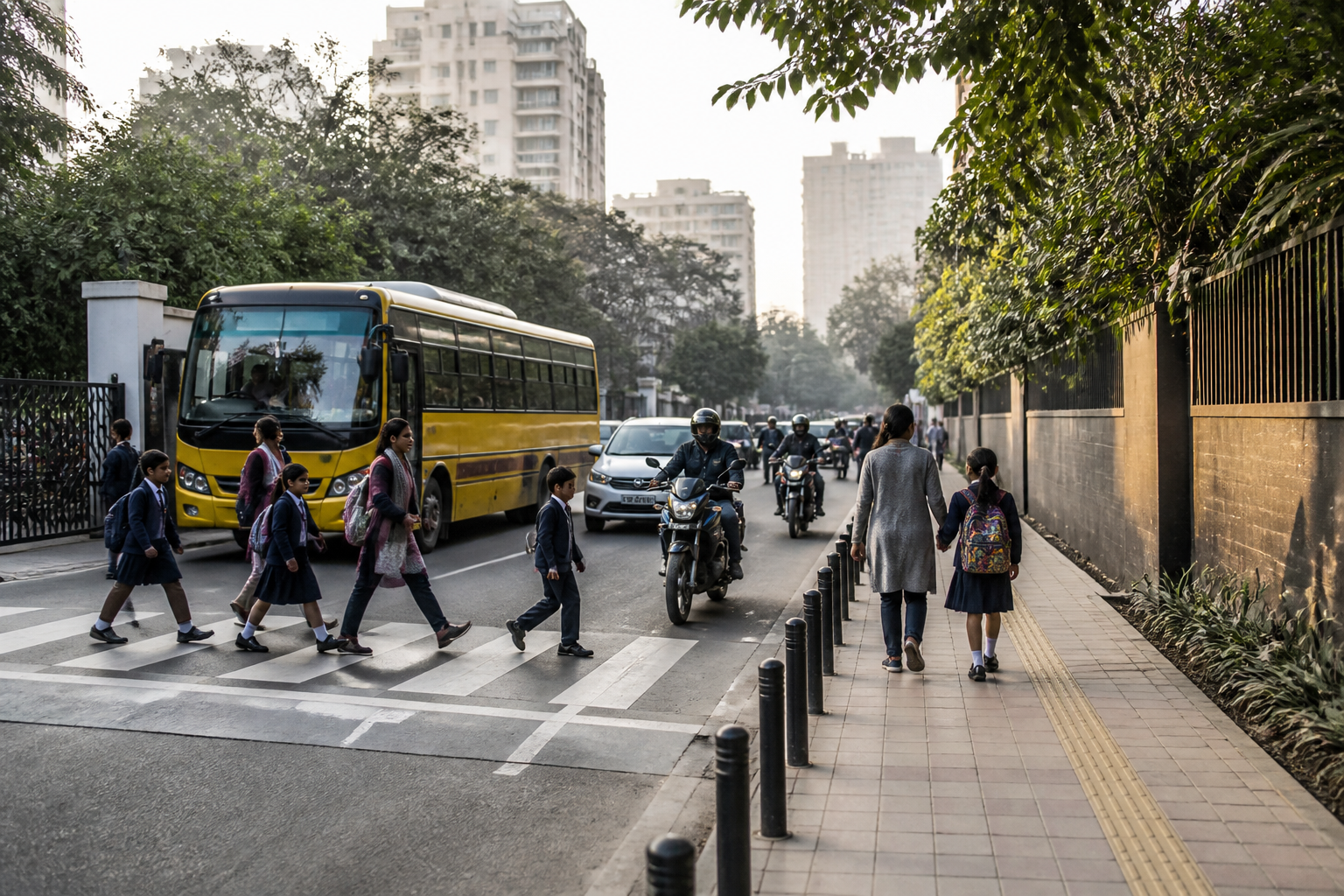
India’s new Vision Zero road-safety roadmap shifts the focus of urban transport from moving vehicles faster to preventing deaths among the people most exposed to traffic: two-wheeler users and pedestrians. Released by the Rahgiri Foundation at Urban Adda 2026, the plan sets the national goal of halving road-accident deaths by 2030 and recommends a maximum speed of 30 kmph on shared streets, while also proposing an electric transition for Delhi-NCR’s school-bus fleet.
The roadmap is significant because it treats road safety as a design and governance issue rather than only a matter of driver behaviour. Its recommendations cover street geometry, speed limits, crossing design, footpaths, accident-data analysis and the prioritisation of high-risk corridors. It also connects mobility safety with air pollution through a separate proposal to electrify around 15,000 school buses operating in Delhi, Gurugram and Noida.
According to the report published by Jagran – New Delhi, India recorded 177,175 road deaths in 2024. Two-wheeler riders accounted for 46.2 per cent of those fatalities, while pedestrians represented 20.6 per cent. Together, the two groups made up more than two-thirds of the deaths cited in the roadmap. The figures underline a central weakness in conventional road planning: the people who use streets without the physical protection of a car remain among the most vulnerable, even as road expansion is often assessed through vehicle movement and traffic capacity.
The roadmap’s proposed 30 kmph limit on roads shared by pedestrians, two-wheelers and motor vehicles is therefore not simply a traffic-control measure. It is an attempt to align street design with the safety needs of mixed urban movement. The plan also recommends raised crossings, narrow lanes and continuous footpaths. These interventions would affect how streets are built and maintained, not only how motorists are penalised after a crash.
The emphasis on continuous footpaths is particularly important in a city system where walking is often treated as an interruption to traffic rather than as a primary mode of transport. A footpath that disappears at a junction, is blocked by parking or forces pedestrians into moving traffic may exist on a plan but fail as a usable piece of infrastructure. The roadmap’s recommendations indicate that pedestrian safety depends on continuity across the entire journey, including crossings and road edges.
The evidence cited in the report points to a wider access problem. A regional walking report by Walk21, the United Nations Environment Programme and CEPT University found that 79 per cent of the assessed roads in India received two stars or less on international pedestrian-safety standards. Forty-four per cent received only one star. The report also stated that only 34 per cent of India’s population is connected to public transport within 500 metres.
These figures connect road safety to the structure of urban accessibility. Where public transport is distant, unreliable or difficult to reach safely, residents depend more heavily on two-wheelers or must walk along roads that may not provide adequate protection. A low public-transport catchment is therefore not only a mobility deficit. It can also increase exposure to unsafe road conditions and make access to jobs, schools and services more dependent on individual vehicles.
The roadmap proposes that the 100 corridors with the highest number of two-wheeler deaths should receive priority based on accident data. It also recommends that every district identify risk locations annually and complete simple safety improvements within six months. This approach would move road safety towards a repeatable administrative process: identify the locations, select interventions, assign responsibility and track completion.
That process matters because dangerous streets are often known locally long before they are formally redesigned. Residents, school communities and daily commuters can usually identify crossings where vehicles do not slow down, junctions where sightlines are blocked or stretches where pedestrians are forced onto carriageways. The proposed annual identification exercise could give such risks an institutional route into district-level planning, provided the data is collected consistently and the six-month improvement target is monitored.
The roadmap was presented by the Rahgiri Foundation, with Mahmud Ahmed, additional secretary in the Union Ministry of Road Transport and Highways, speaking at the event. Ahmed said road infrastructure should not be limited to vehicle movement and that the safety of pedestrians and two-wheeler users should be prioritised. His remarks, as reported by Jagran – New Delhi, place the recommendations within a broader public-infrastructure question: whether road projects are being evaluated for the safety of all users or primarily for traffic throughput.
The 2030 target also creates a responsibility for states and districts. The roadmap calls for every state and district to set its own target for reducing road deaths. This would make road safety partly a local performance question rather than only a national aspiration. The practical challenge will be to convert a broad reduction target into measurable interventions at specific locations, with clear institutional ownership across road agencies, traffic police, municipal bodies and transport departments.
The second part of the roadmap focuses on Delhi-NCR’s school buses. Around 15,000 buses in Delhi, Gurugram and Noida transport between 250,000 and 720,000 children each day, according to the report. Their operation between 8 am and 9 am coincides with a peak PM2.5 level of 165 micrograms per cubic metre cited in the roadmap. The proposal recommends extending a target of electrifying 30 per cent of Delhi’s school buses by March 2030 to Gurugram and Noida, followed by full electrification by March 2035.
This proposal shows how school transport can be viewed through two urban systems at once. School buses occupy roads and interact with pedestrians and other vehicles, but they also contribute to local pollution during a concentrated morning travel window. Electrification could reduce tailpipe emissions along routes used by children, although the proposal’s financial figures show why fleet transition will require public support rather than relying only on operators.
The roadmap recommends assistance of between Rs 20 lakh and Rs 25 lakh per bus. It reports that electric buses have operating costs 54 per cent lower per kilometre, but that their total cost over 10 years is 91 per cent higher at current prices. The contrast captures the central financing problem: lower running costs do not automatically overcome the upfront cost of replacing an existing fleet.
For Delhi-NCR, the institutional challenge is also regional. The buses operate across Delhi, Gurugram and Noida, which are governed by different administrative authorities even though they form a connected metropolitan travel system. A common electrification target would therefore require coordination among multiple governments, school operators and transport agencies. The reported roadmap identifies the scale and timeline, but the supplied material does not establish how the proposed assistance would be funded or which authority would administer it.
The same distinction applies to the road-safety recommendations. A 30 kmph limit, continuous footpaths and raised crossings are policy directions, but their effect will depend on street-level implementation. Speed limits require enforcement and road designs that encourage compliance. Footpaths require protection from encroachment and parking. Raised crossings and narrow lanes require engineering decisions that take account of drainage, emergency access and the needs of people with disabilities. The roadmap identifies the interventions, while the implementation framework remains to be developed by the relevant authorities.
The evidence presented so far confirms three linked pressures. India’s road deaths are concentrated heavily among pedestrians and two-wheeler users; pedestrian infrastructure performs poorly on the cited assessment; and public transport access remains limited for much of the population. In Delhi-NCR, the school-bus proposal adds a concentrated air-quality and fleet-financing challenge to the safety agenda.
The larger urban question is whether Indian cities can treat safety as a basic measure of infrastructure performance. If roads are planned only for speed and vehicle capacity, the risks are shifted to people walking, riding two-wheelers or waiting beside traffic. The Vision Zero roadmap offers a different framework, but its success will be determined by whether states, districts and metropolitan authorities translate recommendations into funded designs, enforceable standards and time-bound local action.
The roadmap sets 2030 as the target for halving road deaths and March 2035 as the suggested deadline for full electrification of Delhi-NCR’s school buses. The next developments to monitor are the adoption of district-level death-reduction targets, the identification of priority corridors, completion of the proposed six-month safety upgrades and the funding mechanism for electric school buses.
