


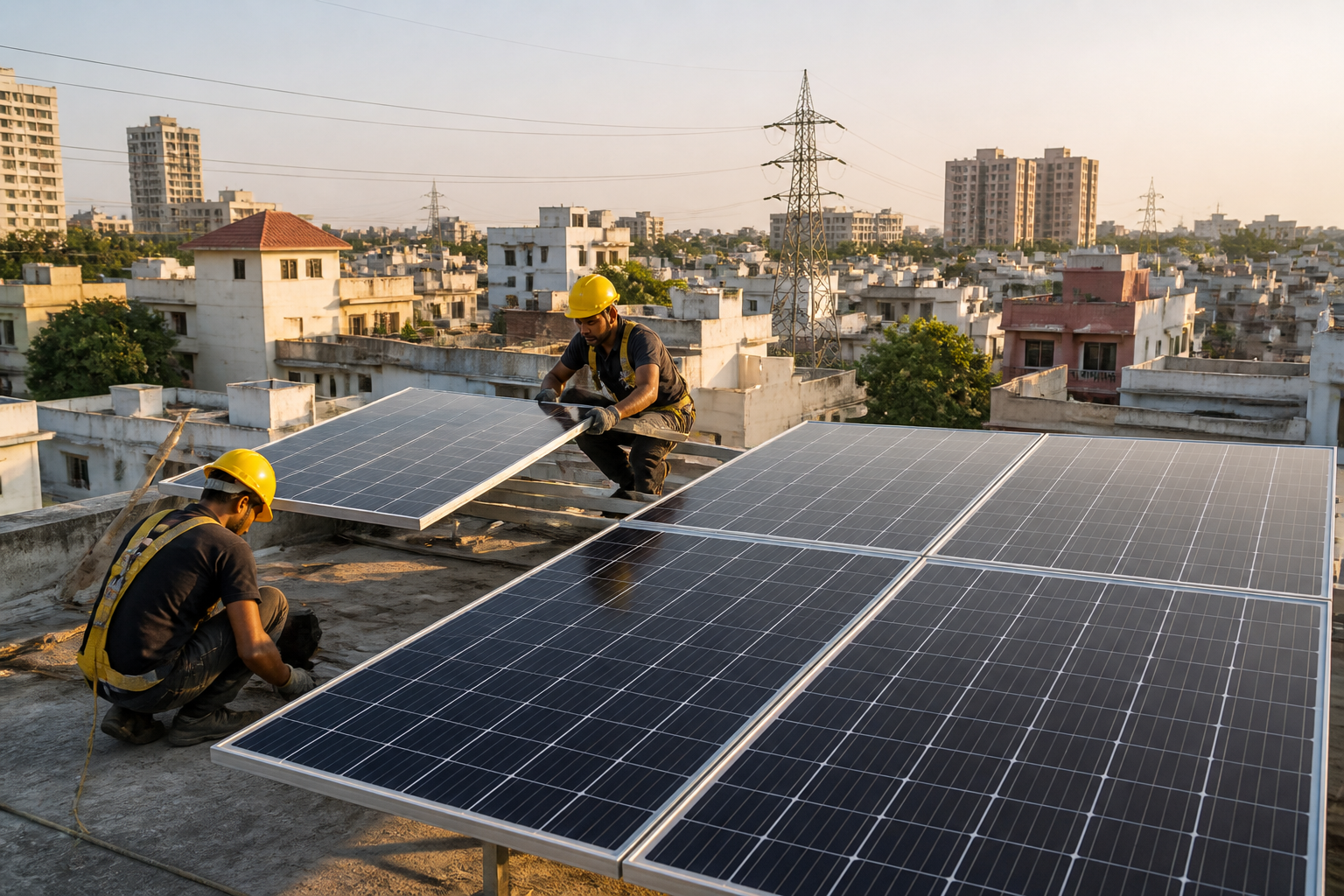
The PM Surya Ghar scheme has crossed 60 lakh households, according to a report by Aaj Tak Business, marking a significant expansion of rooftop solar in India. The milestone represents 60% of the government’s stated target of covering one crore homes, but its larger significance lies in how quickly the programme has moved from a slow early rollout to a system built around digital applications, electricity distribution companies, direct subsidy transfers, concessional loans and a growing installation workforce.
The programme was launched on 13 February 2024 with a budget of ₹75,021 crore. In its initial phase, the first one lakh households took 118 days to join the scheme. The pace has since increased sharply: the report says every additional one lakh households are now being added in approximately six days. The change points to an implementation challenge that is common to large urban and infrastructure programmes. Announcing a national target is relatively simple; connecting households to a functioning delivery chain involving portals, lenders, distribution companies, installers, inspections, commissioning and subsidy payments is more difficult.
The report attributes the faster expansion to the simplification of the application process and the integration of more than 80 distribution companies with the national portal. This integration matters because rooftop solar is not delivered by the central government alone. The electricity distribution company must remain involved in approving the system, enabling grid connection and managing net metering. A national portal can standardise parts of the process, but the final experience for a household still depends substantially on the local power utility and the availability of trained installers.
The reported numbers also show that the scheme is operating through several different measures of progress. More than 60 lakh families are described as having been reached, while more than 50.99 lakh rooftop solar systems are reported to have been installed. The source does not explain the precise difference between households reached and systems installed. These figures should therefore not be treated as interchangeable. A household may have applied, received approval, obtained a subsidy or been connected at different stages, while an installed system represents a later point in the process.
This distinction is important for assessing whether the programme is meeting its practical objectives. A large application count indicates demand and public awareness. Installed systems show conversion of that demand into physical infrastructure. Grid-connected capacity and actual electricity generation provide another layer of measurement. The report says the installed rooftop systems have added 17,855 megawatts to the grid, but it does not provide generation data or explain how the capacity is distributed across states, cities, building types or household sizes.
The scheme’s household impact is being framed most directly through electricity bills. According to the report, more than 20.7 lakh families have seen their monthly electricity bills fall to zero. The source also says that, through net metering, participating households can sell surplus solar power to the local grid. This changes the traditional relationship between the consumer and the distribution system. A household is no longer only buying electricity; where the system, connection and tariff arrangements permit, it can also supply excess power.
That model has a clear urban dimension. Rooftop solar depends on the physical characteristics of buildings, including roof availability, ownership arrangements, structural suitability, access for installation and maintenance, and the design of the local electricity network. Detached homes may be easier to serve than apartment buildings, where a common roof must be shared among multiple residents. The report does not provide a housing-type breakdown, but the distinction is central to how evenly the benefits of a household rooftop programme can spread across cities.
The financing structure is another important part of the programme’s expansion. The report says ₹33,642 crore in subsidies has been transferred directly to beneficiary bank accounts through the Public Financial Management System. It also states that these payments are made within 15 days of commissioning. In addition, loans are available through the Jan Samarth portal at a concessional interest rate of 5.75%, with a collateral-free tenure of up to 10 years.
These arrangements address two barriers that often slow household infrastructure adoption: the upfront cost of installation and uncertainty about when financial support will arrive. A subsidy that is paid only after commissioning requires families to manage the initial expense or obtain credit. The loan facility can reduce that pressure, while direct transfers can make the payment process more traceable. However, the supplied report does not provide information on loan uptake, rejection rates, repayment performance or the time taken between application, installation and reimbursement.
The reported subsidy figure also needs to be understood as a programme-delivery number rather than a complete measure of public value. The relevant question is not only how much money has been transferred, but whether the supported systems remain operational, whether households receive the expected savings, and whether distribution companies can manage the additional two-way flow of electricity. None of these performance indicators is provided in the source material. The 20.7 lakh households with zero monthly bills offer one outcome measure, but the report does not explain how the figure was calculated or whether it refers to a particular billing period.
The programme is also being positioned as an employment and industrial initiative. Against a stated target of training three lakh skilled workers, more than 2.5 lakh people have reportedly been trained through institutions including the National Institute of Solar Energy and the National Power Training Institute. This includes one lakh solar photovoltaic technicians. More than 37,000 local businesses are said to be registered under the scheme, with approximately 17 lakh direct and indirect jobs estimated across manufacturing, supply chains, installation and maintenance.
This workforce layer is critical because rooftop solar is distributed infrastructure. Unlike a large power plant, it requires thousands of site visits, roof assessments, installations, inspections, repairs and customer interactions. The quality of the system depends on the competence and availability of local workers. Training numbers and business registrations indicate the creation of an ecosystem, but they do not by themselves establish the quality of installations, the stability of employment or the geographic distribution of trained personnel.
The six-day pace for adding each one lakh households is therefore both an achievement and a test. Faster processing can improve access and reduce administrative friction, but a rapid increase in installations also places pressure on distribution companies, inspection systems, installers and maintenance networks. The source reports the expansion of the portal and the growth of the workforce, yet it does not provide information on complaints, equipment failures, approval backlogs or the reliability of local net-metering arrangements.
The scheme’s broader policy significance lies in its attempt to combine household welfare with energy transition. It uses public finance to encourage private investment by families, relies on digital administration to scale delivery, and places distribution companies at the centre of the grid connection process. It also links energy infrastructure with local employment and business formation. In that sense, PM Surya Ghar is not only a subsidy programme for solar panels; it is a delivery system connecting households, lenders, utilities, training institutions, installers and the electricity grid.
The evidence supplied so far confirms rapid numerical expansion: 60 lakh households reached, more than 50.99 lakh systems installed, 17,855 MW of reported capacity added, ₹33,642 crore transferred as subsidies, 20.7 lakh households reporting zero bills, more than 2.5 lakh people trained and over 37,000 local businesses registered. What remains less clear is how these indicators relate to one another and how evenly the benefits are distributed across India’s different housing and electricity systems.
The next phase of the programme will be judged not only by whether it reaches one crore homes, but by whether the systems continue to generate power, whether households receive dependable savings, whether distribution companies can manage rooftop generation and whether the workforce can sustain installation and maintenance at scale. The reported milestone establishes that the scheme has moved beyond its slowest early phase. Its long-term urban and energy significance will depend on the quality and durability of the infrastructure behind the headline number.
