


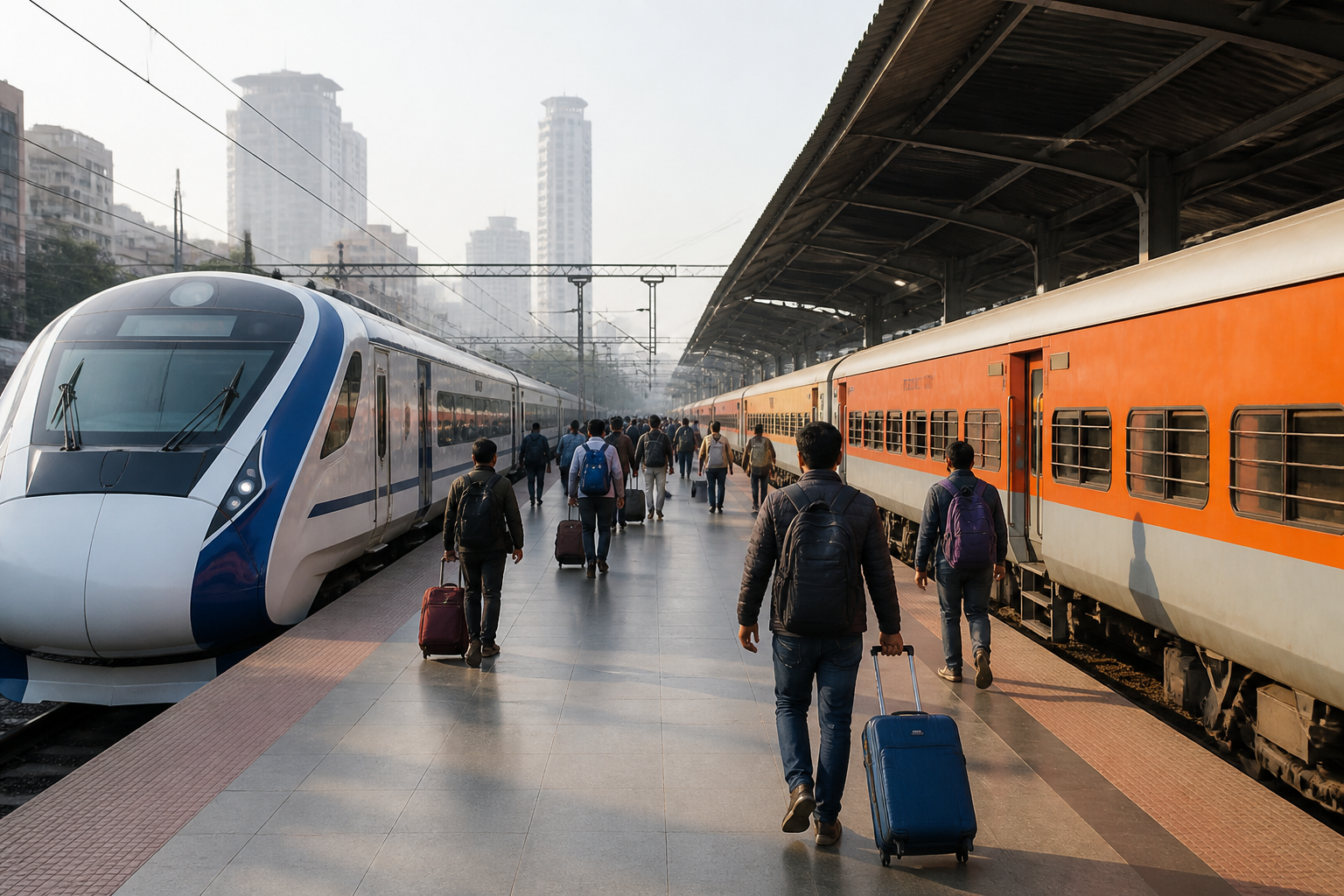
The Vande Bharat vs Amrit Bharat comparison reveals that India’s railway modernisation is not following a single model. The two train families represent different answers to the same transport challenge: how to reduce travel time and improve passenger experience while serving travellers with sharply different budgets, distances and expectations.
According to a comparison published by Aaj Tak Business, Vande Bharat is positioned as a premium, fully air-conditioned train, while Amrit Bharat is designed as a lower-cost, non-air-conditioned option for longer journeys. Their differences extend beyond interiors. They use different propulsion arrangements, target different passenger groups, operate at different stated speed levels and offer different onboard services. Together, they show how railway modernisation is being divided between premium intercity travel and mass-market connectivity.
That distinction matters because a railway system is not judged only by its fastest service. It must also determine who can access improved mobility, at what price and over what distance. The two trains therefore reflect two parallel priorities: making selected journeys faster and more comfortable, and bringing better facilities to passengers who may not be able to pay premium fares.
Vande Bharat’s model is built around speed, time savings and a higher service category. The source describes it as a completely air-conditioned train with AC Chair Car, Executive Class and, in newer variants, AC Sleeper accommodation. It places Vande Bharat in the premium segment, with fares described as comparable to or slightly higher than those of Rajdhani and Shatabdi services.
The train is also described as India’s first self-propelled trainset. Instead of relying on a separate locomotive at the front, motors are fitted beneath the coaches. Aaj Tak Business says this arrangement allows the train to accelerate rapidly, in a manner comparable to metro train technology. The source states that Vande Bharat is capable of speeds between 160 kmph and 180 kmph and is mainly intended for intercity and longer routes of about 200 km to 600 km.
These features make Vande Bharat a time-sensitive mobility product. Its intended user, as described in the report, includes business travellers, corporate professionals and passengers willing to pay more to complete a journey in less time. The service is not simply an upgraded coach; it is a different proposition in which fare, speed and comfort are linked.
Amrit Bharat follows a different logic. It is described as a fully non-air-conditioned train with Sleeper Class and unreserved general coaches. Its stated target is the middle class and ordinary passengers, including migrants, workers and budget travellers undertaking long-distance journeys. The source places its typical route geography at around 800 km to more than 1,500 km, connecting states and cities over substantially longer distances than the intercity journeys associated with Vande Bharat.
The propulsion system also differs. Aaj Tak Business reports that Amrit Bharat uses two WAP-5 locomotives, one at each end, operating in a push-pull configuration. Under this arrangement, the front locomotive pulls the train and the rear locomotive pushes it. The source says this enables smoother acceleration and helps save time without the train relying on the self-propelled design used by Vande Bharat.
The stated maximum speed for Amrit Bharat is 130 kmph, lower than the speed range cited for Vande Bharat. But speed alone does not determine the value of a railway service. For a passenger travelling 1,000 km or more, the more consequential questions may be whether a seat is affordable, whether sleeper accommodation is available and whether the train connects the relevant origin and destination. Amrit Bharat’s design indicates that its role is to improve the long-distance experience within a conventional fare-sensitive market.
This is the central institutional distinction between the two trains. Vande Bharat uses modern trainset technology to support a premium, faster service. Amrit Bharat uses a push-pull locomotive arrangement and a simpler class configuration to offer a modernised long-distance service at fares described as similar to ordinary express trains. Their technological choices are therefore tied to their intended markets rather than being interchangeable upgrades.
The fare difference is not presented in the source through specific route-wise ticket prices. Instead, the comparison places the two services in different fare categories. Vande Bharat is linked to premium pricing, while Amrit Bharat is described as being priced like regular express trains. This distinction is important because railway affordability cannot be assessed only through the presence of modern features. It depends on whether those features are available within the budget of the passenger groups the service is meant to serve.
The difference in onboard facilities reinforces that separation. Vande Bharat provides onboard catering or pantry-related services, along with automatic doors. Amrit Bharat does not include catering as part of the service described in the report, although it has bottle holders, charging points and tables for packed snacks. Its doors are manual. These are not minor cosmetic differences: they define two distinct service environments, one designed as a premium managed journey and the other as a more basic but modernised travel option.
The comparison also highlights an important feature of railway planning: passenger segmentation. Vande Bharat is associated with shorter intercity and selected long-distance travel by passengers prioritising time. Amrit Bharat is aimed at people travelling farther and seeking a lower fare. The distinction suggests that train design is increasingly being matched to travel purpose, route length and paying capacity rather than treating all passengers as a single market.
For urban systems, the implications extend beyond the railway station. Faster intercity services can strengthen connections between cities that already have strong economic and professional links. Affordable long-distance services serve a different urban network, connecting workers, migrants and families across states and regions. The two services therefore operate within different mobility geographies: one is centred on time-sensitive intercity movement, while the other addresses the affordability and scale of mass travel.
The source’s description of Amrit Bharat as a service for migrants, workers and budget travellers also places it within the wider question of access to urban opportunity. Long-distance railways are not only passenger conveniences. They connect people to employment, education, family networks and seasonal work. When fare levels remain closer to ordinary express services, the service can be relevant to travellers for whom premium rail is financially out of reach. The available material does not provide passenger numbers or route-level demand data, so the scale of that impact cannot be quantified here.
Similarly, the stated speed figures should not be read as evidence that every passenger will experience those maximum speeds on every route. The comparison identifies the trains’ stated capabilities and intended service models, but it does not provide route-specific operating speeds, journey-time reductions, punctuality data or occupancy figures. Those details would be necessary to assess actual performance rather than design potential.
The policy landscape visible in the comparison is therefore one of differentiated modernisation. Indian Railways is presented as developing a premium train for faster, more comfortable journeys and a budget-oriented train for longer-distance, mass-market travel. This approach avoids making affordability and premium comfort compete within the same service design, but it also creates a clear need to track how routes and capacity are allocated between passenger segments.
The evidence supplied by Aaj Tak Business confirms five broad differences: air-conditioned versus non-air-conditioned accommodation, self-propelled trainset versus push-pull locomotives, higher stated speed versus a lower maximum speed, premium versus ordinary-express fare positioning, and different passenger and catering models. It does not establish whether either model is superior in every context. Their value depends on the journey being served.
The larger urban question is whether railway modernisation can improve both speed and inclusion without reducing the importance of either. Vande Bharat represents the visible premium face of rail upgrades. Amrit Bharat represents an attempt to extend modern features to passengers travelling long distances on tighter budgets. The future significance of the two models will depend on their actual routes, fares, capacity, reliability and ability to match service design with the needs of the people they are intended to carry.
