


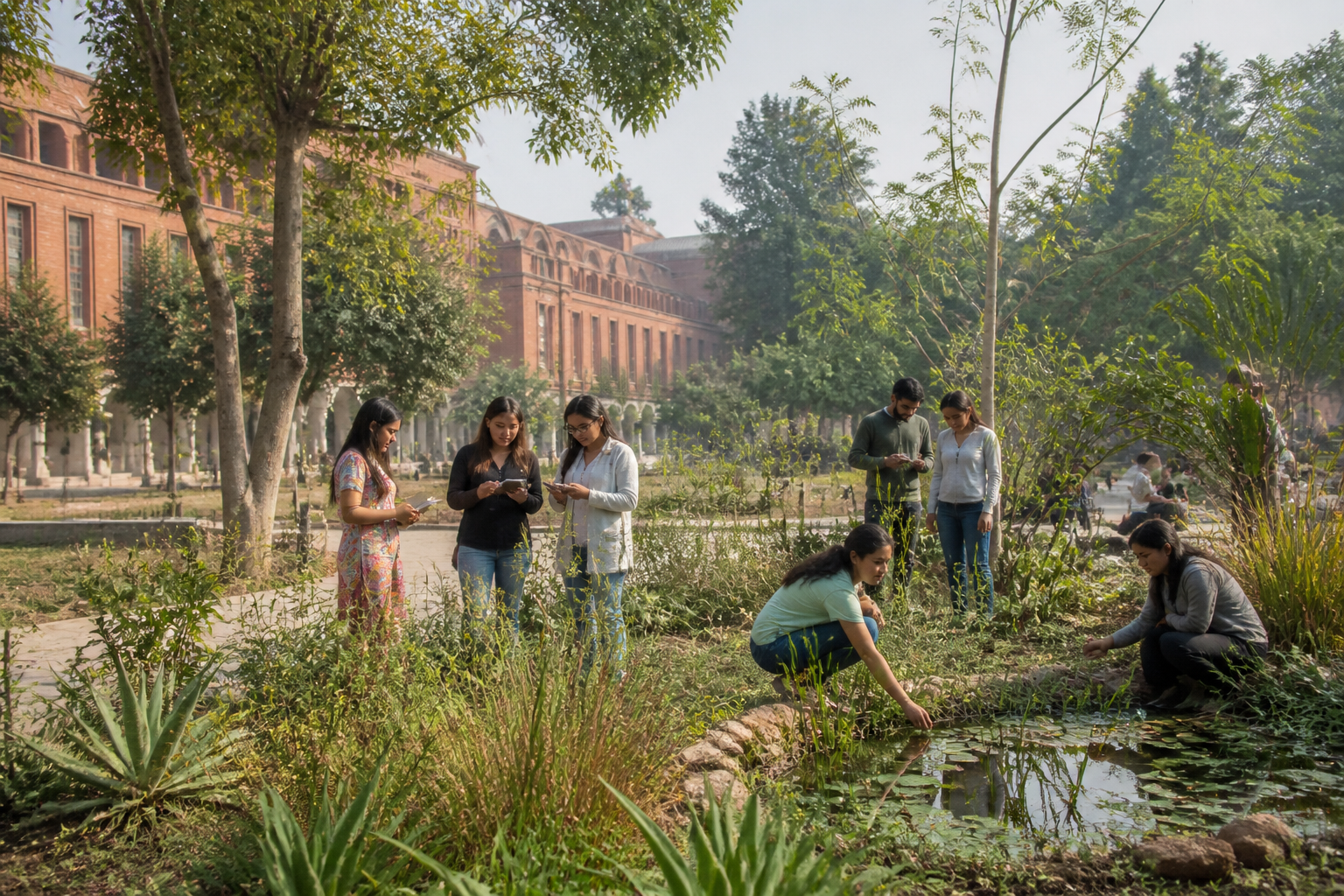
Miranda House, a University of Delhi college, has inaugurated a carbon garden on its campus to increase carbon absorption, support biodiversity and help students understand nature-based responses to pollution and climate change. The college said the garden is the first of its kind in India and will function as a living laboratory for teaching and research.
The garden, inaugurated on Monday, has been developed as Delhi faces continuing environmental pressures linked to pollution and changing climatic conditions. It includes around 50 plant species representing different ecological requirements, including hydrophytes, xerophytes and mesophytes.
Local species such as guava and drumstick have also been planted at the site. The mix is intended to expose students and researchers to plants adapted to different water and environmental conditions, while creating a campus space focused on carbon absorption and ecological learning.
The inauguration was conducted by Professor Dinabandhu Sahu, head of the Department of Botany at the University of Delhi and chairperson of the university’s Research, Innovation and Entrepreneurship Council. Professor Sahu is also identified as the founder of India’s first carbon garden.
Speaking at the event, Professor Sahu said the relationship between nature and Indian culture and traditions needed to be advanced through modern science and environmental understanding. He said green areas were particularly important in cities such as Delhi, and that the carbon garden would contribute to environmental protection while helping students reconnect with nature.
Professor Sahu also linked the garden to student wellbeing, saying it could support students’ mental health and welfare. He emphasised the need for young people to participate actively in environmental protection, placing the campus initiative within a wider effort to build awareness about climate change and ecological responsibility.
Miranda House principal Professor Bijayalakshmi Nanda said the college took its environmental responsibility seriously. She expressed the hope that the initiative would encourage students to take active steps on climate change and environmental conservation.
The college said the MH-Carbon Garden would be used by students and researchers to study carbon absorption, ecosystems and sustainable environmental practices. In that role, the garden is designed not only as a planted area but also as an educational facility where ecological processes can be observed on campus.
The initiative reflects how institutional campuses can combine green space with environmental education. However, the information released about the inauguration does not specify the garden’s area, its projected carbon-absorption capacity, the monitoring method to be used or the timeframe for measuring its environmental impact. Further details on these indicators will determine how the garden’s contribution is assessed beyond its educational role.
