


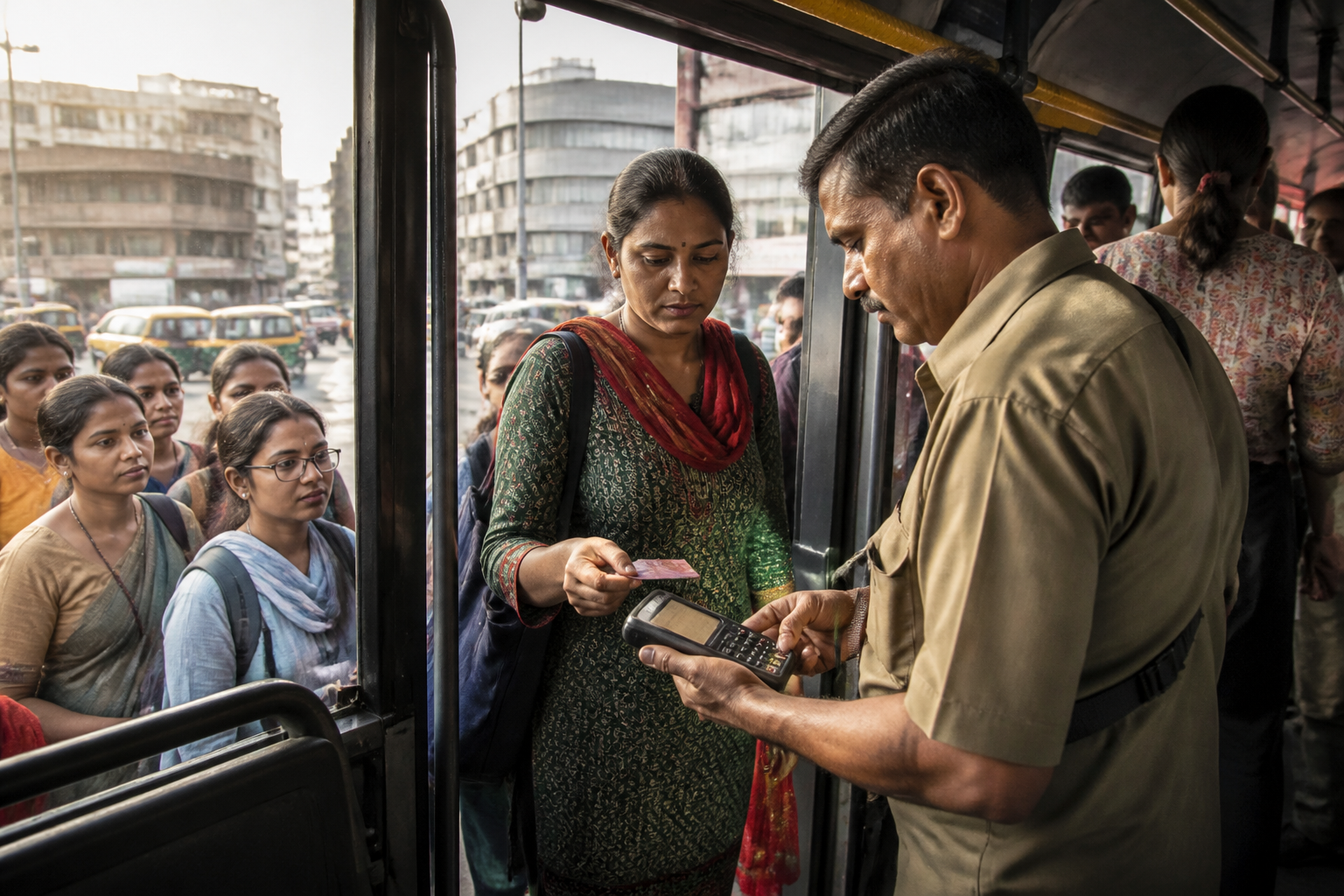
Delhi Transport Corporation’s Pink Card system for free bus travel for women faced electronic ticketing machine glitches, passenger confusion and inconsistent enforcement on its first day, delaying journeys and leaving some women worried about being fined.
The system requires women passengers to use a Pink Card to record their free journey on DTC buses. However, several electronic ticketing machines, or ETMs, reportedly stalled when conductors tried to scan the cards. The delays were particularly difficult for passengers getting off at the next stop, who had to wait for the machine to restart or risk missing their destination.
A working woman travelling from ITO towards Shahdara, identified as Bushra Khan, faced this problem when the ETM stopped responding. The delay raised concerns over whether her free travel would be recognised through the card or whether she would have to wait for the machine to work. The report said passengers feared a ₹200 penalty if the journey was not recorded during checking.
The card-scanning process reportedly took between two and five minutes in several cases. Conductors had to repeatedly attempt transactions while passengers waited in crowded buses. The operational burden increased when conductors also had to explain the new rules and issue free passes to women who did not have their Pink Cards with them.
The report cited DTC bus number 623, where conductors said the ETM had stalled several times since morning. On that bus, journeys of 27 women were recorded through Pink Cards, while 17 women without cards were issued free passes. This meant that card scanning, troubleshooting and issuing alternative passes were taking place simultaneously on the same service.
Passenger awareness was another difficulty. Some women knew that Pink Cards had been introduced but did not know that carrying the card on every journey was required for free travel. Two passengers travelling from Mandi House to Anand Parbat, identified as Sonia and Manisha, had obtained cards but had not carried them on the day. A conductor issued them free passes, while women without cards on some other buses were reportedly asked to pay the fare.
The different responses raised questions about whether the same rule was being applied across DTC services. The initial rollout therefore depended not only on the availability of cards and functioning ETMs, but also on the conductors’ interpretation of the procedure and the availability of an alternative when machines failed.
The problem became more visible during the evening rush, when the number of working women and students increased. Conductors had to manage card tapping, regular ticketing, rule-related explanations and free-pass issuance at the same time, adding to the time required for boarding and travel.
DTC said that only women holding Pink Cards would be eligible for free travel on its buses from 5 October, while those without the card would have to pay for a ticket. The corporation also said it would assess the difficulties emerging during the initial phase and make arrangements accordingly. The next steps will depend on how quickly ETM failures, passenger communication and uniform enforcement procedures are addressed across the bus network.
