


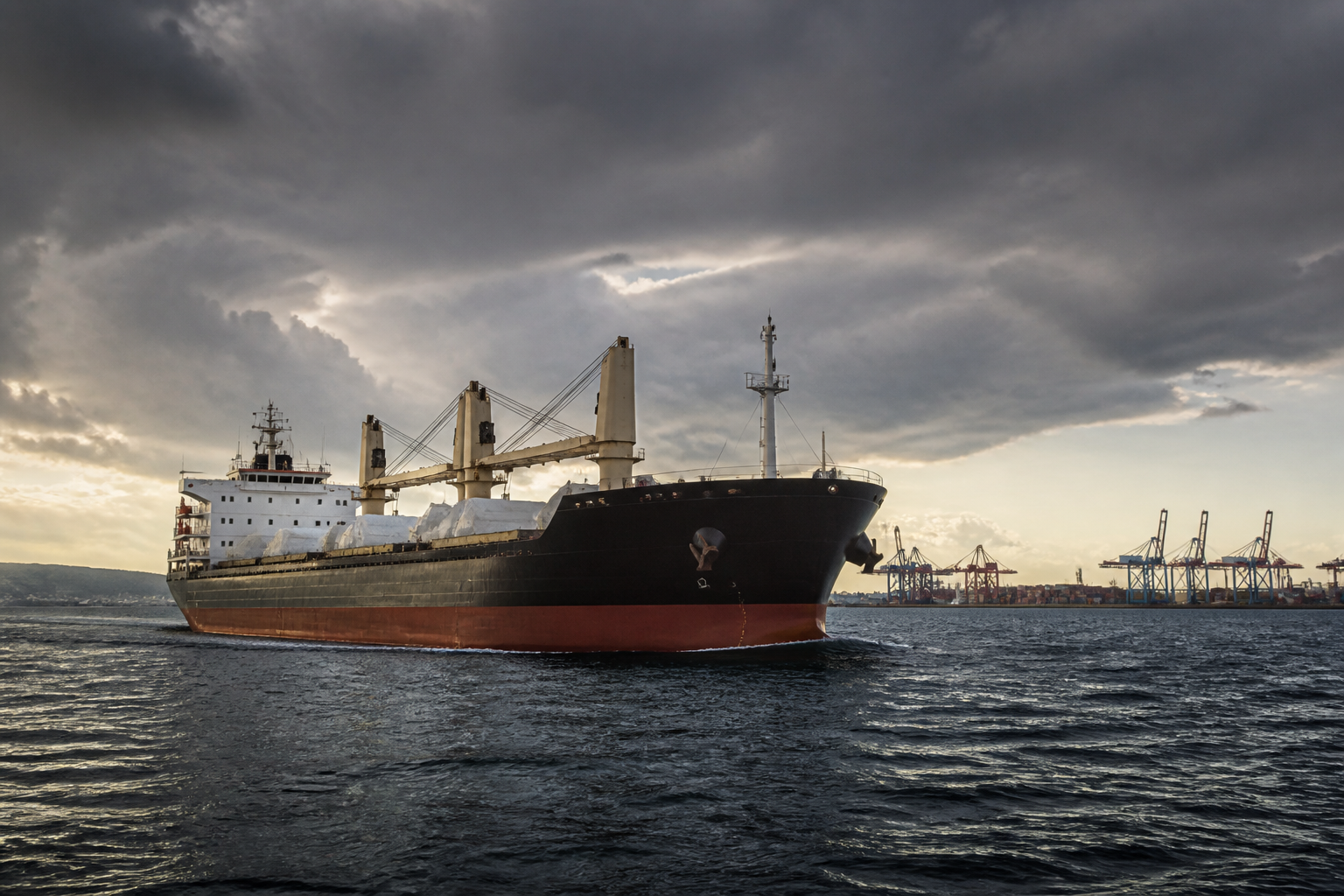
Finance Minister Nirmala Sitharaman’s warning about global food security has placed a largely invisible urban system under scrutiny: the maritime network that moves fertilizer, food and other essential goods across continents. Speaking at the Munich Leaders Meeting, she linked disruption in the Strait of Hormuz and Bab el-Mandeb to a potential threat to food security, while also cautioning that any problem in the Malacca Strait could make the situation significantly worse.
The warning matters because food security is not determined only by agricultural output. It also depends on whether ships can move, whether cargoes can be insured, whether importers can pay higher freight costs and whether fertilizer reaches producers in time. Sitharaman’s remarks, as reported by Aaj Tak Business, connect all of these factors. They also show how a geopolitical disruption at sea can become an economic and urban concern much further away from the shipping lanes themselves.
For cities, the effects of such a shock would be transmitted through supply chains rather than through a single visible infrastructure failure. Fertilizer affects agricultural production, shipping affects import availability, insurance affects the cost of transport, and prices ultimately influence household budgets and food distribution networks. The supplied report does not establish that a global food crisis has already begun. It records a warning that maritime disruption could increase the risk of such a crisis.
The shipping routes behind the warning
The Strait of Hormuz, Bab el-Mandeb and the Malacca Strait occupy different positions in the global maritime network, but Sitharaman’s comments treat them as connected pressure points. Hormuz and Bab el-Mandeb were identified as routes where disruption could threaten global food security. The Malacca Strait, she said, was not facing a problem at the time of her remarks, but any disruption there would worsen the situation.
That distinction is important. The minister did not describe all three routes as being equally disrupted. Instead, she identified existing concern around Hormuz and Bab el-Mandeb, while presenting Malacca as a further risk because of its importance to maritime movement. The report does not provide cargo volumes, route-specific delays or the duration of any disruption. What it does show is the dependence of food-related supply chains on a small number of strategic passages.
This creates a structural vulnerability. A supply chain can remain operational in normal conditions while still being highly exposed to disruption at a small number of chokepoints. When a route becomes more difficult or expensive to use, the pressure does not stop at the port. It moves through freight rates, insurance premiums, delivery schedules and the price of imported inputs.
Fertilizer is the immediate pressure point
The specific supply-chain concern highlighted by Sitharaman is fertilizer. According to the report, shipping lines carrying fertilizer are facing higher insurance premiums, limited shipping availability and higher prices. These factors are making fertilizer imports more difficult, prompting India to create a shipping emergency fund to help with insurance premiums and payments.
The fund is presented as a response to a logistics and financing problem rather than as a replacement for imports. If a vessel is available but the cost of insuring or paying for its movement rises sharply, the supply chain can still be constrained. This makes maritime finance part of food security policy. The ability to move fertilizer depends not only on production capacity or agricultural demand, but also on whether the transportation system remains commercially viable.
Sitharaman also said India is increasing domestic urea and phosphate production. However, she cautioned that this effort will take time. That statement identifies the difference between an emergency response and a structural solution. An emergency fund can help maintain supply under immediate pressure, while expanded domestic production could reduce dependence on some external shipments in the longer term. The source does not provide production targets, investment figures or a completion timeline for this expansion.
The distinction is relevant for cities because urban consumers are usually distant from both fertilizer production and agricultural fields. They encounter the consequences through food prices, availability and the cost of distribution. The report does not quantify any current price impact, but it establishes the transmission mechanism: maritime disruption can raise the cost and reduce the availability of an input used in agriculture.
Why this is also an infrastructure story
Maritime routes are often treated as background infrastructure because they are outside the daily visual field of most urban residents. Yet ports, ships, insurance systems, payment channels and inland distribution networks form part of the infrastructure that keeps cities supplied. A disruption at sea can therefore expose the dependence of urban life on systems that are geographically remote but economically connected.
The minister’s warning also brings attention to the difference between physical capacity and operational resilience. India may have ports, shipping lines and domestic manufacturing facilities, but those assets do not function in isolation. They depend on predictable routes, affordable insurance and access to payments. When any of those conditions deteriorates, capacity on paper may not translate into reliable movement of goods.
The information supplied does not say that Indian ports have stopped operating or that fertilizer stocks have fallen to a specified level. It also does not give a measure of the disruption in the Hormuz or Bab el-Mandeb routes. That limits what can be concluded about immediate domestic shortages. The evidence supports a narrower finding: the government is responding to higher logistics and financial risks because it considers them serious enough to affect fertilizer imports and, potentially, food security.
This is a governance challenge as much as a transport challenge. The response described by Sitharaman combines financial support for shipping with efforts to increase domestic production. It therefore crosses institutional boundaries involving trade, finance, shipping, agriculture and industrial production. The report does not identify the administrative structure of the emergency fund or explain how eligibility and disbursement will work. Those details will determine how quickly the measure can support actual shipments.
## India’s response combines short-term support and longer-term capacity
The measures cited by the finance minister operate on two timelines. The shipping emergency fund is intended to address the immediate pressure created by higher premiums and payment difficulties. Increasing domestic urea and phosphate production is a longer-term effort to strengthen supply capacity. Sitharaman’s acknowledgement that domestic production will take time makes clear that the second response cannot immediately eliminate import dependence.
This combination reflects a familiar policy problem in infrastructure planning: resilience requires both redundancy and continuity. New domestic capacity may reduce exposure to international disruptions, but it takes time to build. Financial support can preserve access to imports during a crisis, but it may not resolve the underlying dependence on vulnerable maritime routes. The source does not state how the two measures will be coordinated or what share of future fertilizer demand domestic production is expected to meet.
The warning about the Malacca Strait adds another layer. Sitharaman said there was no problem there at the time, but that any disruption would make the situation worse. This suggests that resilience planning cannot focus only on a route that is already under pressure. It must also account for the possibility that another major passage could become unavailable or more expensive. No scenario estimates or contingency plans for Malacca are provided in the report, so the scale of that additional risk remains undefined.
The broader lesson is that food security policy now includes the management of maritime and financial exposure. Agricultural policy alone cannot address a problem that begins with the movement and insurance of fertilizer cargoes. Nor can shipping policy be separated from the consequences for food production and urban consumption.
## The wider economic context
Sitharaman discussed the shipping risks alongside the India-US trade negotiations, saying that the two countries had reached a point of stability in their talks and that further concessions were difficult for either side at that stage. She also said the United States was seeking to reduce its trade imbalance with India through measures separate from the ongoing negotiations.
The report says India and the United States have been discussing a broader bilateral trade agreement since February 2025, after Prime Minister Narendra Modi and US President Donald Trump agreed during Modi’s Washington visit to begin talks. Several rounds of negotiations have followed, and both countries have set a target of more than doubling bilateral trade to $500 billion by 2030.
The trade discussion is separate from the immediate fertilizer-shipping response, but its presence in the same ministerial remarks shows how India’s economic policy is being shaped by two forms of uncertainty: negotiations over market access and disruption risks affecting physical supply chains. The supplied material does not establish a direct link between the trade talks and the Hormuz-related shipping measures. It does, however, place both issues within the finance minister’s account of India’s external economic environment.
For urban India, the central question is whether essential supply systems can absorb external shocks without transferring the entire burden to households. The available evidence does not show the final impact on food prices, city-level availability or agricultural output. It does show that the government is treating shipping costs, insurance and domestic production as connected parts of the food-security challenge.
The evidence therefore confirms a risk-management response, not a completed solution. India has created a shipping emergency fund, is pursuing higher domestic urea and phosphate production, and is monitoring the implications of disruption around major maritime routes. The effectiveness of those steps will depend on implementation details that have not been provided, including the operation of the fund, the pace of domestic capacity expansion and developments in the Hormuz, Bab el-Mandeb and Malacca passages.
