


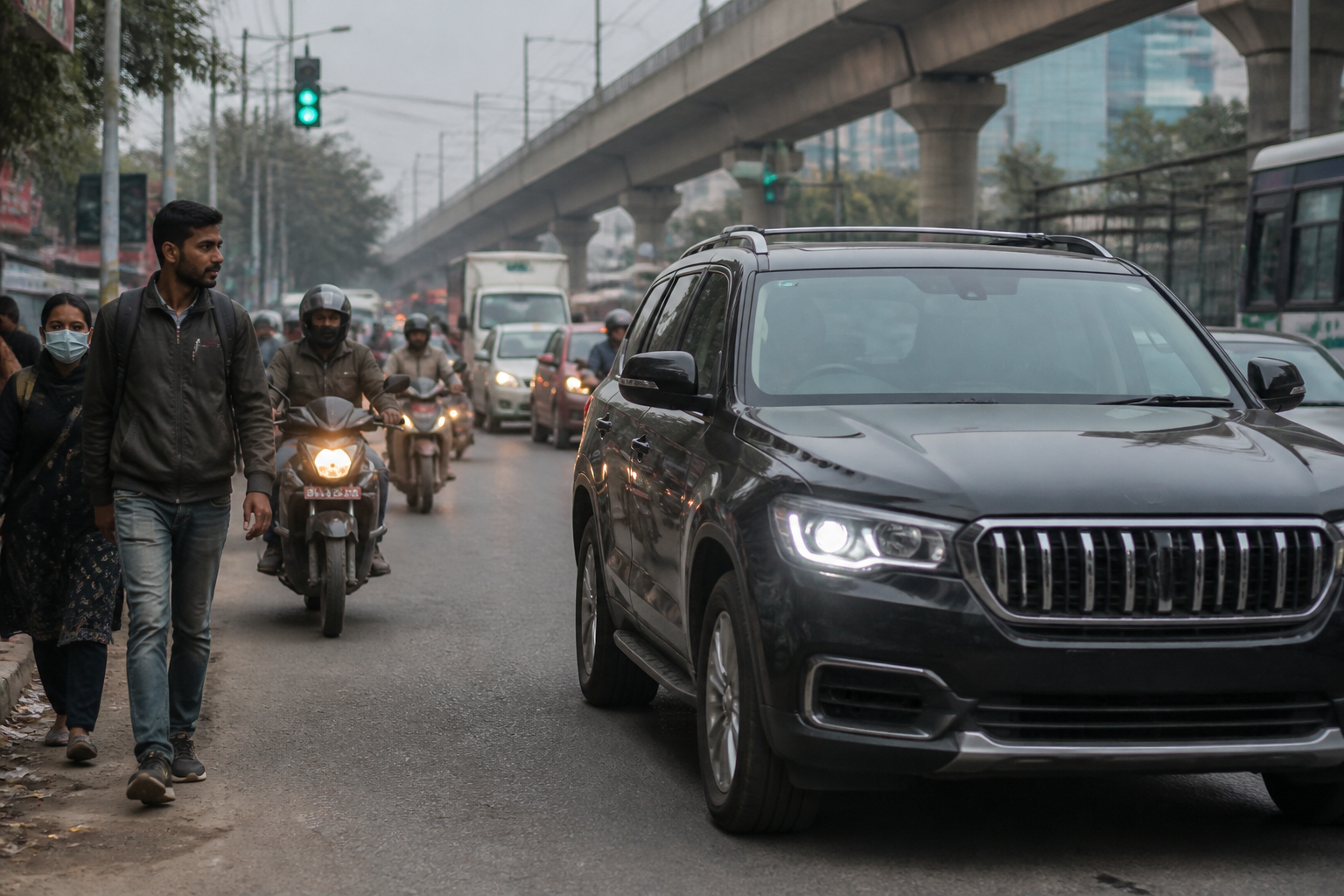
A series of aggressive-driving incidents involving SUVs across Delhi-NCR has revived a larger road-safety question: are powerful vehicles creating more dangerous behaviour, or are they simply making the failures of enforcement and driver training more visible? The evidence cited by mobility and road-safety experts points to a more complicated answer. SUVs are not inherently responsible for road violence, but their size, power and road presence can interact with driver psychology, weak deterrence and an inadequate culture of responsibility.
The immediate concern comes from a sequence of incidents reported in September. On September 2, two people were killed after a speeding SUV hit their motorcycle in Delhi Cantonment. On September 18, an intoxicated driver allegedly rammed a commercial cab repeatedly with an SUV in Sector 89, Gurgaon, after a dispute. The impact deployed the cab’s airbags and severely crushed its side. On September 26, a dashcam recorded an SUV weaving through traffic near Dwarka Expressway, attempting to pass through a narrow gap, knocking down a motorcycle and injuring two riders before leaving the scene.
These incidents are not identical. Some involve speed, some apparent intimidation, some deliberate collisions and some failure to stop. Treating them as one category risks losing the distinctions that matter for policing and prevention. Yet their recurrence raises a common institutional question: how should a road system respond when a vehicle capable of causing serious harm is operated with aggression, entitlement or disregard for other users?
The presence of SUVs in these cases has made the vehicle type a visible part of the public conversation. But Gaurav Vangaal, associate director of production forecasting at Mobility Global, cautions against turning SUVs into villains. SUVs account for more than 55% of passenger vehicles sold in India and have overtaken sedans and hatchbacks in popularity over the past decade. Their greater presence on the road means they will also appear more frequently in traffic incidents, even without proving that the vehicle type itself causes reckless conduct.
That distinction is important in a city where road space is shared by cars, two-wheelers, pedestrians, cyclists and animals. A vehicle’s dimensions and performance determine the potential consequences of a mistake, but the immediate cause remains the driver’s decision. Vangaal separates accidents in which a motorist unintentionally loses control, is fatigued or misjudges traffic from incidents involving reckless behaviour such as overspeeding, dangerous overtaking or failing to stop. The policy response to these categories cannot be the same.
At the same time, experts cited in the report say the physical and psychological characteristics of SUVs may influence how some drivers behave. Piyush Tewari, founder and chief executive officer of SaveLIFE Foundation, points to a 2024 study of 546 licensed drivers across India, published in Transport Policy. The study found that SUV drivers reported significantly riskier driving behaviour than sedan and hatchback drivers, with speeding emerging as an important predictor.
Tewari also refers to international research on what is described as the “car cushion effect”. The idea is that a larger vehicle, perceived as more protective, may give its driver a greater sense of security and control. In one controlled driving-simulator experiment cited by Tewari, participants who believed they were driving a larger vehicle displayed riskier behaviour than those who believed they were driving a smaller one, even though the underlying simulator settings were the same.
The evidence does not establish that every SUV driver is aggressive or that SUVs inevitably produce risk-taking. It does, however, identify a possible interaction between vehicle characteristics and human behaviour. SUVs can combine greater size and mass with strong acceleration, engine power and marketing built around performance. Those characteristics increase the consequences of poor judgement. They also make the quality of driver training and enforcement more important.
Riya Yadav, a rider who has conquered Khardung La in Ladakh, offers another explanation rooted in the way drivers experience the road. SUVs have a higher seating position because they are designed to provide greater ground clearance. That height gives motorists a commanding view of traffic and the bonnet, which can support safer driving. But Yadav says it may also create a feeling of being physically above other road users. She stresses that this does not mean SUV drivers generally develop an aggressive mindset, noting that many women in Delhi drive such vehicles without appearing in viral videos of road rage.
The road-safety problem therefore cannot be reduced to consumer preference or vehicle design. It is also about what the transport system teaches drivers to do, what it detects, and what it makes costly. Bani Yadav, India’s only woman to win all major cross-country rally titles in a single calendar year, draws a sharp line between controlled motorsport and public-road driving. She says drivers seeking speed or competition should use tracks rather than ordinary roads, where their decisions affect people who have not consented to the risk.
Her argument highlights a gap in public-road governance. Speed and performance can be legitimate attributes of a vehicle, but roads are not closed circuits. A motorist racing another car, drifting into a neighbouring lane or using a larger vehicle to intimidate a smaller one changes the risk for everyone sharing the corridor. The problem is especially acute in Delhi-NCR, where high-speed expressways, dense urban roads, motorcycles and pedestrian movement coexist within a connected but unevenly managed metropolitan region.
The enforcement challenge is not only about issuing fines after a violation. Former special commissioner of police Muktesh Chandra says police should look for patterns associated with intimidation, including casteist stickers and VIP-style number plates. He recalls seeing an SUV owner use “8055” on a number plate in a way that made it read like “BOSS”. Such markers do not prove dangerous driving, but Chandra’s point is that enforcement agencies may need to examine the culture of assertion surrounding certain incidents rather than treating each act as an isolated traffic offence.
Tewari similarly argues that enforcement against speeding, dangerous overtaking and other forms of rash driving needs to be strengthened. The concern is not simply that rules exist but that drivers may believe violations will not lead to serious consequences. Bani Yadav says some motorists assume they can break the law and eventually avoid major punishment. If that perception is widespread, enforcement becomes a behavioural signal: inconsistent action can turn road rules into negotiable boundaries.
The problem begins even earlier, in the licensing system. Nand Gopal, a former motor licensing officer with the Sarai Kale Khan Regional Transport Office, says Delhi’s driving tests focus more on manoeuvring and vehicle control than on responsible conduct towards other road users. He helped implement Delhi’s first automated driving test track in early 2018, but argues that technical assessment alone is not enough.
Gopal also points to the online learner’s licence test, which can be taken from home. In his view, this creates a risk that applicants may game the system. The government-prescribed course contains guidance on responsible driving, but he says many applicants are barely aware of it. A licensing process that confirms the ability to move a vehicle without adequately testing judgement, restraint and awareness leaves a major gap between competence and responsibility.
That gap becomes visible when a large vehicle, a motorcycle and a pedestrian occupy the same limited road space. Training must address not only how to control a vehicle but also how to anticipate the vulnerability of smaller road users. Gopal says instruction should cover what drivers must do after a crash, including providing first aid where possible and helping victims obtain medical attention. He also argues that learners should understand the human importance of these actions and how intention can be considered in legal proceedings.
Vehicle manufacturers have a role within this system as well. Tewari says marketing that emphasises power, speed and performance should be accompanied by an equally strong emphasis on responsible driving. This is not an argument against SUVs or their owners. Rather, it reflects a basic transport principle: as a vehicle’s capacity to accelerate, occupy space and cause injury increases, the responsibility attached to operating it must increase too.
The available evidence does not show whether SUVs are disproportionately involved in Delhi-NCR crashes after accounting for their share of the vehicle fleet. The cited national research identifies riskier self-reported behaviour among SUV drivers, while the international evidence concerns vehicle size, perceived protection and pedestrian-fatality risk. These findings are relevant but do not by themselves explain every incident in the capital region.
What they do establish is that road safety sits at the intersection of design, behaviour, licensing and enforcement. The growing dominance of SUVs has changed the physical mix of traffic, but it has not changed the basic obligation to protect other road users. The larger urban question is whether Delhi-NCR’s institutions are adapting their testing, policing and public messaging to a vehicle market in which heavier and more powerful cars are increasingly common.
The incidents reported in September have brought that question into focus. The evidence supports neither the demonisation of SUVs nor the assumption that individual recklessness is unrelated to the vehicles people drive. It points instead to a layered problem: driver choices can be amplified by vehicle characteristics, while weak training and uncertain deterrence can allow those choices to become dangerous. The next test for the region’s road-safety system is whether it treats aggressive driving as a pattern requiring prevention, rather than only as a series of disconnected collisions.
