


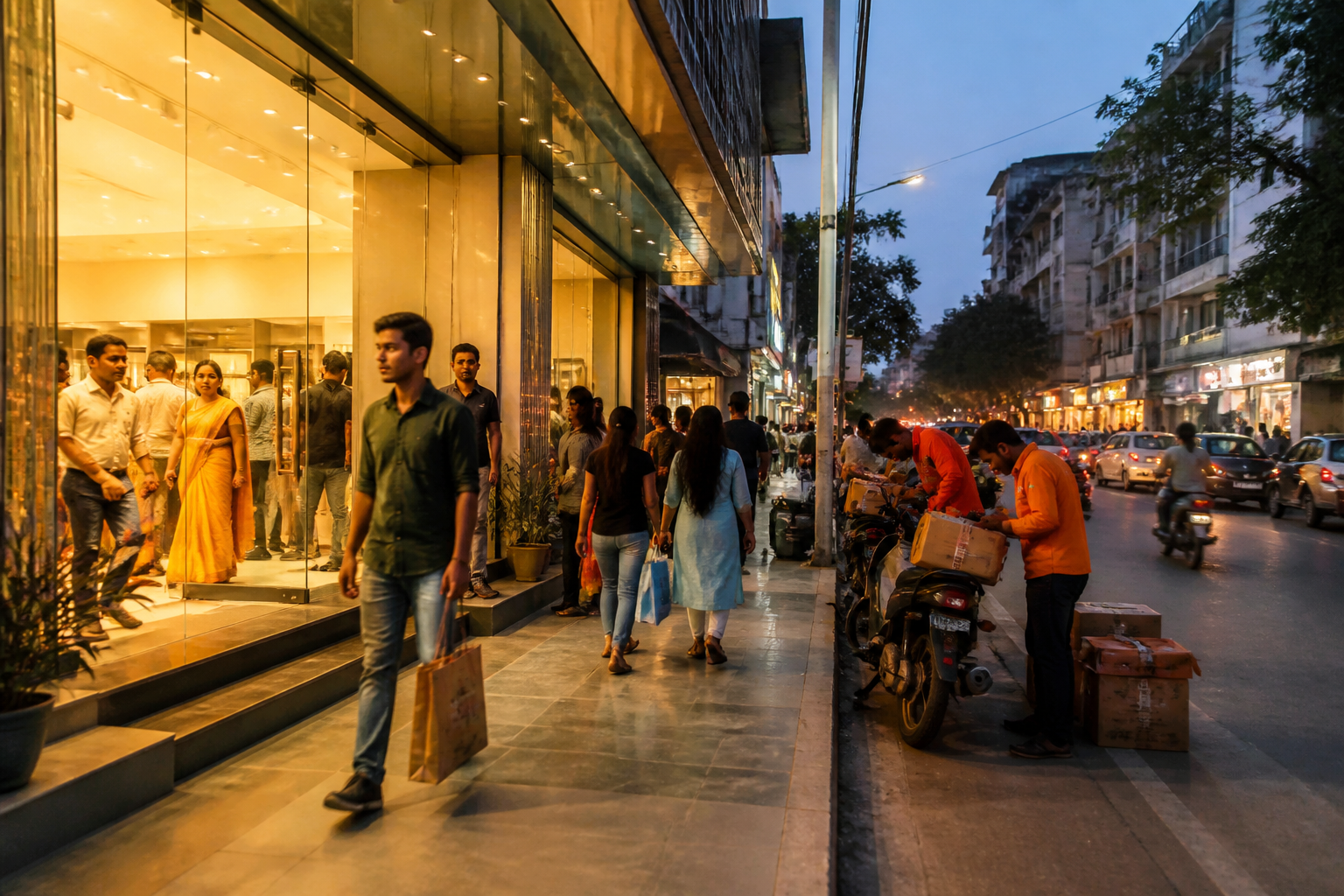
Consumer brands are moving beyond India’s metros for festive-season growth, but the shift is more consequential than a change in marketing strategy. It signals that the country’s consumption geography is broadening, with tier-2 cities and smaller towns becoming more important to retail networks, last-mile delivery systems, digital commerce and the built environment that supports them.
The immediate trigger is pressure in metropolitan consumption. Urban consumption dropped 4% year-on-year in the first quarter of 2026, according to a recent report by market researcher Worldpanel. The report also said 48% of consumers had cut back on non-essential purchases, while 59% expressed concern about inflation and rising fuel prices. In response, companies are looking to cities such as Jaipur, Coimbatore, Kochi, Lucknow, Indore and Bhopal, where they see room to acquire consumers and expand distribution.
Titan, Nykaa, Biba, Fabindia and Forest Essentials are among the brands increasing marketing, distribution and last-mile delivery in new localities, according to executives cited by The Economic Times. The reported strategy includes lower-priced products, local stores, on-ground sales teams and wider delivery coverage. Taken together, these moves suggest that the small-town opportunity is not being treated as a temporary festive-season campaign alone. Companies are building the physical and operational systems needed to serve markets beyond the largest urban centres.
Rahul Shukla, chief sales and marketing officer of Titan Company’s watches division, said about 70% of India’s consumption was coming from breakout towns, referring to tier-2 markets. He attributed the changing consumption pattern to government policies, money flowing into upcountry towns, new smart cities and the digitalisation of the economy. These factors, he said, had exposed consumers to new brands and trends regardless of the tier in which they lived.
The claim points to an important change in how urban demand is distributed. Retail growth is no longer dependent only on the scale and density of metros. Smaller cities can become commercially significant when rising incomes, digital discovery and improved connectivity reduce the distance between consumers and brands. But that transition depends on more than demand. It also requires stores, warehouses, delivery routes, payment systems, sales staff and reliable movement of goods across dispersed urban markets.
Nykaa’s expansion illustrates this operating model. The beauty and fashion platform has made a strategic push into tier-2 and tier-3 markets and has begun its festive campaign by establishing two to five local stores in each such town, according to the report. The company plans to double its total outlet count to more than 600 by 2030. The decision combines physical retail with the reach of an online platform, allowing the company to use local stores as points of consumer access and, potentially, as part of a wider distribution network.
For smaller cities, the presence of these stores can change the everyday retail landscape. Consumers who previously depended on local retailers or travelled to larger cities for particular brands may gain more local access. At the same time, the expansion puts pressure on urban systems to support a higher volume of commercial activity. More stores require suitable commercial space, staff, storage, deliveries and connections to regional supply chains. The report does not establish how much additional space or employment the expansion will create, but it shows that retail companies are making longer-term commitments to these markets.
The home and household sector offers another indicator of the changing consumption base. A recent Deloitte South Asia report said small-town consumers spent an average of ₹3.9 lakh per home on interiors in 2025, equivalent to nearly 74% of tier-1 spending. It expects this momentum to continue through the festive season. The figure places smaller-city households within the wider market for interiors, furnishing and home improvement rather than treating them only as consumers of low-value goods.
That distinction matters for the built environment. Interior spending is connected to the condition, size and aspirations of homes, as well as to the availability of formal retail, installation services and product distribution. The evidence supplied by the report does not explain whether the spending reflects new housing, renovation or replacement purchases. It does, however, indicate that household consumption in smaller cities is reaching a scale that retailers and brands consider commercially viable.
The same pattern is visible in sectors that require more local market development. Indo Bevs, a company producing spirits and liqueurs including Bro Code, Eden and Wingman, is strengthening its presence in tier-2 and emerging markets through on-ground teams, distribution and closer relationships with consumers and trade, its founder Sam Mahandru said. He described the focus as long term, even though the festive season offers an opportunity to build momentum.
This approach highlights the institutional work behind market expansion. A brand cannot reach dispersed consumers through advertising alone. It needs local distributors, trade relationships, sales personnel and delivery arrangements. For cities outside the main metropolitan corridors, such networks can become part of the commercial infrastructure that links households to national brands. Their expansion may also deepen the role of smaller cities as service and distribution hubs for surrounding towns.
Amazon India’s delivery expansion provides the clearest logistics example. The company said it had expanded its Amazon Now instant-delivery platform to more than 120 cities, including Varanasi, Kochi, Jalandhar, Ranchi, Salem and Gorakhpur, ahead of the festive shopping season. It also announced a 50% increase in storage capacity to 64 million cubic feet and said same-day deliveries had reached 30% more cities over the previous year.
These figures show that the shift towards smaller cities is being supported by physical capacity, not just digital demand. Instant and same-day delivery require inventory positioned closer to customers, local fulfilment operations and dependable urban movement. As these services expand, the quality of roads, access to commercial premises, electricity, digital connectivity and traffic management becomes relevant to the consumer experience. The supplied material does not provide city-level data on warehouses, delivery traffic or service performance, but the expansion itself indicates that companies are investing in a wider operating footprint.
The policy context described by Titan’s executive is also significant. Government policies, investment flows into upcountry towns, the development of new smart cities and digitalisation were identified as factors exposing consumers to new brands. These are not identical interventions: policy can shape business conditions, smart-city projects can create new urban infrastructure, and digitalisation can expand access to information and commerce. Their combined effect, as described in the report, is to reduce the commercial separation between metros and smaller urban markets.
That does not mean the urban consumption gap has disappeared. Worldpanel’s figures show that metropolitan households are under pressure from inflation and higher fuel costs, while the retail responses reported by the companies remain differentiated by market. Lifestyle brands are releasing lower-priced products to attract first-time consumers, and Deloitte South Asia said ticket sizes in smaller towns may be lower even as the number of participating households grows. The opportunity therefore rests on a combination of reach, affordability and repeated consumption rather than on metropolitan-style spending in every category.
The emerging retail map is consequently uneven. Jaipur, Coimbatore, Kochi, Lucknow, Indore, Bhopal and the other named markets are not interchangeable, and the report does not provide comparable figures for their incomes, retail space, logistics costs or consumer demand. Nor does it establish whether the reported expansion will produce durable growth after the festive season. What it does establish is that companies are allocating capital and operational attention to a set of cities previously treated as secondary markets.
The larger urban question is whether this commercial shift will be matched by the systems required to support it. Retail expansion can bring greater choice and access, but it also depends on land, transport, storage, digital networks and local employment. If smaller cities become more important consumption centres, their role in regional logistics and service economies will grow as well. The evidence in the report points to that transition, even though its full infrastructure and governance implications remain to be measured.
For now, the clearest conclusion is that India’s festive retail strategy is no longer centred exclusively on metropolitan demand. Small-town India is becoming a testing ground for lower-priced products, hybrid online-offline retail, local distribution and faster delivery. The developments to monitor are whether the announced store and logistics expansions reach their planned scale, whether consumer demand remains resilient beyond the festive season, and how effectively smaller cities absorb the commercial infrastructure required by this new retail geography.
