


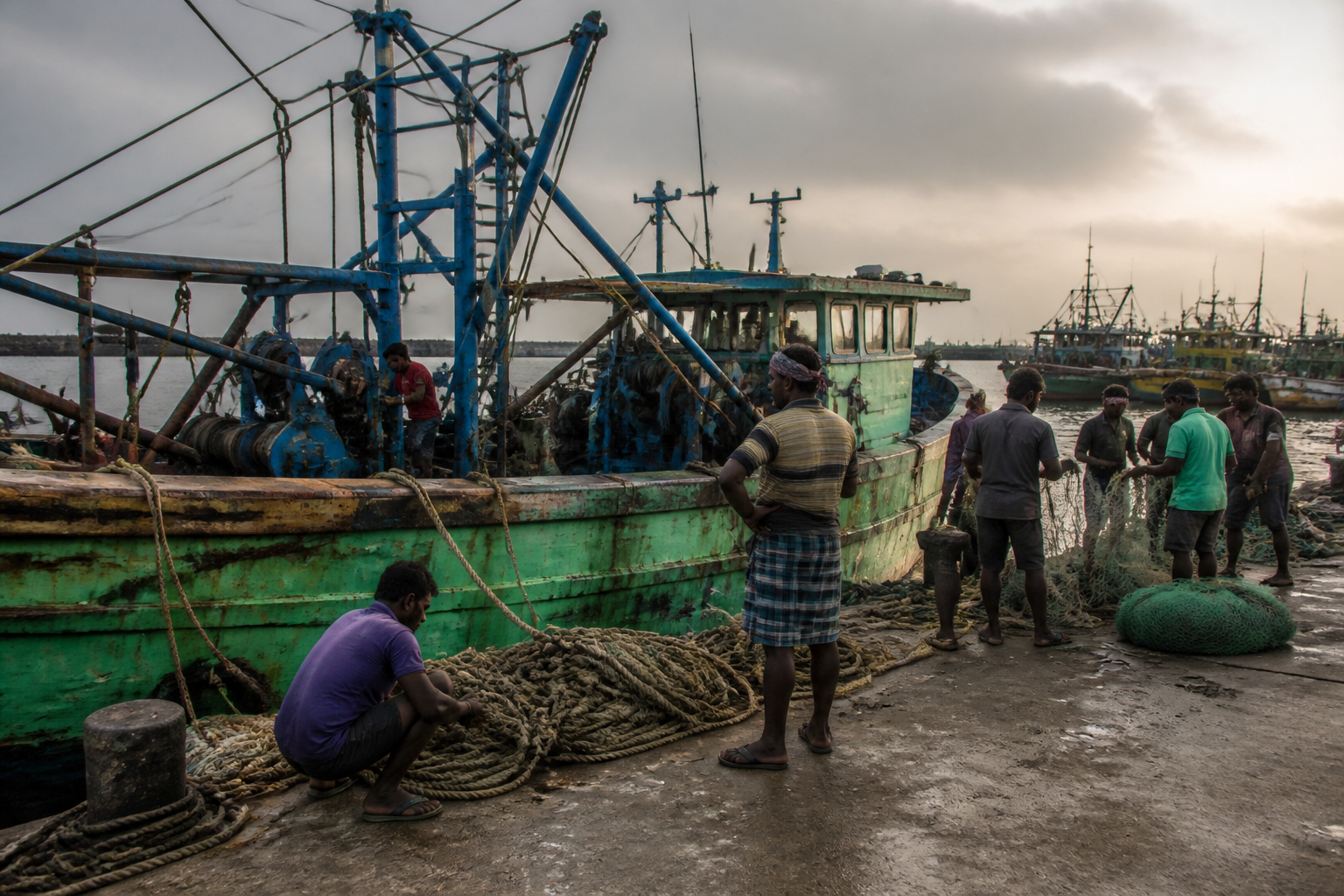
The unresolved seizure of eight trawlers linked to Chennai’s Kasimedu fishing harbour has become more than a dispute over boats. It has exposed how quickly a coastal enforcement action can become an inter-state governance problem, leaving boat owners, fish workers and marine-service providers without a clear route to recover productive assets or restore their livelihoods.
Andhra Pradesh coastal authorities seized seven mechanised trawlers belonging to Chennai fishers off the Nellore coast after the fishing ban ended on June 14, according to a report by the Times of India. The Andhra Pradesh Coastal Task Force and fishers seized another boat the following month. The affected fishermen say the eight boats are collectively worth about ₹6 crore and that more than 100 days have passed without a settlement.
The Kasimedu fishermen have now sought the Union government’s intervention, saying efforts by the Tamil Nadu government have not resolved the matter. Fisheries department officials from Tamil Nadu met Andhra Pradesh authorities in mid-September, but the fishermen said there had been no progress since then. Their demand is not only for the return of the vessels but also for a functioning administrative process that can settle the dispute before prolonged detention causes permanent economic damage.
The available account does not establish the precise legal or operational grounds on which each boat was seized. The fishermen, however, maintain that the incident did not involve fishing in another country’s waters. That distinction is central to their argument: they see the matter as an inter-state dispute involving citizens and assets from within India, rather than an international fishing case requiring a different diplomatic or consular channel.
That claim also shows why the dispute has become difficult to resolve. Fishing activity takes place across a coastline divided by state administrative boundaries, while the economic chain connected to a vessel is concentrated in a particular harbour and community. A boat operating from Kasimedu may support people well beyond its owner. B Raj, a fisher whose boat was seized, told the Times of India that each trawler supports at least 20 families, including fish catchers, sellers and boat mechanics.
If that estimate is applied to the eight vessels, the disruption touches at least 160 families, although the report does not provide an independently verified total or a detailed breakdown of those affected. The wider point is that a trawler is not simply a private asset. It is part of a local employment network involving fishing crews, auction and sales activity, repairs, maintenance and related services. When a vessel is held for months, the immediate loss extends beyond the owner and can affect the functioning of the harbour economy.
Kasimedu’s importance lies partly in this interconnectedness. The report describes the fishermen’s concern through the people who depend on the boats, from those catching fish to those selling it and repairing the vessels. This makes the dispute a question of urban livelihood security. Chennai’s coastal economy is not confined to the shoreline or to the fishing community formally registered at a harbour. It includes a set of supporting occupations whose income depends on the regular movement of boats and catch.
The case also reveals a gap between enforcement and resolution. Coastal authorities may have the power to impound a vessel when they believe rules have been breached. But the economic and administrative consequences of holding that vessel for more than 100 days are substantially different from those of a short-term seizure followed by a prompt decision. The longer the process remains unresolved, the more difficult it becomes for affected families to absorb the loss of income and for owners to maintain or finance their boats.
The fishermen say the Tamil Nadu government has failed to find a solution despite repeated requests. Fisheries officials did meet their Andhra Pradesh counterparts in mid-September, which indicates that an inter-governmental channel exists. Yet the reported absence of progress after that meeting suggests that contact between departments has not produced a decision acceptable to the affected fishers. The source report does not specify whether the remaining obstacles concern evidence, penalties, jurisdiction, release conditions or communication between agencies.
That missing information is itself significant. For communities dependent on marine work, uncertainty can be as damaging as a formal adverse order. A transparent process would need to make clear which authority is handling the case, what findings have been recorded, whether the boat owners have been given a hearing, and what steps are required for release or further proceedings. None of those details is established in the supplied report, so the central facts about the grounds for seizure and the status of the vessels remain unresolved.
The call for Union government intervention reflects the limits of a state-level response when the alleged enforcement action was taken by another state’s coastal authorities. Tamil Nadu can represent the interests of its fishers and communicate with Andhra Pradesh, but the dispute may require coordination across departments and jurisdictions. The fishermen’s appeal therefore points to a broader institutional issue: coastal livelihoods are locally rooted, while enforcement and access to waters can involve multiple authorities.
The dispute also places pressure on political accountability. M K Vijesh, president of the Kasimedu Visaipagadu Urimayalargal Sangam, said the fisheries minister had not been accessible since September and warned that thousands of fisherfolk would stay off the waters indefinitely if the issue was not resolved. That statement is a position of the fishermen’s association, not an independently verified estimate of participation. It nevertheless signals that the matter may move from an individual vessel dispute into collective industrial action affecting fish supply and harbour activity.
Any such action would carry consequences for several groups, but the supplied material does not establish its likely scale or duration. What is clear is that the fishermen have framed the issue as a livelihood crisis rather than a narrow property dispute. The value of the boats, stated at ₹6 crore in total, provides one measure of the financial exposure. The number of workers and families linked to each vessel provides another, less easily captured measure of the social cost.
The case points to three layers of responsibility. The first is the authority that seized the vessels and must establish the basis and status of the action. The second is the Tamil Nadu administration, which is expected by the fishermen to secure the return of boats linked to Kasimedu. The third is the Union government, whose intervention has now been requested because the state-to-state engagement has not produced a solution. The report does not indicate that any of these institutions has issued a final public decision.
This division of responsibility can make accountability difficult. Affected communities may know which state’s authorities hold the boats but still lack a single office responsible for resolving the matter. Departments may meet, exchange requests and refer cases across administrative lines without giving boat owners a clear timeline. The Kasimedu episode shows how an enforcement decision can outlast the administrative attention available to the people affected by it.
The immediate facts remain limited but serious: eight trawlers have been seized, the fishermen place their combined value at ₹6 crore, more than 100 days have passed, and a meeting between fisheries officials in mid-September has not produced progress according to the affected community. The source report does not confirm whether charges have been filed, whether hearings have taken place or whether any release mechanism has been offered.
Those unanswered questions will determine whether this remains a prolonged administrative dispute or develops into a larger confrontation involving fishing operations from Kasimedu. The next meaningful step is a documented response from the Tamil Nadu and Andhra Pradesh fisheries authorities, followed by clarity on the legal status of each vessel and the conditions, if any, for release. Until then, the seized boats remain a visible measure of the distance between coastal enforcement and livelihood protection.
