


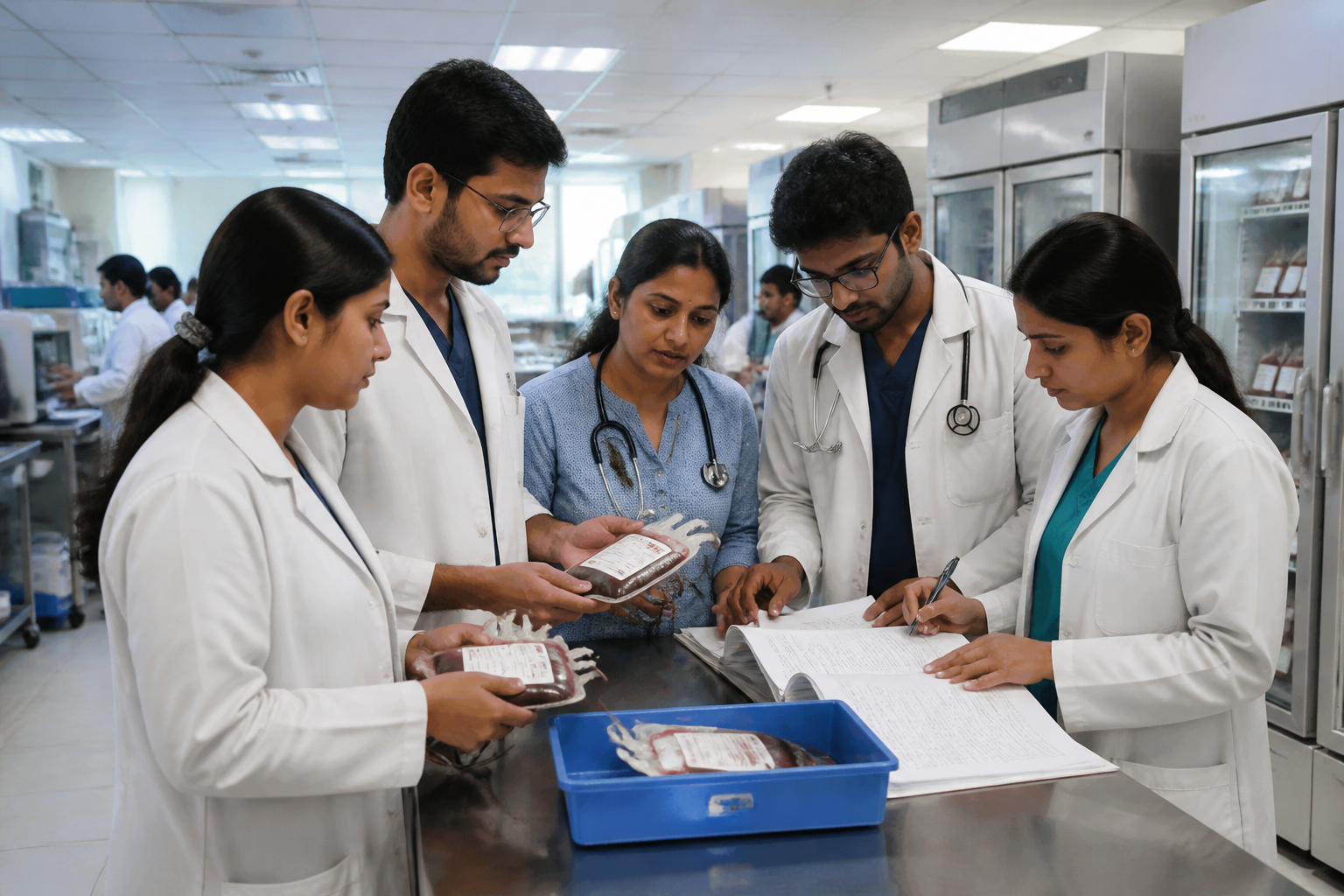
A study of 150 postgraduate doctors at a Chennai college hospital has identified a weakness in the city’s blood transfusion safety system: doctors generally understood blood components and transfusion indications, but many were less familiar with recognising and formally reporting adverse reactions. The finding matters because haemovigilance depends not only on clinical knowledge, but also on whether hospitals have working systems that convert suspected harm into documented evidence.
The study, published in the peer-reviewed BMJ Open, examined the knowledge, attitudes and practices of postgraduate doctors related to haemovigilance. The system is designed to monitor, document and analyse adverse events associated with blood transfusions. In India, the national haemovigilance programme was launched in 2012 to help hospitals investigate the causes of reactions, improve transfusion procedures and strengthen patient safety.
Its central challenge is institutional rather than purely individual. A transfusion reaction may begin with symptoms such as fever, chills, breathing difficulty or a rash. Doctors in training are often among the first to assess such patients. Not every symptom is necessarily caused by a transfusion, but a suspected reaction needs prompt clinical assessment and reporting. If that step does not happen, hospitals lose information that could help identify recurring patterns, investigate whether an error occurred and prevent similar incidents.
The study found that nearly all participants were aware of different blood components. A similar number could identify the blood products used to treat anaemia and thrombocytopenia, a condition involving a low platelet count. This suggests that basic transfusion knowledge was relatively strong among the doctors surveyed.
The gap appeared when the study examined the operational side of transfusion safety. Only 26%, or 39 of the 150 doctors, said they had formally reported a transfusion reaction. Just 21.3%, or about 32 doctors, had attended a haemovigilance-specific education programme or workshop. Awareness of the national haemovigilance programme and the Transfusion Reaction Reporting Form was also limited.
This distinction between knowing what blood products do and knowing how to report a suspected adverse event is important. A hospital can have doctors who understand transfusion indications while still producing incomplete safety data if reporting pathways are unfamiliar, inconvenient or treated as an exceptional administrative task. The result is a system that may respond to serious incidents but fail to learn from less severe or uncertain reactions.
The study does not establish that every unreported reaction caused harm, nor does it suggest that every symptom following a transfusion is transfusion-related. Its finding is narrower and more significant: limited awareness and reporting practice can contribute to under-reporting. Under-reporting makes it harder for hospitals to see whether particular products, procedures, wards or clinical practices are associated with repeated problems.
The researchers found that doctors with stronger knowledge tended to have better reporting practices. The association was stronger among those with favourable attitudes towards haemovigilance. This indicates that training cannot be limited to a one-time transfer of technical information. Doctors also need to understand reporting as part of routine clinical work and patient-safety oversight.
Akilandeeshwari K, the study’s first author from Sri Ramachandra Institute of Higher Education and Research, said that theoretical awareness alone was not enough. Dr Anusha Dakshinamoorthi, the corresponding author, said haemovigilance needed to become part of routine clinical practice rather than an activity undertaken only after a serious event.
That emphasis places the reporting form and the hospital workflow at the centre of the issue. When a suspected reaction occurs, the clinical team must recognise the possibility, assess the patient, communicate with the relevant blood bank or transfusion service and record the event through the prescribed mechanism. Each of those steps can fail if responsibilities are unclear or if postgraduate doctors are not trained to act quickly.
The study’s recommendations therefore focus on institutional design as much as medical education. The authors called for focused haemovigilance training for postgraduate doctors, refresher programmes, greater awareness of reporting forms and hospital systems that make reporting easier. They also identified blood banks and hospital transfusion committees as important actors in embedding these practices into everyday clinical work.
This is a governance question within healthcare infrastructure. The national haemovigilance programme can collect information only when hospitals generate reliable reports. Hospitals, in turn, depend on frontline staff recognising suspected reactions and knowing where the information must go. A national monitoring system therefore rests on a chain of local decisions: who identifies the event, who assesses it, who completes the form, who reviews it and who acts on the pattern.
The numbers in the study show where that chain is weak. All participants agreed that health institutions should enrol in the haemovigilance programme and report transfusion reactions. Yet only about one in four had formally reported one, and only about one in five had received specific haemovigilance education. Support for the principle was therefore much wider than demonstrated participation in the system.
That gap between stated support and reported practice is common to many institutional safety systems, although this study does not measure other hospitals or establish a citywide rate. Its findings come from postgraduate doctors at one city college hospital and should not be treated as a representative estimate for all Chennai hospitals. The evidence does, however, identify a plausible operational risk that can be tested through wider audits and reporting data.
The study also shows why reporting systems should not be judged only by the number of severe incidents recorded. Both serious and non-serious reactions are meant to be reported under the haemovigilance framework. A non-serious event may still provide information about a recurring problem, an unclear procedure or a need for closer monitoring. If only major incidents enter the system, hospitals may lose the early signals that allow them to intervene before a pattern becomes more serious.
Postgraduate doctors occupy a particularly important position in this process. They are often closely involved in ward-based assessment and may be present when symptoms first appear. At the same time, they work within complex hierarchies and high-pressure clinical environments. A reporting process that depends on personal initiative alone can produce uneven results. Clear pathways, structured teaching and practical exposure are intended to reduce that dependence.
The study’s institutional solution is not to assign responsibility to doctors in isolation. Blood banks and hospital transfusion committees can help define procedures, provide training, review reports and connect individual incidents to broader corrective action. Their role is to ensure that reporting does not end with paperwork, but feeds into investigation and improvements in transfusion practice.
The evidence supplied by the study does not specify how many reactions occurred, how many were missed, which types of reactions were most frequently under-recognised or whether the hospital changed its procedures after the findings. It also does not compare public and private hospitals, postgraduate doctors with other clinical staff, or Chennai with other cities. Those are important limitations when considering the scale of the problem.
What the study does establish is that transfusion safety has two linked components. The first is the clinical ability to understand blood products and their indications. The second is the institutional ability to recognise a suspected adverse event and record it consistently. Strength in the first area cannot compensate for weakness in the second.
For hospitals, the immediate question is whether haemovigilance is visible at the point of care. Doctors need to know what symptoms require assessment, which form must be used, whom to contact and how the report will be reviewed. For administrators and transfusion committees, the question is whether those steps are built into routine systems rather than activated only after a serious incident.
The Chennai study therefore points to a measurable patient-safety task: improve the connection between clinical knowledge and institutional reporting. Its findings confirm a training and workflow gap among the doctors surveyed, while leaving the scale of under-reporting across the wider hospital network uncertain. The next developments to watch are whether hospitals introduce structured training, make reporting pathways clearer and use blood-bank and transfusion-committee systems to turn individual reports into prevention measures.
