


India’s power shortage in September exposed a vulnerability that is becoming harder for the electricity system to ignore: strong daytime renewable generation does not automatically guarantee reliable power after sunset. Hydropower generation fell nearly 12% below projected requirements during the first six months of financial year 2026-27, while peak demand rose to 269 GW in September. The combination placed greater pressure on coal-fired generation and contributed to a monthly electricity shortage of nearly 560 million units, according to Power Ministry data cited by the Times of India.
The shortage was substantially higher than the approximately 98 million units recorded in August. It also came during a month when demand was unusually strong because of industrial activity, cooling requirements and irrigation needs amid a deficient monsoon. The result was not simply a shortfall in one generation source. It revealed how dependent the wider system remains on a set of assumptions about rainfall, evening demand, fuel movement, distribution capacity and the ability to shift electricity across time.
That distinction matters for cities and urban economies. Electricity demand is not concentrated only in households switching on fans or air-conditioners. It also comes from factories, commercial buildings, water and wastewater systems, transport infrastructure, telecommunications networks, hospitals, offices and construction sites. When supply becomes unstable during evening and night-time hours, the effects can move through the urban system even when the overall annual or seasonal deficit appears small.
The first six months of FY27 recorded an overall electricity shortage of around 0.2% of demand, according to the data cited in the report. That figure may appear limited, but it does not describe when shortages occur, where they occur or which consumers bear the disruption. A small system-wide deficit can still produce local power cuts when distribution networks are weak, demand peaks sharply or supply cannot be delivered to the right place at the right time.
## The problem is timing, not only volume
Solar and wind generation increased by 25% in September, but their share of overall generation fell to about 17% from 19.5% in August because total demand and other generation requirements rose. Solar power is most useful during daylight hours, while electricity demand often remains high or increases after sunset. Hydropower has traditionally helped bridge that transition because it can respond more flexibly than some other sources.
The rainfall deficit changed that equation. The report attributes the lower hydropower output to a monsoon rainfall deficit of 13%. Charith Konda, lead energy specialist at the Institute for Energy Economics and Financial Analysis, said hydropower usually supports supply during this period. With that source weakened, the pressure moved towards coal generation and the distribution network.
Konda described hydropower as one part of an interconnected system: when it is removed, deficiencies elsewhere become more visible. That is an important institutional insight. The problem is not that one technology failed in isolation. It is that the system had limited flexibility when a source that normally supports evening demand became less available.
Coal-fired generation provided the baseload during the first half of the financial year, but the report also points to constraints in moving coal to power plants. Intense rainfall in coal-producing states created logistical problems, contributing to fuel shortages at several plants. Higher demand therefore met a supply chain that was itself under stress.
This is a reminder that generation capacity on paper is different from electricity that can be delivered when required. A plant may exist, but its contribution depends on fuel availability, transport links, operating capacity, transmission access and the condition of local distribution networks. The September shortage brought several of those dependencies together at the same time.
## Distribution turns a national problem into a local outage
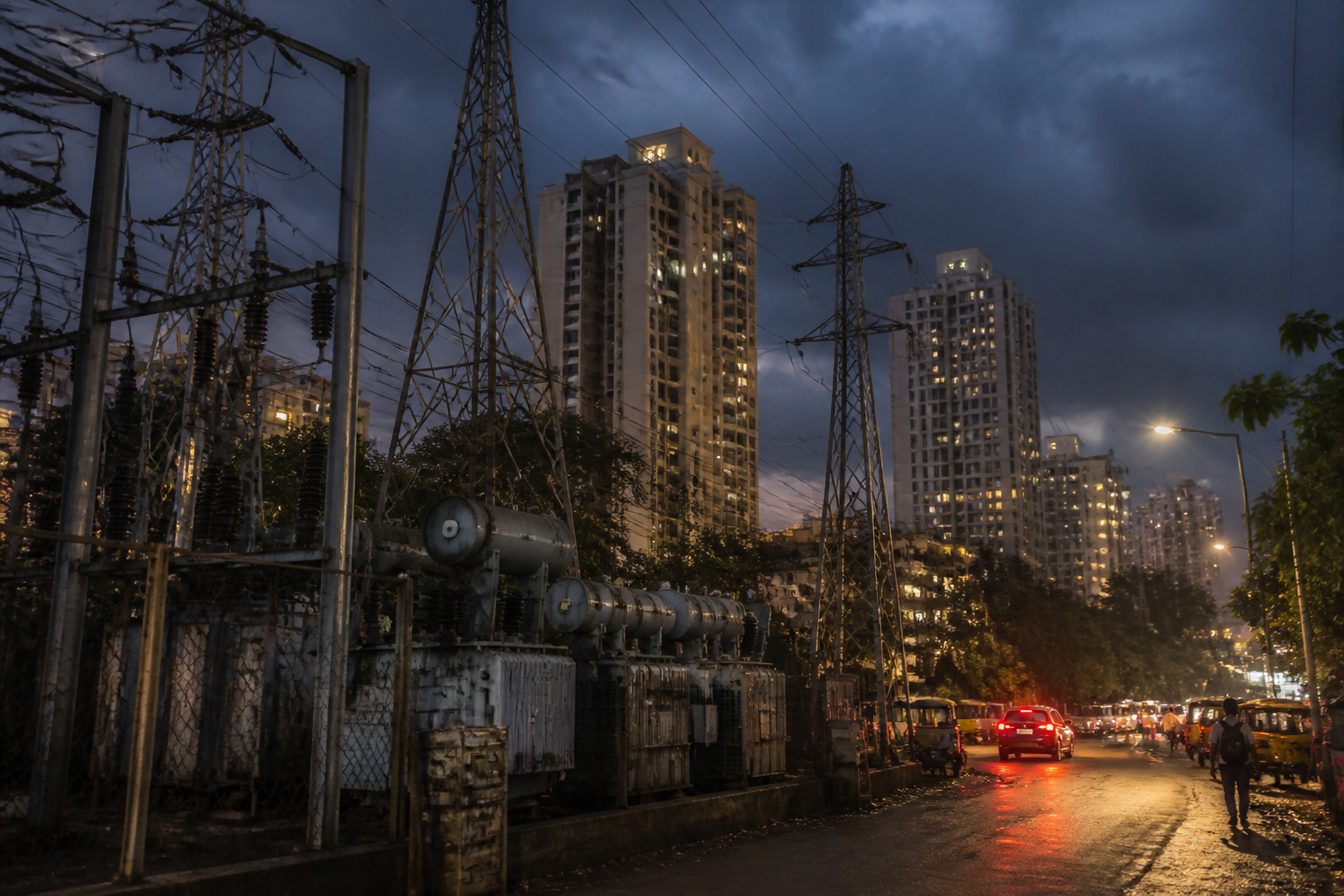
The electricity system is often discussed through national demand and generation figures, but citizens experience it through feeders, transformers and local substations. Konda said distribution was a problem in several states and linked instability and power cuts to inadequate infrastructure in the distribution grid.
This gap between system-level supply and local reliability is central to the urban question. A city may have sufficient generation available elsewhere in the country, but that electricity does not automatically reach every neighbourhood, industrial estate or public facility. Congested networks, overloaded transformers and local demand spikes can produce outages even when the national shortage is relatively low.
Disha Aggarwal, a fellow at the Council on Energy, Environment and Water, said distribution companies faced constraints including stressed finances and subsidy pressures. She also argued that the power system continues to operate on older assumptions about weather and demand. Her proposed response included stronger supply during non-solar hours, demand shifting through smart meters and time-of-day tariffs, and local planning based on feeder, transformer and meter data combined with weather forecasts.
These suggestions point to a shift from treating power reliability as a single generation problem to managing it as a data, finance and network problem. The relevant unit of planning is not only the national grid. It is also the local feeder serving a dense residential district, the transformer supporting a commercial cluster and the distribution network serving an industrial area with predictable evening demand.
The financial condition of distribution companies matters because local reliability requires continuous investment. Distribution networks need maintenance, capacity upgrades and better monitoring, while consumers and utilities also need mechanisms that reflect when electricity is available and when the system is under pressure. The report does not quantify the financial gap faced by discoms, but it identifies stressed finances and subsidy pressures as constraints on smarter planning.
## Storage is the missing link after sunset
The September data also highlighted the absence of sufficient battery storage to retain solar electricity produced during the day for evening use. Renewable generation rose during the month, yet the system still faced a shortage when demand and supply timing did not match.
This is the structural limit of measuring progress only through installed renewable capacity or monthly renewable generation. More solar can reduce daytime pressure, but it does not by itself solve the evening ramp when solar output falls. Without storage, flexible generation or demand shifting, the system must rely more heavily on coal, gas and hydropower to meet the later peak.
Amit Manohar, secretary general of the Indian Solar Manufacturers Association, said faster deployment of solar-plus-storage projects and stronger networks were needed to ensure reliable power throughout the day. His statement connects two requirements that are sometimes treated separately. Storage can shift energy across hours, but networks must still be able to move that power to consumers.
The report said nuclear generation exceeded projections despite its limited available capacity, while gas-based plants also helped meet demand in September. These sources provided support, but the account does not establish how much additional capacity or generation they contributed. What it does show is that the system used multiple sources to manage volatility while coal remained the principal baseload provider.
Rohit Bajaj, joint managing director of Indian Energy Exchange, said the Power Ministry was monitoring the coal situation at power plants and had taken steps to ensure fuel availability. He also said demand and supply dynamics remained volatile during the month, particularly in the final week, when cyclone activity and widespread rainfall moderated demand in several regions.
That volatility makes planning more difficult. Weather can reduce demand in one area while disrupting fuel transport or generation in another. Rainfall can improve some water-related conditions but also create logistical problems for coal movement. A system designed around average conditions becomes more exposed when demand, weather and fuel availability change simultaneously.
## What the September shortage reveals
The immediate numbers are clear: hydropower fell below projected requirements, peak demand reached 269 GW, and the monthly electricity shortage increased sharply from August. Renewable generation grew, but its share of total generation declined. Coal remained central, even as fuel logistics came under pressure. The national deficit for the first six months stayed at around 0.2% of demand, but local distribution weaknesses continued to affect reliability.
The evidence therefore points to a power system facing a flexibility problem. India is adding renewable generation, but the ability to provide dependable electricity depends on what happens during non-solar hours. That requires a combination of dispatchable generation, storage, demand management, fuel logistics and stronger distribution infrastructure.
For cities, the issue is particularly significant because urban demand is concentrated, time-sensitive and infrastructure-intensive. Cooling, water supply, transport, health services, commercial activity and industrial operations all depend on electricity that is not merely available in aggregate but delivered consistently at the required hour.
The September episode does not establish that India’s power system is entering a permanent shortage. It does show that a deficient monsoon and high demand can expose weaknesses across generation, fuel transport, storage and distribution at the same time. The developments that require monitoring are the availability of coal at power plants, the rollout of solar-plus-storage projects, investment in local distribution networks, and whether utilities adopt more detailed planning for weather-linked demand and non-solar-hour reliability.
