


The Bay of Bengal is warming at the surface, becoming more acidic and changing the way sound travels underwater. A study by researchers from the Defence Research and Development Organisation and the Kerala University of Fisheries and Ocean Studies says these linked changes could allow sound to travel longer distances, increasing underwater noise and disrupting marine communication, navigation and feeding behaviour.
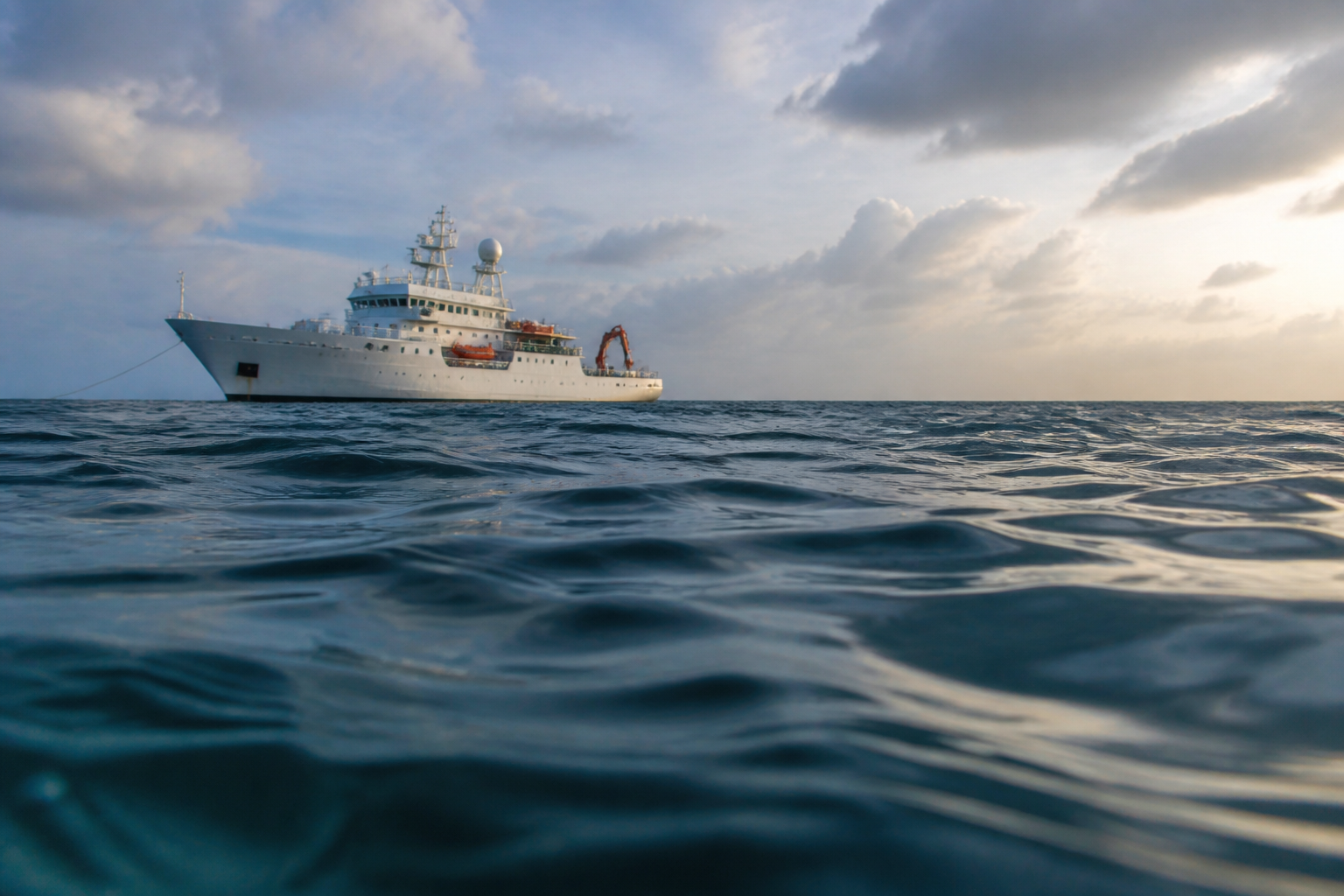
Published in Ocean Dynamics on September 2, the study compared historical observations from the 1963 International Indian Ocean Expedition with measurements collected during the 2019 Sagar Maitri expedition. It also used long-term temperature, salinity and pH datasets covering several decades. The findings offer more than a record of changing ocean conditions. They show how climate change can alter an operating system that is largely invisible from the coast but is important to marine life, research, defence and navigation.
The strongest signal is in the Bay’s upper ocean. The comparison between 1963 and 2019 found that temperatures in the upper 50 metres increased by about 0.2°C to 2.2°C at many locations across the central Bay of Bengal. Long-term records from 1960 to 2020 confirmed sustained warming near the surface, while waters between 100 metres and 200 metres showed signs of cooling.
That contrast matters because the ocean does not respond to warming as a uniform block. Temperature, salinity and depth interact to form layers that determine how heat and sound move through the water. The study found that heat stored in the upper 50 metres of the Bay increased over time. Ocean heat content rose by about 0.018 × 10⁹ joules per square metre per decade during 1965-2020, although the researchers also recorded year-to-year fluctuations.
The increase in heat storage is an important climate indicator because it captures energy accumulating below the immediate surface. Air temperature changes are more visible to people living in coastal cities, but ocean heat can influence the physical conditions around them through changes in circulation, marine ecosystems and the behaviour of extreme weather systems. The supplied study does not establish a direct link between its findings and any specific coastal disaster. It does, however, document a sustained change in the Bay’s upper-ocean structure.
The second major finding concerns acidity. Surface pH in the Bay generally ranged between 8.3 and 8.4 from the 1960s through the late 1980s. After 2000, values commonly ranged between 8.1 and 8.2. The study links the decline to rising atmospheric carbon dioxide. Atmospheric CO₂ concentrations exceeded 350 parts per million during the period examined and reached 414.72 ppm by 2020.
When carbon dioxide dissolves in seawater, it forms carbonic acid and lowers pH. A lower pH does not mean that the ocean becomes acidic in the everyday sense; seawater remains alkaline in the ranges reported by the study. But even a relatively small change in pH can affect chemical processes and the way sound is absorbed in water.
The researchers noted that earlier studies had also reported a stronger decline in surface pH in the Bay of Bengal than in the Arabian Sea. They identified freshwater inflow, mixed-layer processes and ocean circulation patterns as factors that may help explain the difference. The Bay receives substantial freshwater from rivers and rainfall, creating a low-salinity surface layer. That layer influences the distribution of heat, salt and sound.
This is where the study’s oceanographic findings become an infrastructure and governance question. Sound is used in underwater communication, navigation, monitoring and sonar systems. It is also part of the sensory environment of marine animals. If changes in seawater chemistry reduce the absorption of sound, signals and biological sounds can travel farther than they did under earlier conditions. The result may be a noisier and less predictable underwater environment, even without an increase in the number of sound sources.
The study calculated that a decrease of 0.1 pH units could reduce sound absorption by roughly 10% to 12% under representative Bay of Bengal conditions. The researchers also found that changes in salinity can influence sound absorption, in some cases more strongly than temperature changes. This makes the Bay’s freshwater conditions particularly important to understanding its changing acoustic environment.
The finding does not mean that every coastal or marine activity will immediately face the same level of disruption. The study describes a physical change in the conditions through which sound travels. The actual effect on a communication system, navigation operation or marine species would depend on factors such as frequency, location, depth, salinity and the presence of other sound sources. The report identifies the potential for longer-range sound propagation and associated ecological and operational effects, but it does not provide a universal impact assessment for all activities in the Bay.
The ocean layers examined by the researchers help explain why the effects are likely to vary across locations and depths. The study considered the isothermal layer, mixed layer, barrier layer and sonic layer. The barrier layer, which separates surface waters from deeper waters, typically ranged between 25 metres and 45 metres in thickness and averaged about 32 metres.
These layers are not fixed boundaries. Their thickness and structure vary with temperature, salinity, rainfall, freshwater discharge and circulation. The study found substantial long-term variability in them, along with a general decrease in sound-speed gradients in the upper ocean. That trend became more pronounced after 2000. In practical terms, the changing structure means that the same sound source may not behave in the same way under different ocean conditions.
For coastal governance, this creates a problem of coordination. Ocean warming and acidification are usually addressed through climate, environmental and marine science institutions, while underwater communications, navigation and sonar involve separate operational and security systems. Marine animals and fishing communities are affected by the same physical environment, but are not necessarily represented in the same data or decision-making structures. The study’s combined treatment of temperature, pH, salinity and acoustics demonstrates why these issues cannot be managed entirely within separate administrative silos.
The evidence also points to a data challenge. The researchers had to compare observations from 1963 and 2019 and supplement them with long-term datasets from 1960 to 2020. Long-term comparisons are necessary to distinguish persistent ocean change from short-term fluctuations. The study’s finding of year-to-year variation in ocean heat content shows why isolated measurements are not enough to understand the Bay’s direction of travel.
The pH record follows a similar pattern. The broad movement from values of about 8.3-8.4 in the earlier period to 8.1-8.2 after 2000 is significant because it is visible across a multi-decade comparison rather than being based on one observation. At the same time, the supplied report does not provide a complete map of pH changes across every part of the Bay, nor does it quantify the effect on particular fisheries, ports or coastal settlements.
That distinction is important for public understanding. The study establishes a changing physical environment, but not a single forecast for every coastal city or marine industry. Its findings are best read as evidence that climate-linked changes are affecting several connected ocean systems at once: heat storage, acidity, salinity structure, sound absorption and the movement of sound.
The Bay of Bengal is therefore becoming a more complex planning environment. Activities that rely on stable assumptions about underwater conditions may require better monitoring as the ocean changes. Marine research, navigation, communication and environmental management all depend on measurements that can capture conditions across time, depth and location. The study does not prescribe a specific policy response, but its evidence makes the need for integrated observation clear.
The larger urban question is how coastal regions account for changes that are not immediately visible on land. Cities and ports are often planned around shorelines, transport links, drainage systems and built assets. Yet their wider operating environment includes the water column offshore, where climate change is modifying the physical conditions that support ecosystems and maritime activity. The Bay of Bengal study brings that hidden layer into view.
What the evidence confirms is a sustained warming of the upper Bay, increased heat storage, a decline in surface pH and changes in the ocean layers that shape sound propagation. What remains less certain from the supplied material is the scale of the resulting impact on individual species, navigation systems, communication networks or coastal economies. Those questions will require continued, location-specific monitoring. The next step for institutions working across climate, marine science, navigation and coastal governance is to track how these physical changes evolve together rather than treating them as separate signals.
