


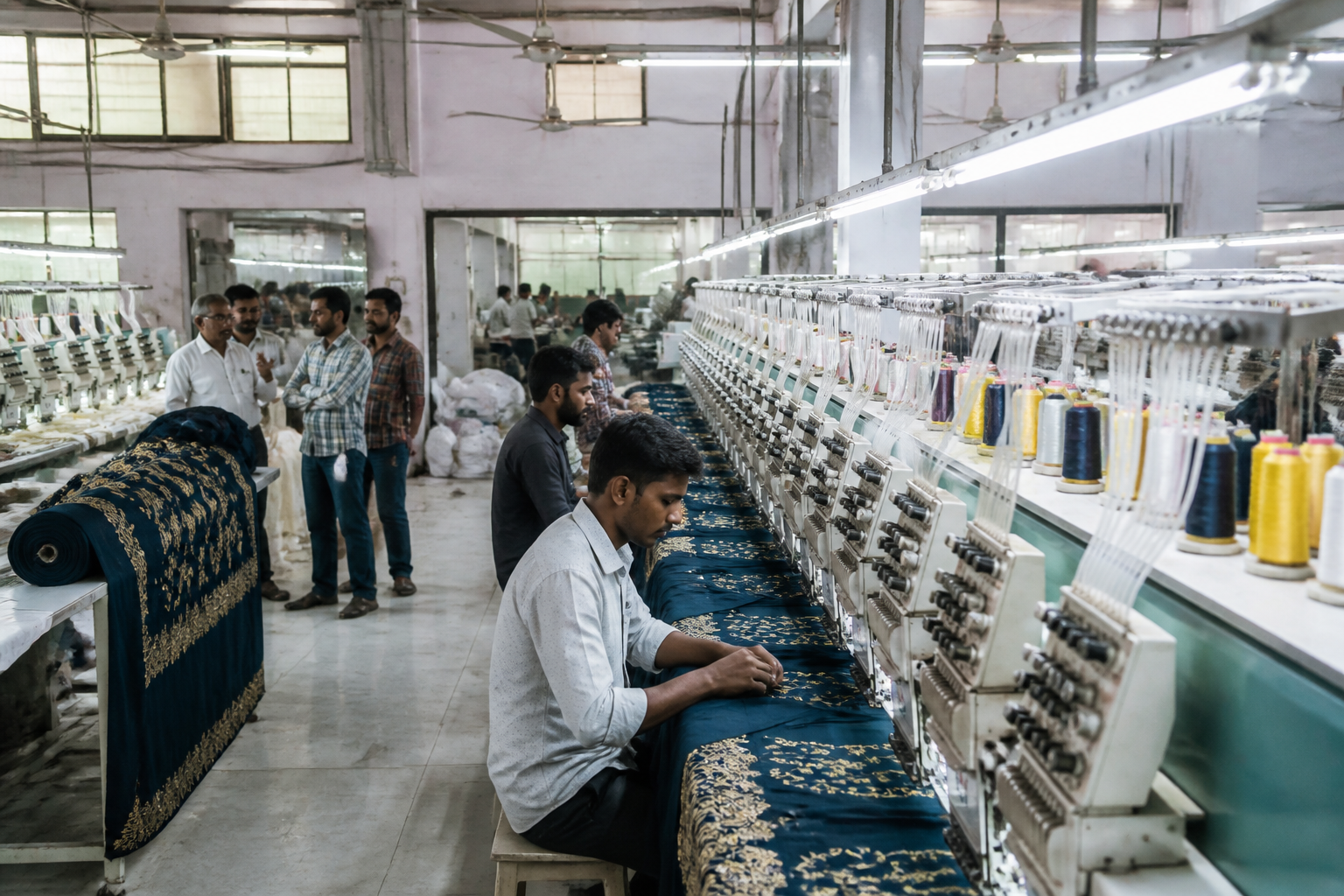
A labour department circular directing Surat’s embroidery units and the Textile Embroidery Jobwork Association of Surat (TEJAS) to comply with the four labour codes has led worker leaders to call off a protest planned for October 1, but disagreements over working hours, wages and benefits remain unresolved.
The circular has temporarily eased tensions in an industry that has witnessed repeated unrest over employment conditions. Workers have been seeking clarity on an eight-hour workday, paid weekly holidays and the continuation of existing benefits, while unit owners are assessing how the changes could affect production costs.
TEJAS has convened a meeting of its members on October 10 to discuss the implications of the labour department’s directive and formulate a common position. Unit owners have also begun holding meetings across Surat’s industrial clusters to prepare an agenda for the discussion.
The dispute centres on whether workers should receive the same salary for an eight-hour schedule that they currently receive for longer working hours. Industry representatives have warned that maintaining existing pay levels while introducing paid weekly holidays could increase labour costs and force changes to other benefits provided by some units.
“A section of workers demanded that they should get the same salary for eight hours that we pay for 12 hours. In that condition, to manage production costs, we will have to reduce other benefits, such as accommodation and free power,” Karunesh Ranpariya, former president of TEJAS, was quoted as saying.
Association members maintain that some unit owners already provide non-wage benefits, including accommodation and free electricity. They have cautioned that higher compliance costs could lead employers to reconsider these facilities, creating another point of uncertainty for workers who depend on them in addition to their wages.
Hitesh Bhikadiya, president of TEJAS, said unit owners were examining how to manage the financial effect of an eight-hour schedule and a paid weekly holiday. “If we maintain the same salary for eight hours and give one paid weekly off, we will have to adjust production costs in other areas. We are working out various ways to deal with it,” he said.
Trade sources indicated that embroidery units may consider revising piece rates, restructuring shifts and incorporating higher compliance costs into jobwork pricing. These options remain under discussion and have not been finalised. Workers, meanwhile, continue to seek clarity on wage arrangements and whether existing accommodation and electricity benefits will continue.
The developments illustrate how a labour compliance directive can affect not only formal working hours but also the wider operating model of an urban industrial cluster. In Surat’s embroidery sector, wages, production schedules, jobwork pricing and non-cash benefits are closely linked in the ongoing negotiations between workers and employers.
With the planned protest called off, the immediate disruption has been avoided. The next formal step will be TEJAS’s October 10 meeting, where members are expected to discuss the labour department’s directive, production costs and the proposed changes to working arrangements.
