


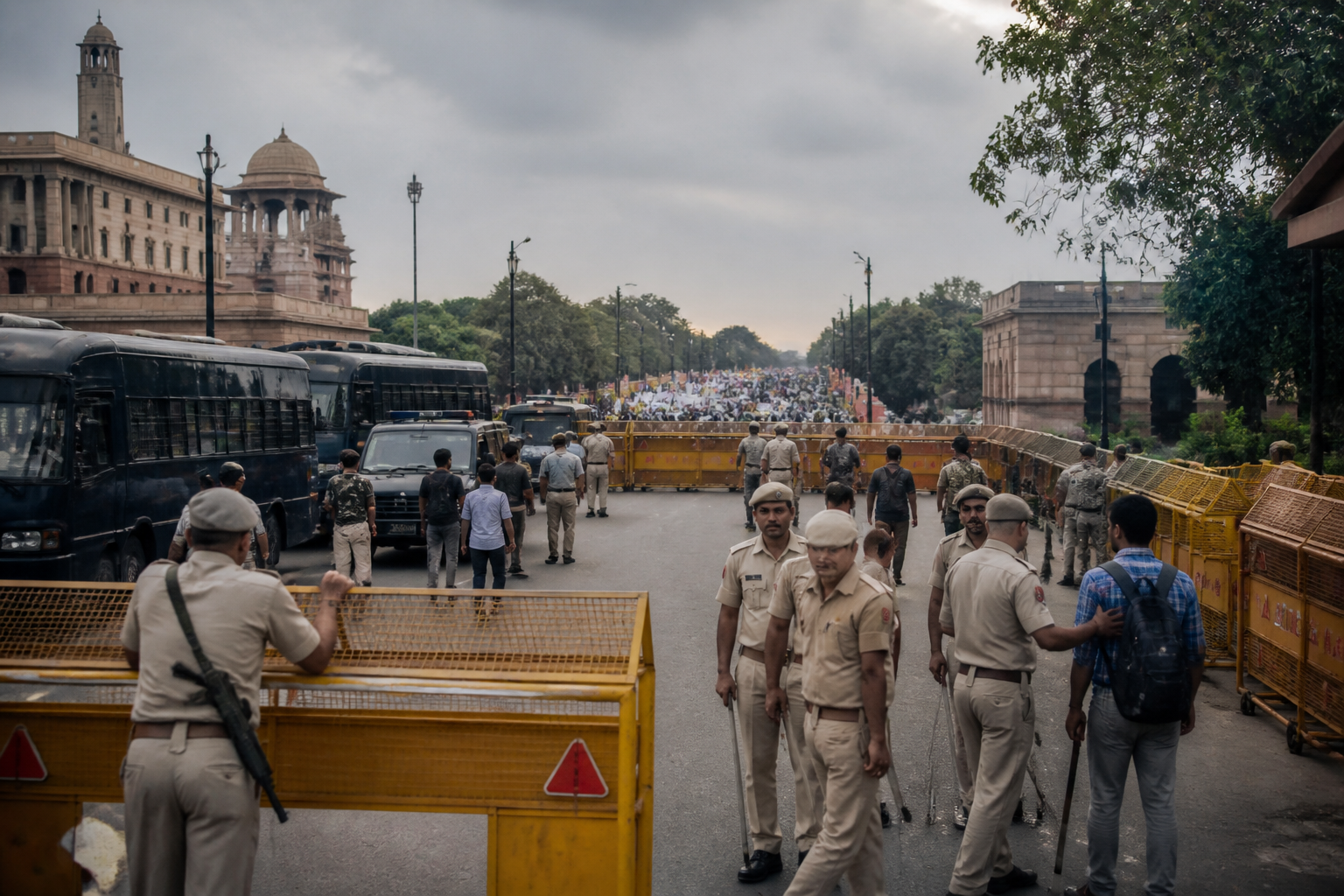
Police barricades and a deployment of about 4,000 personnel restricted access to Jantar Mantar in central Delhi on Gandhi Jayanti, October 2, as protesters seeking the removal of Election Commission chief Gyanesh Kumar were stopped and detained. More than 500 people, including former Delhi Chief Minister Atishi, were detained, according to the report.
Prohibitory orders under Section 163 of the Bharatiya Nagarik Suraksha Sanhita were enforced across the Parliament Street subdivision, where Jantar Mantar is located. The order restricted public meetings and assemblies of five or more people, as well as the carrying of firearms, banners, placards, sticks and other objects. Slogans, speeches, processions, demonstrations and dharnas were also prohibited.
The actual protest site was excluded from the wider order, and demonstrations were permitted there until 5 p.m. with permission. However, the two main approaches to Jantar Mantar—from Sansad Marg and the Kerala House side—were blocked by Delhi Police, Central Armed Police Forces and Rapid Action Force personnel. Buses and police vans were positioned around the entry points, while drones were used for surveillance.
The restrictions also affected public transport. The Delhi Metro Rail Corporation closed entry and exit gates at 12 stations, including Patel Chowk, Janpath, Rajiv Chowk, Mandi House and Central Secretariat. Interchange facilities continued at the affected stations except New Delhi. Public vehicles were barred from Ashoka Road, Jantar Mantar Road and Sansad Marg, and commuters were asked to take alternate routes. People waiting at bus stops were also instructed to leave.
Internet service disruptions in the area created difficulties for nearby shopkeepers and gig workers who depended on UPI payments, the report said. The restrictions therefore extended beyond the protest zone, affecting movement and transactions in a busy central Delhi district that includes government offices, commercial establishments and major transport connections.
Student organisations and Opposition party workers attempted to reach the protest site through different routes. The Students’ Federation of India and the Democratic Youth Federation of India planned to march from Mandi House, while the National Students’ Union of India began from Raisina Road. Members of the All India Students’ Association surveyed possible routes before changing their plans as access points were closed.
N. Sai Balaji, a CPI(ML) activist and former AISA national president, said a crowd of at least 350 people had gathered before detentions began. AISA national president Neha Bora, psephologist Yogendra Yadav and other protesters were stopped near Samrat Ashok Chowk after attempting to approach the site from Patel Chowk.
AAP Delhi president Saurabh Bharadwaj and MP Sanjay Singh were detained at Janpath Lane at about 10.30 a.m., according to the report. The AAP said the action raised questions about the future of democratic dissent. The Indian Youth Congress also arrived during the evening with about 500 workers, of whom around 50 were detained.
At least 20 to 25 buses and vans transported detained protesters from the area. Police barricades remained in place throughout the day. AISA’s Neha Bora later called for another protest at Jantar Mantar at 1 p.m. on October 3, indicating that access restrictions and the protest mobilisation could continue into the following day.
