


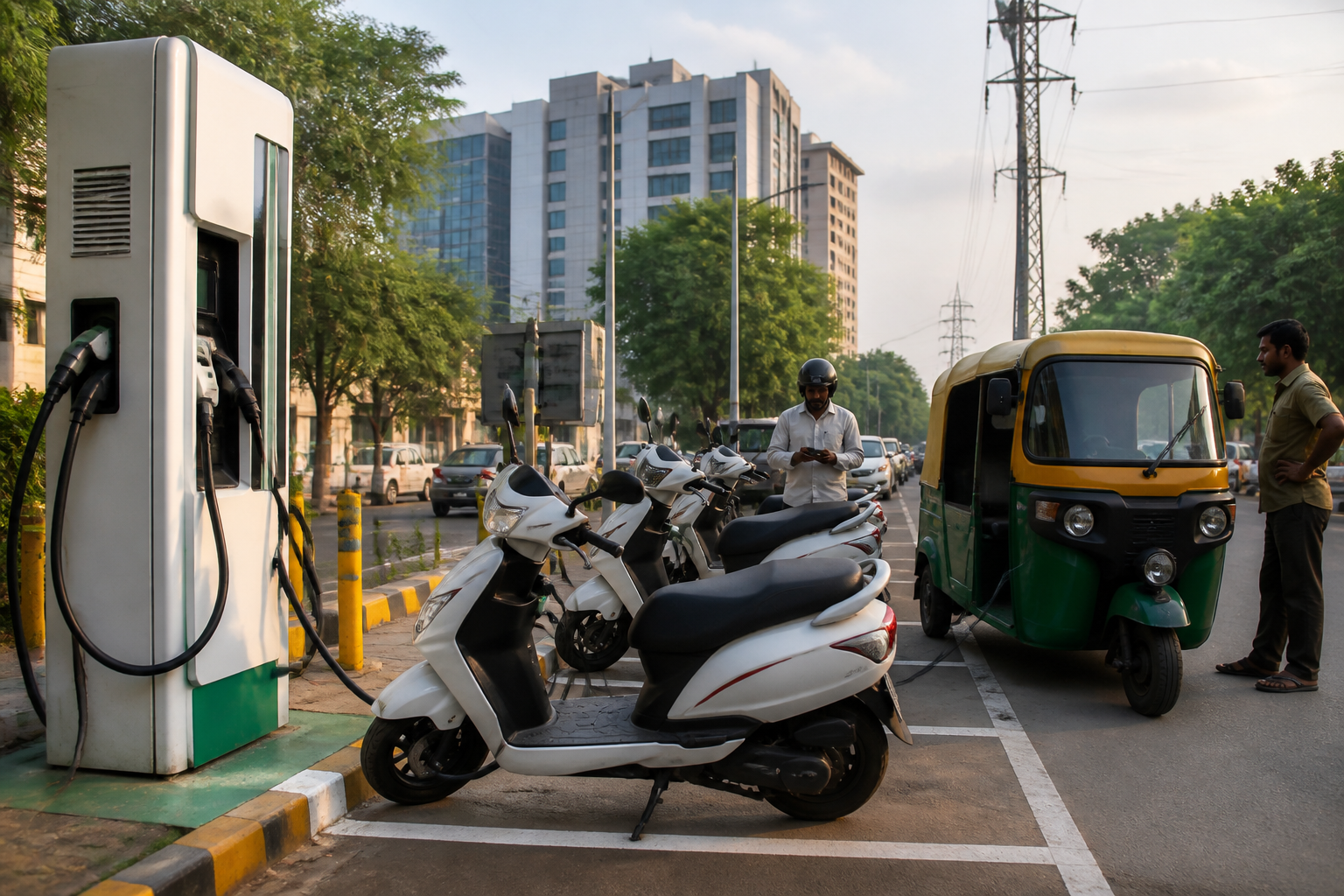
Delhi’s electric vehicle policy has moved from announcement to implementation, with electric two-wheeler registrations rising 30% in the first three months and 382 charging sites receiving approval. The early numbers suggest that incentives can stimulate demand, but the policy’s more consequential test will be whether the city can build a reliable, segment-specific charging network before it seeks to end new internal-combustion-engine two-wheeler registrations in 2028.
Introduced on July 1, the policy aims to make Delhi the country’s EV capital and achieve at least 30% electrification of the city’s vehicle fleet by 2030. Its design combines purchase incentives with mandates and public infrastructure for charging, vehicle scrapping and battery recycling. That combination is significant because vehicle adoption depends not only on the upfront price of an electric vehicle, but also on whether users can charge it conveniently and whether the wider system can manage the resulting demand for power and services.
The first three months provide an initial view of how the policy is performing. Officials told The Indian Express that electric two-wheeler registrations rose 30% in the July-September quarter compared with April-June. Four-wheeler goods vehicles recorded the highest increase, at 83% over the previous quarter, while electric car registrations rose 27% and three-wheelers increased 18%. A total of 6,225 people had applied for subsidies through the Delhi EV subsidy portal, according to officials.
These figures show that the policy is affecting more than one vehicle category. However, two-wheelers occupy a particularly important place in Delhi’s transport system because they account for nearly two-thirds of the city’s vehicle fleet. The policy therefore places special emphasis on converting this segment, where range, charging access, purchase price and daily operating costs can directly influence household and commercial decisions.
The incentive structure is front-loaded. Buyers of electric two-wheelers priced up to Rs 2.25 lakh ex-showroom are eligible for Rs 10,000 per kWh, capped at Rs 30,000, during the first year after notification. The incentive falls to Rs 6,600 per kWh, capped at Rs 20,000, in the second year, and Rs 3,300 per kWh, capped at Rs 10,000, in the third year. The design creates a stronger financial push during the early phase of the policy, when the government is attempting to accelerate market adoption.
That approach also makes infrastructure delivery time-sensitive. A buyer may receive support to purchase an electric scooter, but the practical value of that support depends on access to charging at home, at work, near commercial areas or along frequently used routes. The policy’s infrastructure plan is consequently not a secondary feature. It is the mechanism that can determine whether early registrations become sustained use or remain concentrated among consumers with private charging access.
Delhi’s charging-site process has involved multiple institutions. The Revenue department identified and aggregated 456 sites for development as charging stations, while another 49 sites were identified through the Delhi Transport Corporation. Of the 456 sites, the Ministry of Heavy Industries approved 382. Officials said the sites were reassessed over the last 90 days for deployment across two-wheelers, three-wheelers and four-wheelers.
The reassessment matters because different vehicle categories impose different requirements on the network. A private electric scooter, a commercial three-wheeler and a goods vehicle do not have identical charging patterns, parking needs or operating cycles. The government’s decision to categorise sites by segment indicates that the policy is moving beyond simply counting locations and towards planning how those locations will be used.
Delhi Transco Limited is the nodal agency responsible for planning, coordinating and implementing the infrastructure. Its responsibilities include aggregating demand, identifying locations and assessing load requirements. This places electricity planning at the centre of transport policy. Charging stations require not just land and equipment, but also feasible connections to the power network and sufficient capacity at the relevant locations.
Power Minister and Chairman of the Group of Ministers on EV Policy Ashish Sood said the EV transition could not rely only on short-term financial payouts. He said the government was prioritising power availability, grid feasibility and segment-specific charging nodes so that users of electric two-wheelers, three-wheelers and commercial vehicles could access charging across the capital.
The statement identifies the administrative challenge behind the registration figures. Subsidies can be announced and processed through a portal, but charging infrastructure requires coordination between transport authorities, land-owning departments, electricity agencies and the Central government. It also requires decisions on where public sites should be located and which users they should serve.
The policy requires the Delhi government to submit proposals to the Ministry of Heavy Industries under the PM-DRIVE scheme and other Central government schemes for charging and battery-swapping infrastructure. This creates a funding and implementation chain that extends beyond the Delhi government. Approval of 382 sites is therefore an important milestone, but it is not the same as operational availability. The next stage is procurement and execution.
KPMG has been appointed as the Project Management Unit to work with the government. Officials said the consultancy had completed a comprehensive reassessment of the sites and that the government was prepared to float a tender for the first tranche of 160 to 180 high-readiness sites. That tender will be the next visible test of whether the policy can convert planning decisions into physical infrastructure.
The proposed ban on registering new ICE two-wheelers from April 2028 gives the charging programme a defined deadline. The restriction is still more than a year away from the initial policy implementation period described in the report, but its significance is immediate: consumers, manufacturers, charging operators and public agencies need clarity about the pace at which the transition is expected to occur.
For citizens, the policy’s success will be measured less by the number of approved sites than by whether a user can reliably find a functioning charger without making a major detour, waiting excessively or depending on a private facility. The supplied figures do not establish how many of the approved sites are operational, what charging capacity each will provide or how usage will be distributed across Delhi. Those remain important gaps in assessing the policy’s practical performance.
The early registration data nevertheless provides a clear signal. Demand is responding to financial incentives across several vehicle categories, while the government is building an institutional framework around charging, grid feasibility and project management. The central urban question is now whether Delhi can match the speed of vehicle adoption with the delivery of infrastructure needed to make electric mobility dependable.
The available evidence confirms progress on registrations, site approvals and administrative preparation. It does not yet show the final impact on emissions, household costs, charging reliability or fleet-wide electrification. The next milestones are the tender for the first 160 to 180 high-readiness sites, the development of the approved locations and the government’s continued preparation for the proposed 2028 restriction on new ICE two-wheeler registrations.
