


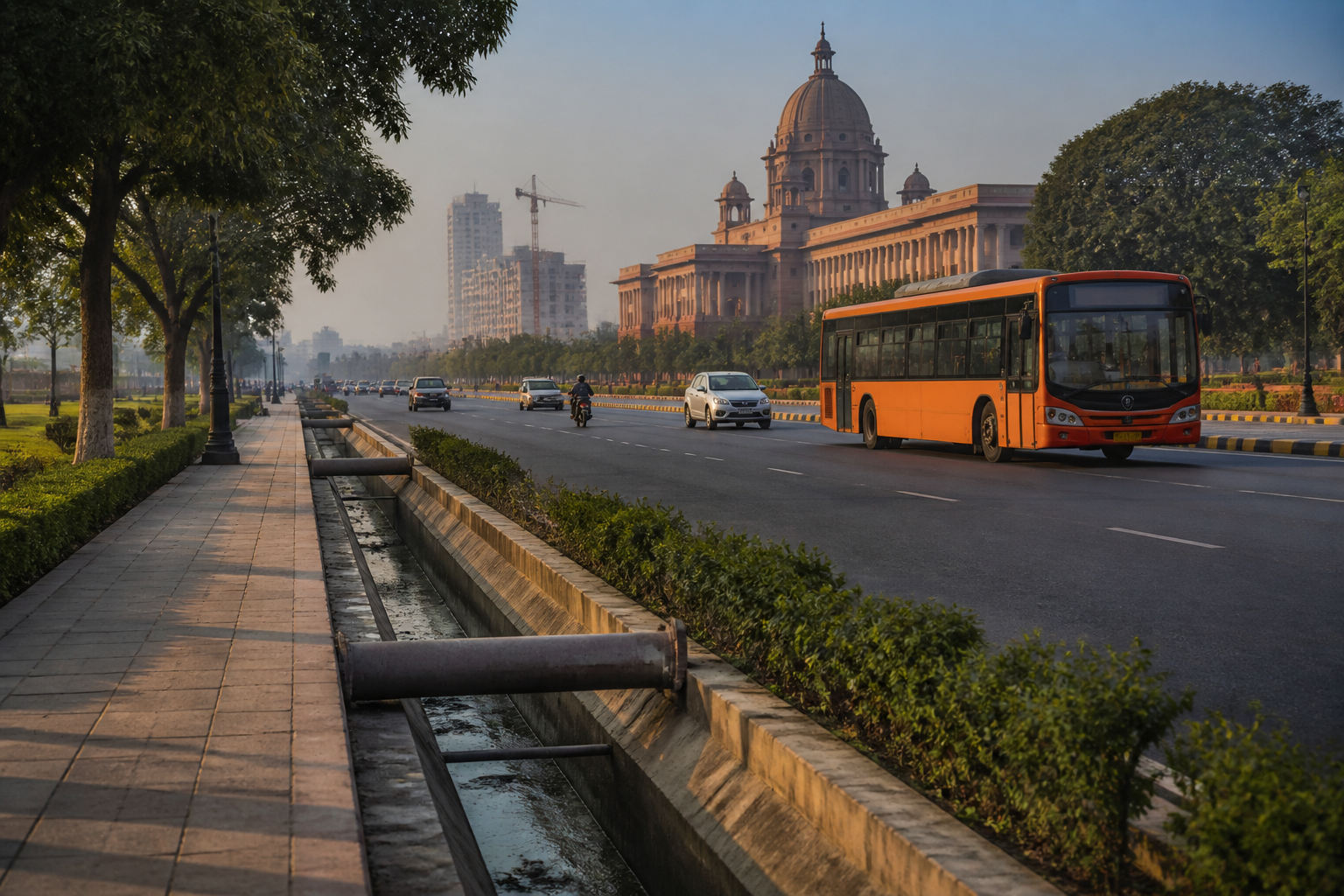
The Union ministry of home affairs’ direction to Delhi government departments to prepare five-year capital investment plans is more than a request for another round of departmental reports. It is an attempt to change how the capital identifies, sequences and coordinates infrastructure projects in a city where responsibilities are distributed across several departments and agencies.
The instruction asks departments to look beyond immediate annual requirements and identify projects that can form part of Delhi’s infrastructure pipeline for the next five years. The proposals are expected to identify areas where capital investment is most necessary and where spending can create long-term public assets. The plans will then be submitted to the MHA, which is expected to hold a high-level review meeting in the second week of October.
The immediate administrative change is a move away from planning that relies primarily on the annual budget. Annual budgeting remains necessary for allocating funds and authorising expenditure, but it can make infrastructure creation heavily dependent on short-term departmental requirements. A five-year capital plan, in principle, gives departments a longer period over which to identify major works, estimate investment needs and connect individual projects to wider public infrastructure priorities.
The supplied report does not establish the size of the proposed investment pipeline, identify specific projects that will receive funding or set out a final approval mechanism. Those details will depend on the plans prepared by the departments and the subsequent review by the MHA. What is clear at this stage is that the Centre is seeking a consolidated view of Delhi’s capital requirements across multiple sectors.
The list of departments being asked to prepare plans spans much of the city’s public infrastructure system. It includes the Public Works Department, urban development, transport, health and family welfare, education, irrigation and flood control, environment and forest, power, industries, revenue, tourism, and training and technical education departments, among others.
That range matters because the infrastructure needs of a city rarely fit within a single departmental boundary. A road project can affect drainage, transport movement and access to public facilities. New schools and hospitals require not only buildings but also land, roads, utilities and long-term maintenance. Flood protection and drainage improvements can influence roads, neighbourhood access and the safety of public assets. The report does not provide a project-by-project framework for resolving these overlaps, but the request for plans across departments creates a formal opportunity to identify them before execution.
The Public Works Department sits at the centre of Delhi’s public infrastructure push, according to the report. Its responsibilities include the construction, renovation and improvement of government buildings and other public assets, including roads and major structures under its mandate. A five-year capital plan from PWD could therefore provide a substantial part of the city’s physical infrastructure pipeline, although the supplied material does not state which assets or corridors will be prioritised.
The urban development department has a different but closely connected role. It deals with civic and urban infrastructure development and coordinates with multiple agencies when projects cut across departments. That coordination function is important because the central challenge in Delhi is not only the construction of individual assets. It is also the alignment of agencies that may control different parts of the same urban system.
Transport, health and education illustrate how the proposed planning exercise could translate sectoral responsibilities into long-term public assets. The transport department is responsible for transport-related infrastructure. The health and family welfare department oversees government healthcare infrastructure, including hospital construction and the expansion and strengthening of existing facilities. The education department handles capital investment in the construction and expansion of schools and other educational infrastructure.
These departments face different forms of demand, but the capital investment decision in each case has a long time horizon. A hospital or school requires more than an initial construction budget. It becomes part of the city’s public-service network and must be connected to surrounding neighbourhoods and supported by other infrastructure. The source material does not provide capacity figures, population projections or service-gap data, so it is not possible to assess whether the eventual departmental plans will match demand. That evidence will be necessary when the proposals are made public.
The irrigation and flood control department demonstrates another dimension of the exercise. Its responsibilities include flood protection and drainage infrastructure, including strengthening Yamuna embankments and maintaining several major drains. These are assets whose performance is linked to the wider city rather than to a single site. A long-term plan could make it easier to treat embankments, drains and related works as part of a continuing infrastructure programme instead of isolated annual interventions. However, the supplied report does not say whether the proposed plans will contain project sequencing, maintenance commitments or measurable flood-risk targets.
The institutional context is central to the MHA’s involvement. Delhi is a Union territory, and the report describes governance in the capital as being spread across multiple authorities. This multiplicity can create bottlenecks in development work, particularly when a project requires decisions, funding or implementation by more than one agency. The official quoted in the report said that the MHA is the ultimate authority for all agencies in Delhi and that its involvement could help speed up the planning exercise and support timely execution.
That assertion should be understood as an administrative expectation, not as evidence that execution problems have already been resolved. A central review can bring departments into a common planning process, but a plan by itself does not remove issues involving land, permissions, procurement, technical design, financing or agency coordination. The supplied report does not identify the specific bottlenecks that have delayed earlier projects, nor does it explain how the proposed five-year plans will be monitored once approved.
The shift from annual requirements to a five-year infrastructure pipeline also raises a sequencing question. Departments may be able to identify more projects than can be funded or executed within five years. A credible capital plan therefore has to distinguish between immediate priorities, projects requiring preparatory work and longer-term proposals. The report says departments have been asked to identify where investment is needed most and where it can create long-term assets, but it does not specify the criteria that will be used to rank competing proposals.
The same gap applies to financing. No overall budget, departmental allocation, funding formula or expenditure ceiling is provided in the source material. Without those details, the announcement should not be treated as confirmation that all projects identified by departments will receive funding. It is, at this stage, a planning and review exercise that may create a pipeline for future decisions.
The significance of the exercise will therefore depend on the quality of the information submitted by departments and the way the MHA evaluates it. If each department prepares an independent list of works, the result may simply be a larger collection of proposals. If the plans identify shared dependencies, implementation responsibilities and long-term asset needs, they could provide a more coherent basis for infrastructure decisions across Delhi.
The timing of the proposed high-level meeting in the second week of October provides the first formal milestone. Before that meeting, departments are expected to work on their respective plans and identify areas requiring capital investment. The next stage will reveal whether the process produces broad sectoral wish lists or a coordinated five-year roadmap with defined priorities.
For residents, the practical test will not be the existence of a planning document but whether it improves the delivery and reliability of public assets. Roads, government buildings, schools, hospitals, drainage systems, embankments and transport infrastructure are experienced as connected parts of the city. The MHA’s intervention recognises that these systems are planned by different departments but operate in the same urban environment.
The evidence currently confirms a change in planning direction, not yet a change in infrastructure outcomes. Delhi’s departments have been asked to prepare five-year capital investment plans, and the MHA is expected to review them at a high-level meeting in October. The key developments to monitor are the projects included, the criteria used to prioritise them, the funding arrangements, the allocation of responsibilities and the mechanisms proposed to prevent coordination bottlenecks during execution.
