


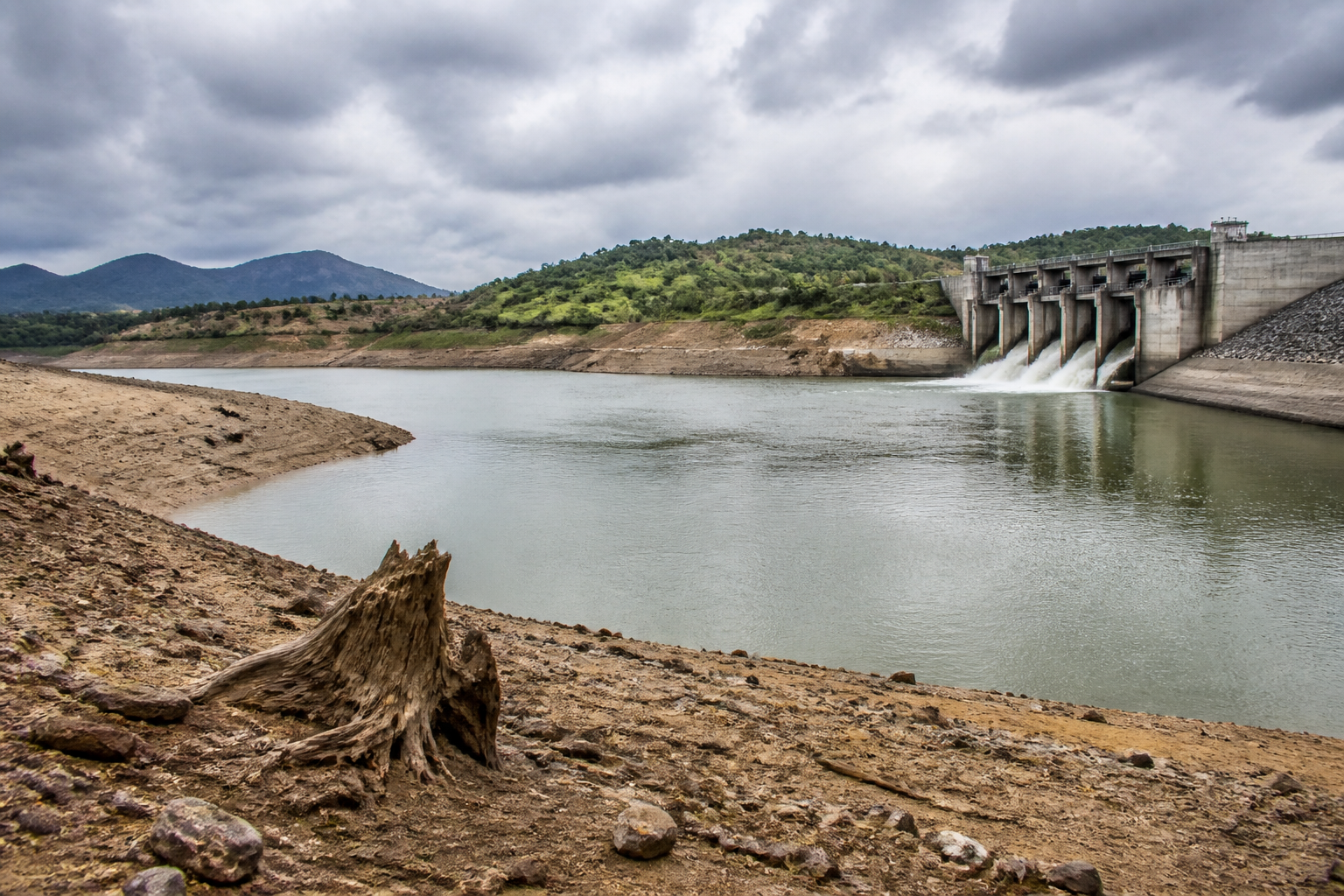
Karnataka’s 14 major reservoirs now hold about 600 TMC feet of water, down from 828 TMC feet at the same time last year, raising concern over drinking-water availability in Bengaluru and other cities as the state enters the later part of the monsoon season.
The Water Resources Department said reservoir storage has fallen to about 67% of combined capacity, compared with 92% during the corresponding period last year. The reservoirs together can store 895 TMC feet. The department has begun water management measures ahead of summer, with four months still remaining before the season begins.
Only the Ghataprabha reservoir in Belagavi district is reported to be full. The reservoir has 50.80 TMC feet of water, with an inflow and outflow of 180 cusecs each. Its maximum level is listed as 2,175 feet. The department’s figures show that storage in the other 13 reservoirs is below full capacity.
Storage levels are strongest in parts of the Krishna basin. Almatti, Narayanapura and Bhadra reservoirs each have more than 80% storage, according to the department. The Krishna basin reservoirs together hold about 80% of capacity, or 336 TMC feet. Reservoirs in the Malnad region have about 56%, or 185 TMC feet, while the Cauvery basin reservoirs have about 52%, or 59 TMC feet.
The gap with last year is especially pronounced in several large reservoirs. The Linganamakki reservoir in Shivamogga district holds 84.24 TMC feet, or 56% of its capacity, compared with 143 TMC feet last year. Its current inflow is 1,713 cusecs and its outflow is 6,864 cusecs. The Supa reservoir in Uttara Kannada has 83.99 TMC feet, or 58% of capacity, against 127.40 TMC feet last year. It is receiving 889 cusecs and releasing 2,560 cusecs.
The Hemavathi reservoir in Hassan district is among the most depleted, with 15.15 TMC feet, or 41% of capacity, compared with 33.83 TMC feet last year. Its inflow is 802 cusecs and its outflow is 300 cusecs. Harangi in Kodagu has 6.28 TMC feet, or 74% of capacity, compared with 8.40 TMC feet last year.
The Bhadra reservoir in Chikkamagaluru holds 58.19 TMC feet, or 81% of capacity, against 69.35 TMC feet last year. Narayanapura in Yadgir has 28.17 TMC feet, or 85% of capacity, compared with 31.46 TMC feet last year. Narayanapura is receiving 9,684 cusecs and releasing 440 cusecs.
Five reservoirs listed in the report have no current inflow: Malaprabha, Tungabhadra, Varahi and others included in the department’s assessment. Malaprabha has 21.42 TMC feet, or 57% of capacity, and is releasing 194 cusecs. Tungabhadra has 71.87 TMC feet, or 68% of capacity, with no inflow and an outflow of 9,221 cusecs. Varahi has 17.08 TMC feet, or 55% of capacity, and is releasing 1,065 cusecs.
The lower storage levels have already prompted concern about possible water stress in several locations. The report said a similar situation two years ago led to shortages in reservoirs and drinking-water difficulties in Bengaluru and other cities. The Water Resources Department is now managing supplies ahead of summer, when urban demand and dependence on stored water are expected to become more significant.
