


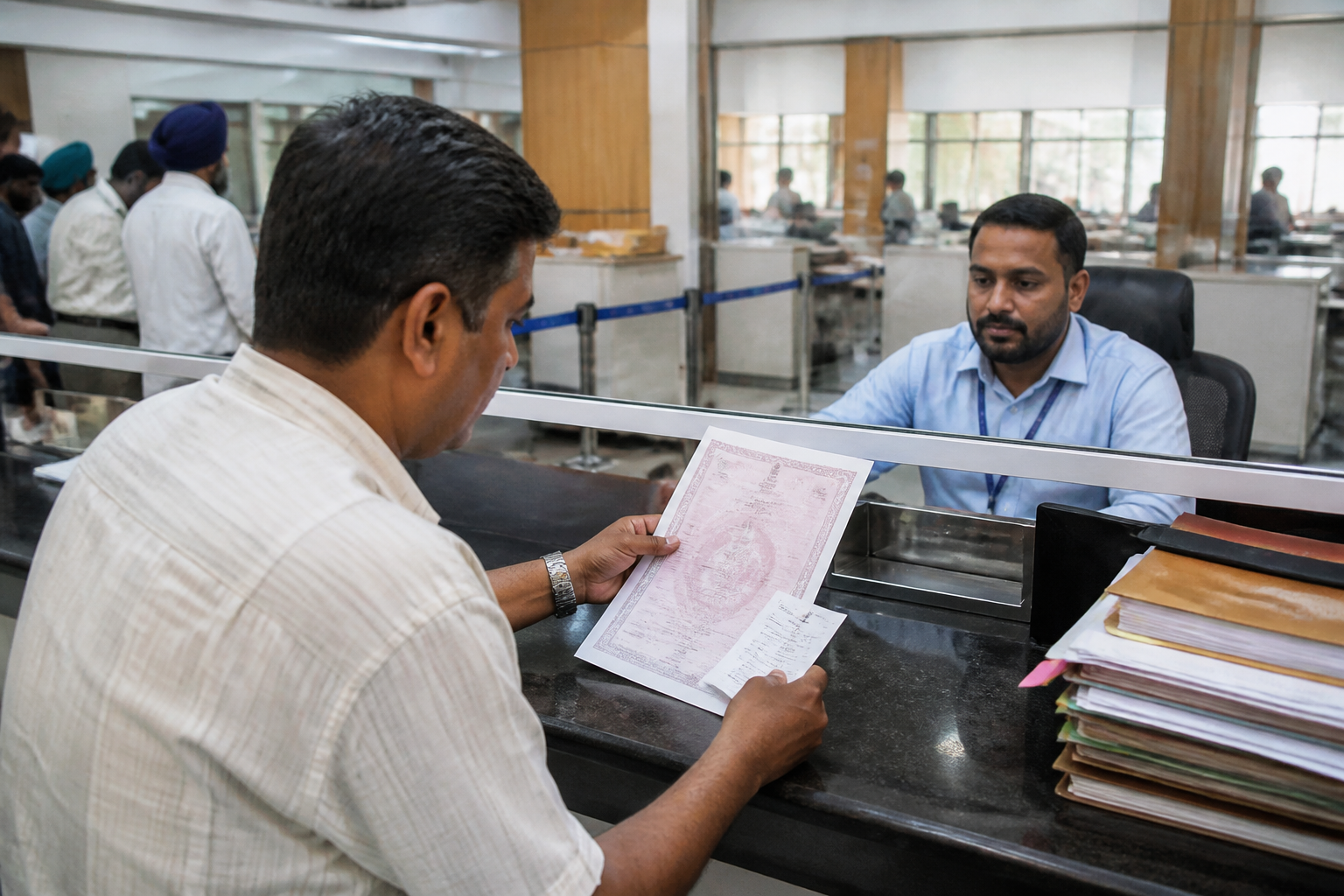
Chandigarh residents buying a Rs 5 non-judicial stamp paper at a Sampark Centre are being charged nearly Rs 21, with application and facilitation fees adding Rs 15.97 to the stamp’s face value, according to a charge breakup cited by a city resident.
The total payable amount is Rs 20.97. The additional charges comprise Rs 2.66 as an application-form charge and Rs 13.31 as facilitation charges. Together, these fees amount to 319.4% of the stamp paper’s value.
The charge structure has prompted a representation to the Chandigarh UT Administrator seeking a review of the legality and rationale of the additional fees. The representation was submitted by city-based advocate Ajay Jagga, who is also a member of the administrator’s advisory council.
Jagga questioned whether a public service delivery centre can impose charges over and above the value of a stamp paper. He said the issue involved proportionality, transparency and financial accountability, besides raising questions about whether Sampark Centres were specifically authorised to sell stamp papers.
According to the representation, Rule 28(vii) of the Punjab Stamp Rules, 1934, as applicable to Chandigarh, states that a stamp vendor cannot demand or accept consideration exceeding the value of the stamp. The rule also provides for remuneration of stamp vendors through the discount authorised by the government, Jagga said.
The representation also refers to Rule 34(iii), which provides for a discount or commission to licensed and specially licensed vendors on the value of non-judicial stamps purchased from an ex-officio vendor. Jagga has argued that if the existing rules provide a mechanism for remunerating licensed stamp vendors, the basis for charging residents separate application and facilitation fees needs to be clarified.
The dispute places a small-value public transaction within a larger administrative question: how service-delivery charges are structured, disclosed and authorised when citizens use government-linked facilitation centres. The report does not establish whether the fees have been found unlawful by any authority. It records a citizen’s challenge and a request for examination by the UT administration.
The representation has sought scrutiny of both the legal basis and the rationale for the additional charges, particularly in the context of e-governance. Sampark Centres are intended to provide access to government-related services, and the complainant has argued that such systems should simplify transactions and reduce the costs of accessing public services.
The next step rests with the UT administration, which has been asked to examine the applicable rules, the authority under which the charges are levied and the basis for the fee breakup presented to residents.
