


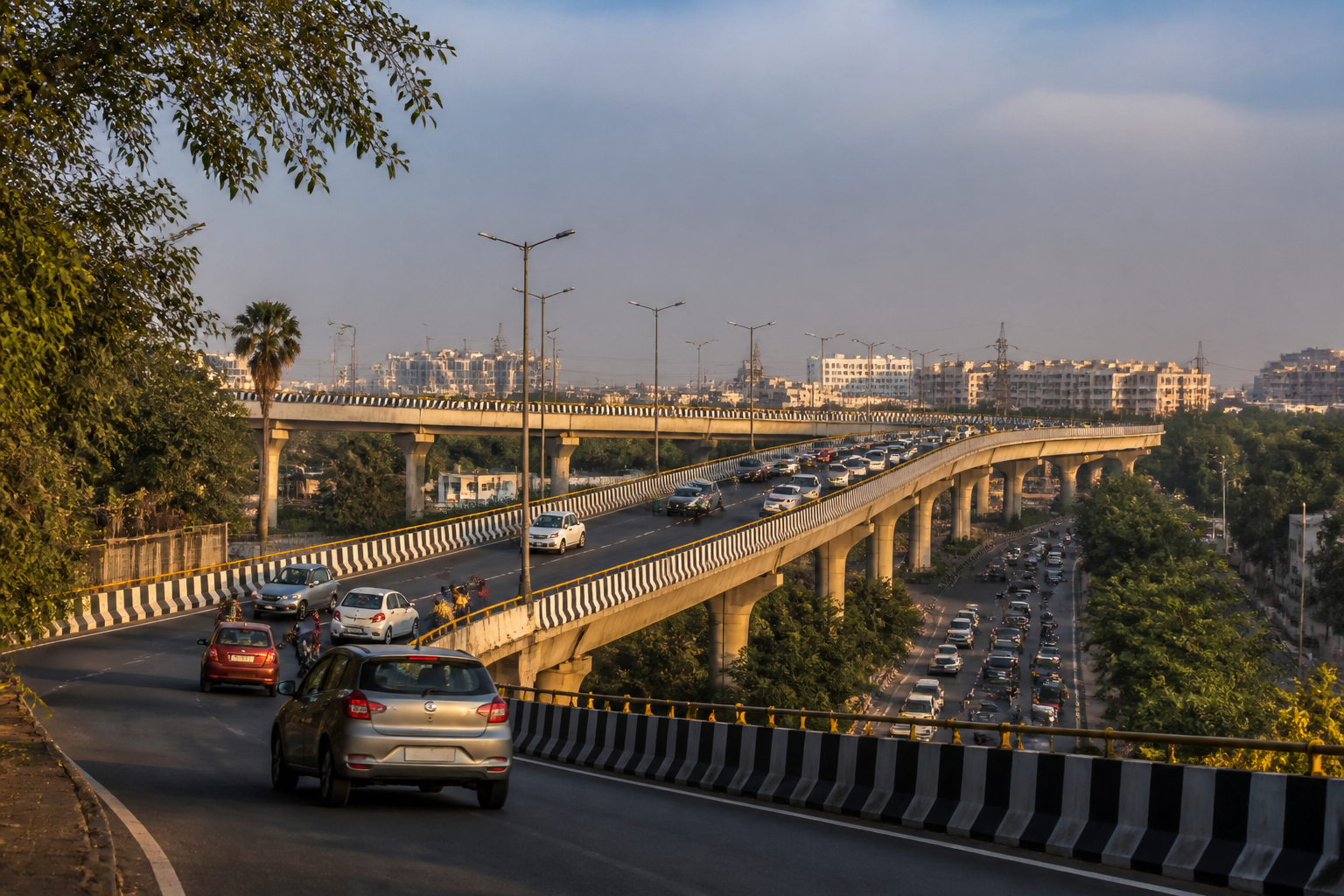
The Barapullah Phase III elevated corridor is set to give commuters between Noida, Ghaziabad and South Delhi an alternative to the DND–Ring Road route, potentially reducing the volume of traffic converging at Sarai Kale Khan. Its significance lies less in adding another road than in separating journeys that currently depend on the same overloaded network.
The corridor is expected to allow vehicles travelling between the eastern side of the Yamuna and South Delhi to cross the river without first joining the Ring Road. Commuters from Noida and Ghaziabad who currently use the DND and then approach Sarai Kale Khan may be able to take the Barapullah route instead. Vehicles travelling in the opposite direction would also have an alternative route towards Noida, Ghaziabad, Mayur Vihar and Akshardham.
That change addresses a specific weakness in Delhi’s road network: the concentration of different traffic streams at a small number of junctions and corridors. The supplied report does not describe the problem as a simple shortage of lanes. It shows how vehicles travelling to different parts of the city are funnelled into the same links before crossing the Yamuna or continuing towards South Delhi.
### The congestion problem is about convergence
Around 11 lakh vehicles from the National Capital Region enter Delhi every day, according to the figures cited in the report. Nearly five lakh of these come from Noida and Ghaziabad. An estimated three to four lakh vehicles currently use the eastern corridor, including the DND, National Highway 9/National Highway 24 and the Akshardham–Ring Road stretch, to enter South Delhi.
These numbers explain why Sarai Kale Khan remains vulnerable to congestion even when there is no single incident blocking the road. The Ring Road around the area is four lanes, while the DND is a six-lane approach. Traffic from the DND, Akshardham and other eastern routes enters the same broader network, creating a concentration point for vehicles with different origins and destinations.
The result is a corridor that remains busy through much of the day rather than only during the morning and evening peaks. The issue, as described by traffic officials, is not simply how many vehicles use the roads but where their routes merge.
Additional Commissioner of Police D K Gupta said the key difference was “not merely the addition of another road, but the creation of an alternative route for vehicles that currently converge on the Ring Road”. He said the corridor would be beneficial for the public.
A traffic official cited in the report said vehicles travelling from INA towards Mayur Vihar, Noida and Ghaziabad would be able to use the Barapullah corridor to cross the Yamuna instead of moving towards Sarai Kale Khan and the DND Road. The same route logic would apply to vehicles travelling from the eastern side towards INA and South Delhi.
### Barapullah Phase III changes the route choice
For a vehicle travelling from Noida towards South or Central Delhi, the existing journey may involve taking the DND before joining the Ring Road. A vehicle from the Akshardham side enters the same network. In the reverse direction, vehicles leaving South Delhi for Noida and Ghaziabad use the Ring Road before reaching the DND or other eastern routes.
The proposed benefit of Barapullah Phase III is that some of these trips can avoid the Ring Road altogether. That does not mean every vehicle will shift to the elevated corridor, nor does it mean congestion will disappear. The value of the project is that it creates another path for journeys that do not necessarily need to pass through Sarai Kale Khan.
This distinction matters in assessing urban road projects. A new corridor can improve traffic conditions without carrying all traffic or eliminating congestion across the surrounding network. Its immediate function may be to prevent additional vehicles from entering an already heavily loaded section.
Gupta said the aim was not to eliminate congestion on the corridor because of the enormous traffic volumes it handles. Instead, the objective was to reduce the additional pressure created by vehicles that do not need to use it. He said the impact could be particularly visible around Sarai Kale Khan, where traffic from the DND, Ring Road and other approaches comes together.
The supplied report does not provide a projected reduction in vehicle numbers on the Ring Road, a travel-time estimate or a detailed operating schedule for the corridor. Those figures will be necessary to assess whether the route redistribution produces a measurable change after opening.
### An alternative to adding capacity at the bottleneck
The project also reflects a broader approach to managing urban traffic. When congestion appears on a major road, the usual response is often to consider widening the road or adding lanes. But the Barapullah example shows why capacity alone may not address a network problem. If multiple routes continue to feed the same corridor, additional lanes can remain under pressure.
Here, the intervention is designed to alter the pattern of movement before traffic reaches the bottleneck. Vehicles from the eastern side of the Yamuna that are bound for South Delhi would have another crossing and another connection. The project therefore works as a network intervention rather than only as a piece of elevated infrastructure.
That does not remove the need to examine the approaches to the new corridor. If traffic shifts from the DND and Ring Road but begins to concentrate at entry points to Barapullah Phase III, the location of congestion could change rather than disappear. The available report does not establish whether such a shift will occur, and no independent traffic performance data is supplied.
The immediate question for road agencies and traffic managers will be whether the new route is legible and convenient enough for drivers to use. The report identifies the Noida Link Road and the connections between INA, Mayur Vihar, Noida and Ghaziabad as part of the intended movement pattern. How effectively these links operate together will influence the corridor’s practical usefulness.
### A project with regional commuter consequences
The corridor’s catchment extends beyond a single neighbourhood. Noida and Ghaziabad commuters form a substantial share of the vehicles entering Delhi, while South Delhi destinations such as INA attract traffic from the eastern side of the Yamuna. Sarai Kale Khan is where these flows interact with the DND, Ring Road and other approaches.
For commuters, the potential benefit is not only a shorter route. It is the possibility of avoiding a section where delays are produced by the interaction of several traffic streams. The route could provide more direct movement between eastern Delhi and South Delhi, although the supplied material does not quantify how much time individual journeys could save.
For the wider road network, the proposed gain is more limited but still significant: fewer vehicles feeding into a corridor that already carries heavy traffic for much of the day. This is a redistribution strategy. Its success will depend on how much traffic changes route and whether the connecting roads can accommodate that movement.
The figures cited in the report also show the scale of the challenge. With around 11 lakh NCR vehicles entering Delhi daily and nearly five lakh coming from Noida and Ghaziabad, even a partial shift could have network-level effects. At the same time, the estimated three to four lakh vehicles using the eastern corridor indicate that demand is large enough for congestion to persist even after an alternative becomes available.
### What remains to be established
The opening of Barapullah Phase III creates a new option in Delhi’s east–south movement network, but the available evidence does not yet establish its actual traffic impact. The report does not state the opening date, the corridor’s operating conditions, expected daily capacity, toll or access arrangements, or the projected number of vehicles likely to shift from the DND and Ring Road.
Those details will determine whether the project delivers a visible reduction at Sarai Kale Khan or mainly provides another route within an already crowded system. Traffic counts before and after opening, travel-time comparisons and monitoring of the approach roads will be needed to distinguish between genuine decongestion and the relocation of queues.
For now, the confirmed urban logic is clear. Barapullah Phase III is intended to reduce pressure not by solving all congestion on the Ring Road, but by allowing some Noida, Ghaziabad, Mayur Vihar and eastern Delhi traffic to cross the Yamuna without entering the Sarai Kale Khan network. The next important milestone will be the corridor’s operation and the traffic data showing whether commuters actually shift to it.
