


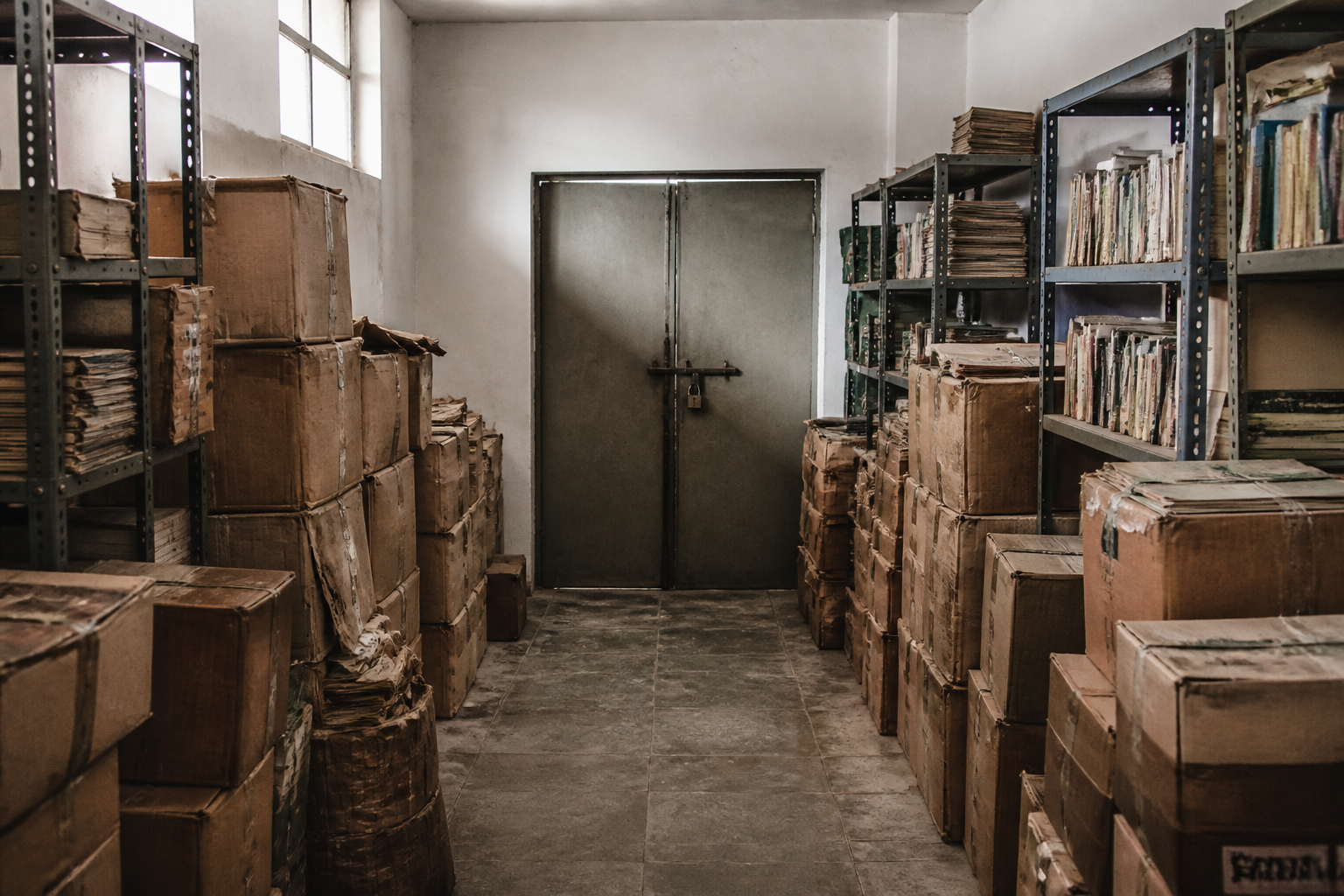
More than two lakh books belonging to Delhi’s Tulsi Sadan Library have remained largely locked in cartons for 15 years, turning a temporary relocation caused by Delhi Metro construction into a prolonged failure of public cultural infrastructure. The library’s uncertain future is now linked to the wider Central Vista redevelopment, which is reshaping the government district and requires the movement of several existing offices and institutions.
The collection was earlier housed at Bahawalpur House on Bhagwan Das Road, within the premises of the National School of Drama. The regional languages section was shut in 2011 for construction of the Delhi Metro station at Mandi House. Since then, most of the collection has been stored in one room on the first floor of an office complex in R K Puram. Access to the room is through the office of the Central Adoption Resource Authority, according to a report by The Indian Express.
Tulsi Sadan Library was opened in 1972 to commemorate 400 years of the Ramcharitmanas. Its collection covered 14 Indian languages: Assamese, Bengali, Gujarati, Hindi, Kannada, Kashmiri, Malayalam, Marathi, Oriya, Punjabi, Sanskrit, Tamil, Telugu and Urdu. The books included literary classics and formed the regional languages section of the Central Secretariat Library, which is administered by the Union Ministry of Culture.
The central issue is not simply that a library was moved for infrastructure work. It is that a temporary logistical decision was not followed by a clearly completed institutional transition. The Culture Ministry’s annual reports recorded a sequence of expected reopenings, but the library remained substantially inaccessible years after the metro construction was reported as complete.
The ministry’s 2011-12 annual report said the library had been closed temporarily from August 2011 because of construction of the new Metro station at Mandi House. The 2014-15 report said Delhi Metro Rail Corporation construction had been completed and that action was under way to reconstruct the building. In 2015-16, the ministry said the library would be opened shortly because the National School of Drama was constructing a new building on the same premises.
The wording changed in later years without resolving the underlying problem. The ministry’s 2022-23 annual report said the library had been closed since 2010 due to construction of Delhi Metro. The differing dates in the reports themselves — August 2011 in one account and 2010 in another — illustrate how a prolonged closure can become administratively blurred over time, even when the public-facing consequence remains clear: the collection has not returned to regular public use as a whole.
Photographs reviewed by The Indian Express showed the storage room in a state of disrepair, with books inside cartons bearing the logo of Agarwal Packers and Movers. The report said that when the room was visited on September 18, its door was locked and carried a notice identifying it as the Tulsi Sadan Library store. These details indicate that the books were not merely shifted to an alternative reading facility; much of the collection was placed in storage with limited access.
There have been partial efforts to restore access. A limited number of books from the Assamese and Kannada sections were retrieved when those sections were reopened by then Minister of State for Culture Meenakashi Lekhi on December 25, 2023. On March 11, 2025, the Hindi section was partially reopened at the Central Secretariat Library in Shastri Bhawan. The available information, however, does not establish that the full collection has been catalogued, relocated or made accessible to readers.
That distinction matters because a library is not only a room containing books. Its public function depends on access, cataloguing, reading space, staff, preservation systems and a stable institutional address. A collection can technically remain in government custody while becoming functionally unavailable to researchers, students and readers. In this case, the evidence supplied by the ministry’s reports and the reported condition of the storage room points to a gap between possession of the books and delivery of a library service.
The Tulsi Sadan case also exposes a recurring administrative weakness in urban infrastructure projects: relocation is often treated as a construction activity rather than as a continuity obligation. When land or buildings are required for transport projects, institutions may be moved out quickly because the project has a defined construction schedule. The replacement facility, by contrast, may depend on separate decisions, budgets, permissions and coordination between agencies. If those steps are not assigned a firm completion responsibility, “temporary” accommodation can become the default arrangement.
The Mandi House station construction created the first displacement. The later redevelopment of the Central Vista has created a second layer of uncertainty for the Central Secretariat Library. The CSL, described in the report as one of the Central government’s oldest libraries, was founded in 1891. Its shifting is now part of a larger redevelopment plan involving the construction of 10 new Secretariat buildings after the demolition of several existing office complexes, including Shastri Bhawan, Krishi Bhawan, Nirman Bhawan and Udyog Bhawan.
This places the library within a much larger public-infrastructure programme. Central Vista is not only changing roads, buildings and office locations; it is also affecting the institutional geography of government services and cultural resources. When an older library is moved as part of that process, its future depends on whether cultural infrastructure is planned with the same specificity as office accommodation and construction packages.
The supplied evidence does not establish the full funding structure for Tulsi Sadan’s relocation, the current condition of every book, or the precise timetable for reopening the entire regional languages collection. It does, however, establish a documented sequence: the library was closed for metro construction, its collection was moved into storage, successive ministry reports referred to reconstruction or an imminent reopening, partial sections later reopened elsewhere, and the broader movement of the Central Secretariat Library is now linked to Central Vista redevelopment.
The numbers underline the scale of the institutional loss. This is not a small neighbourhood collection that can be restored through a routine room change. More than two lakh books across 14 languages represent a substantial public cultural archive. The longer such material remains boxed and inaccessible, the more difficult it becomes to verify its physical condition, maintain an accurate catalogue and preserve the connection between the collection and the readers for whom it was assembled.
The case also complicates the meaning of progress in a city. A new metro station can improve mobility and a new government district can reorganise administrative space. But the urban value of those projects cannot be assessed only through construction completion. Public institutions displaced by infrastructure must also have a visible path to continuity. Otherwise, the city gains a new physical asset while losing access to an older civic resource.
For Delhi, the larger question is whether project planning treats libraries and cultural collections as movable property or as functioning public infrastructure. Roads, stations and office buildings have identifiable construction milestones. Libraries require additional milestones: collection inventories, safe storage, staffing, access arrangements, reopening dates and accountability for the transition. The history of Tulsi Sadan suggests that those requirements were not resolved within the period covered by the ministry’s annual reports.
The immediate facts therefore remain both limited and significant. Sections in Assamese, Kannada and Hindi have seen partial reopening, but the supplied material does not confirm the restoration of the full collection. The Central Secretariat Library is also being moved within the broader Central Vista redevelopment. The next meaningful measure of progress will be whether the authorities provide a documented plan for the books’ preservation, relocation and complete public access, rather than another temporary storage arrangement.
