


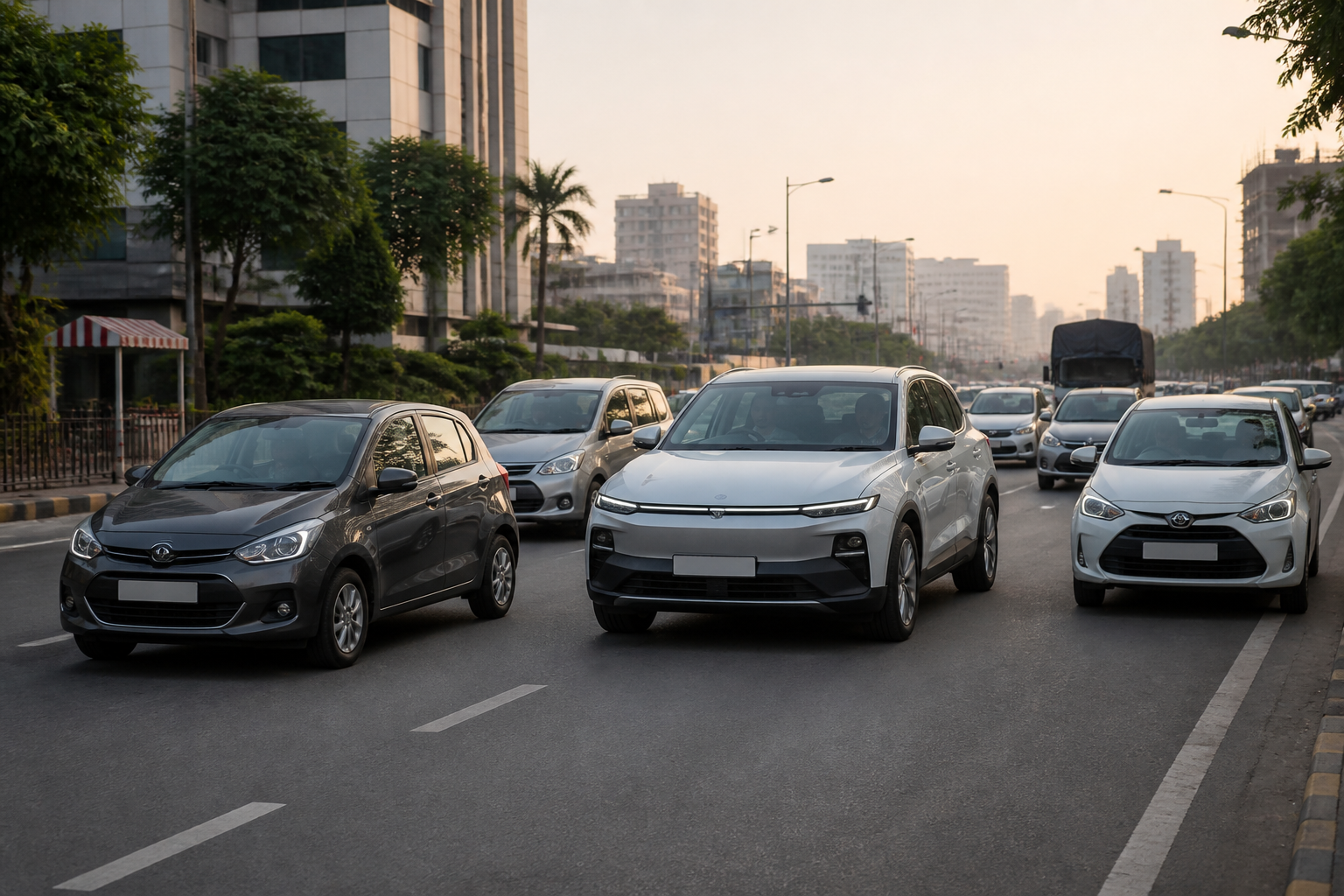
India’s final CAFE III norms tighten passenger-vehicle efficiency targets by nearly 17 per cent through FY32, but the framework also gives manufacturers multiple ways to reduce their compliance burden without relying exclusively on battery-electric vehicles. The result is a rulebook that simultaneously pressures automakers to lower fleet emissions and preserves considerable room for petrol, diesel, hybrid, CNG and ethanol technologies.
Notified by the Ministry of Power on September 29, the norms replace the September 2025 draft and alter the distribution of pressure across manufacturers. The final weight formula is more forgiving for lighter fleets than the draft, while becoming tighter for heavier fleets. At the reference fleet weight of 1,229 kg, the target declines from about 94.8 grams of carbon dioxide per kilometre in FY28 to 78.9 grams per kilometre in FY32.
These are manufacturer-level fleet averages, not limits imposed on individual models. That distinction is important. A company can continue selling vehicles with different efficiency levels as long as the average performance of its qualifying fleet meets the applicable target, supported by credits and other adjustments allowed under the rules.
The design of CAFE III therefore makes fleet composition central to compliance. Automakers with lighter vehicles may face less pressure from the revised formula, while manufacturers whose sales are concentrated in heavier conventional sport utility vehicles will have to find more ways to offset their calculated emissions.
The weight formula has changed the relative position of different portfolios. Compared with the September draft, a 909 kg average fleet receives about 9 per cent more allowance in FY28 and nearly 17 per cent more in FY32. At 1,800 kg, however, the final standard is about 1.8 per cent tighter in FY28 and 4.6 per cent tighter in FY32.
That creates an advantage for manufacturers with lighter products, although the benefit is not automatic. Maruti Suzuki’s portfolio, for example, is weighted towards lighter cars and is supplemented by CNG models and strong hybrids. Renault and Nissan also have relatively light products. But a growing share of heavier SUVs could reduce that advantage because compliance depends on the average weight and sales mix of the fleet.
Compact SUVs cannot be placed in a single winners-or-losers category. Their effect on compliance will depend on their weight, certified fuel consumption, powertrain and sales volume. The final rules make those variables more important because the same vehicle technology can have different consequences depending on how extensively it is sold and how it affects the manufacturer’s fleet average.
Manufacturers with heavier conventional SUV portfolios face greater pressure under the revised curve. Mahindra, however, has another compliance route through electric SUVs, which can lower its calculated fleet consumption. Tata Motors has a combination of small cars, CNG vehicles and electric models, while Toyota can draw on its strong-hybrid portfolio. The structure of the rules gives each company a different mix of tools rather than imposing a single technology pathway.
The most powerful of those tools is the credit system for electrified vehicles. Battery-electric vehicles and range-extended electric vehicles receive a three-times volume multiplier. In practical terms, 10,000 qualifying vehicles would count as an effective 30,000 units for that part of the compliance calculation. Plug-in hybrids and flex-fuel strong hybrids receive a 2.5-times multiplier, conventional strong hybrids receive 1.6 times and flex-fuel ethanol vehicles receive 1.1 times.
The final rules reduce the strong-hybrid multiplier from two times in the September draft to 1.6 times. Hybrids nevertheless retain the benefit of their inherent fuel efficiency and, where applicable, the allowance linked to ethanol. This gives manufacturers an incentive to use a portfolio of technologies rather than move immediately towards battery-electric vehicles across all segments.
That flexibility is at the centre of the debate over how demanding CAFE III will be in practice. Amit Bhatt, managing director at the International Council on Clean Transportation, said the headline stringency was real but that “the flexibilities stack up”. He said super credits, carbon-neutrality factors and technology credits could make actual reductions in fuel use and emissions considerably smaller than the headline targets suggest.
The fuel-related adjustments extend beyond electrified vehicles. E20 or higher petrol vehicles, including strong hybrids and plug-in hybrids, receive an 8 per cent carbon-neutrality factor on tailpipe carbon dioxide. Flex-fuel ethanol vehicles receive 22.3 per cent, while CNG receives 5 per cent or the notified compressed-biogas blending percentage, whichever is higher. Diesel receives a benefit corresponding to its actual notified biofuel blend.
Manufacturers can also claim another 1 gram of carbon dioxide per kilometre for each eligible efficiency technology, subject to a ceiling of 9 grams per kilometre. The 12 eligible technologies include start-stop systems, regenerative braking, six-speed transmissions, micro-hybrids, LED lighting and electric water pumps.
For the first FY28-FY30 compliance block, the technology savings can be based on manufacturers’ self-declarations. Validated test results become mandatory during FY31-FY32. This creates an implementation distinction within the same regulatory framework: early compliance calculations will rely more heavily on declarations, while later calculations will require validated testing.
The effect is to make CAFE III both a fuel-efficiency regulation and a system for assigning value to different technologies and fuels. Battery-electric vehicles receive the strongest volume multiplier, but combustion-based technologies can still receive several forms of regulatory support. A company’s outcome will depend not only on the efficiency of its vehicles but also on the way the rules recognise fuel composition, technology deployment and fleet sales.
The framework also introduces a clearer market mechanism for missed targets. Manufacturers can trade compliance credits with one another and carry credits and debits within a compliance block. Unused surplus credits expire at the end of the block. Companies that retain a deficit can buy credits from the Bureau of Energy Efficiency.
The BEE price rises from ₹2,500 per gram of carbon dioxide per kilometre in FY28 to ₹4,500 in FY32. A 1 gram-per-kilometre deficit across 100,000 vehicles would therefore imply a ₹25 crore credit buyout at the FY28 rate, before other offsets. The mechanism places a direct financial value on non-compliance, although the availability of credits and permitted adjustments will shape the actual cost for each manufacturer.
This tradability also changes the competitive structure of the rules. A company with a portfolio of vehicles that earns surplus credits may be able to transfer them to another manufacturer, while a company facing a deficit can use the market rather than immediately redesigning its entire product range. The system therefore encourages compliance at the industry level, but it may not impose the same technology transition on every manufacturer.
The unresolved transition from the Modified Indian Driving Cycle to the Worldwide Harmonized Light Vehicles Test Procedure could prove equally important. From April 2027, manufacturers must report each model’s performance under both testing systems. The Ministry of Power will separately notify the conversion factor for moving CAFE targets from MIDC to WLTP after receiving testing data.
That conversion factor, along with certification methods and the measurement of biofuel benefits, will determine how the targets translate into reported vehicle performance. Until those details are notified, the headline figures provide a clear direction of travel but not the entire compliance burden faced by each model or manufacturer.
The broader urban significance of CAFE III lies in how vehicle regulation shapes the composition of India’s growing passenger-vehicle fleet. The rules connect consumer vehicle choices, manufacturer sales strategies, fuel policy and emissions performance through a single fleet-average system. They also show that electrification policy is not operating in isolation: hybrids, CNG, ethanol, biofuels and efficiency technologies have all been built into the compliance architecture.
The evidence supplied with the final notification supports two conclusions. First, the industry-wide efficiency target is tightening progressively through FY32, with heavier fleets facing greater pressure under the final weight curve. Second, the available credits and adjustments could reduce the real-world emissions reduction associated with the headline target, particularly if manufacturers rely heavily on combustion-engine technologies and regulatory multipliers.
The next milestones are the dual reporting requirement from April 2027 and the Ministry of Power’s notification of the MIDC-to-WLTP conversion factor. Those decisions, together with validated testing from FY31, will determine how demanding CAFE III becomes in implementation rather than on paper alone.
