


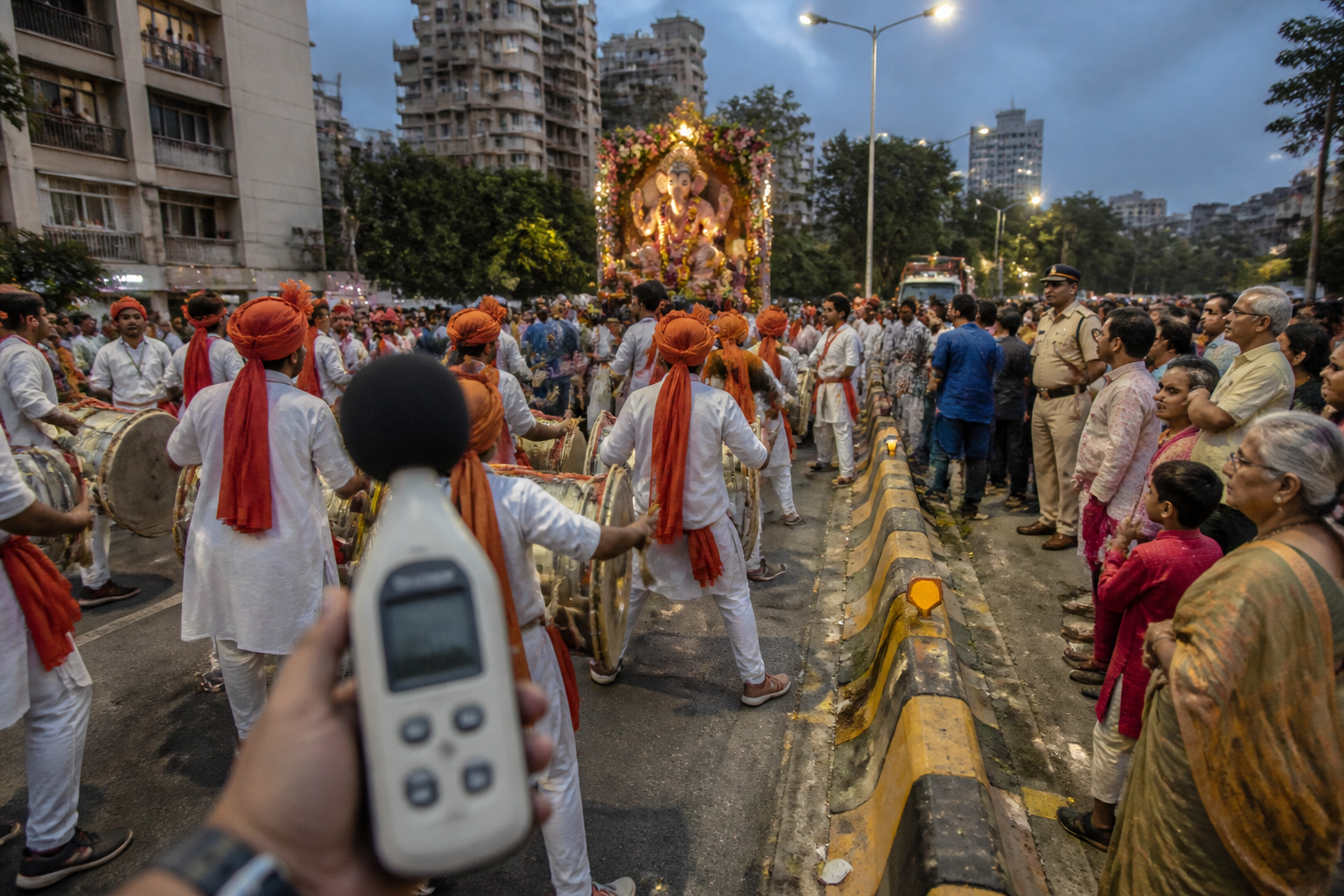
Navi Mumbai Police has claimed that no Ganesh immersion procession breached prescribed noise limits, while residents have reported distress caused by loud firecrackers and dhol-tasha performances across parts of the city. The conflicting accounts have raised questions about how noise levels were measured and how citizen complaints were recorded during the festivities.
According to the police, no Ganesh mandal was found to have crossed the permitted decibel limit during the immersion processions. The force said it used sound-level meters to monitor noise and therefore did not find grounds to register a noise pollution case against any organiser.
The police had earlier instructed Ganesh mandals to follow noise restrictions after directions issued by the Bombay High Court. The instructions included avoiding DJs and high-volume sound systems, as well as informing organisers about court orders concerning the bursting of firecrackers in public places.
Police officials said Navi Mumbai’s Ganesh mandals responded to appeals from the municipal corporation, police and local elected representatives. They claimed that organisers avoided DJs, limited the use of loud dhol-tasha performances and refrained from using firecrackers at high volume, resulting in orderly processions that complied with the rules.
Some residents, however, have questioned this assessment. Citizens from different parts of Navi Mumbai said loud firecrackers were burst during the immersion period and that dhol-tasha performances were audible at high volume in some locations. The reported disturbance was particularly difficult for senior citizens, young children and people who were unwell, according to the complaints cited in the report.
A member of a reputed institution, speaking on condition of anonymity, claimed that the sound from dhol-tasha performances exceeded 80 decibels. The person also said that several senior citizens, including members of the institution, experienced discomfort because of the noise.
The dispute centres on the difference between official monitoring records and residents’ direct experience. The police have said that their measurements did not show any violation, while citizens have described episodes of loud sound that they believed crossed acceptable limits. The report does not provide the police’s individual sound-level readings, the locations where measurements were taken or the duration of each monitoring exercise.
The absence of a direct complaint registered with the police has also become relevant to the issue. Residents reported being affected by the noise, but the source report does not identify a formal complaint or case linked to a specific procession or organiser. That leaves the enforcement record dependent on the measurements conducted by the authorities during the events.
For Navi Mumbai, the episode highlights the practical challenge of enforcing noise rules during large public processions. Compliance depends not only on instructions issued to organisers, but also on the timing and location of measurements, the documentation of readings and the ability of residents to report violations while an event is under way. Police monitoring and the next steps, if any complaints are formally filed, will determine whether the reported gap between official records and public experience is examined further.
