


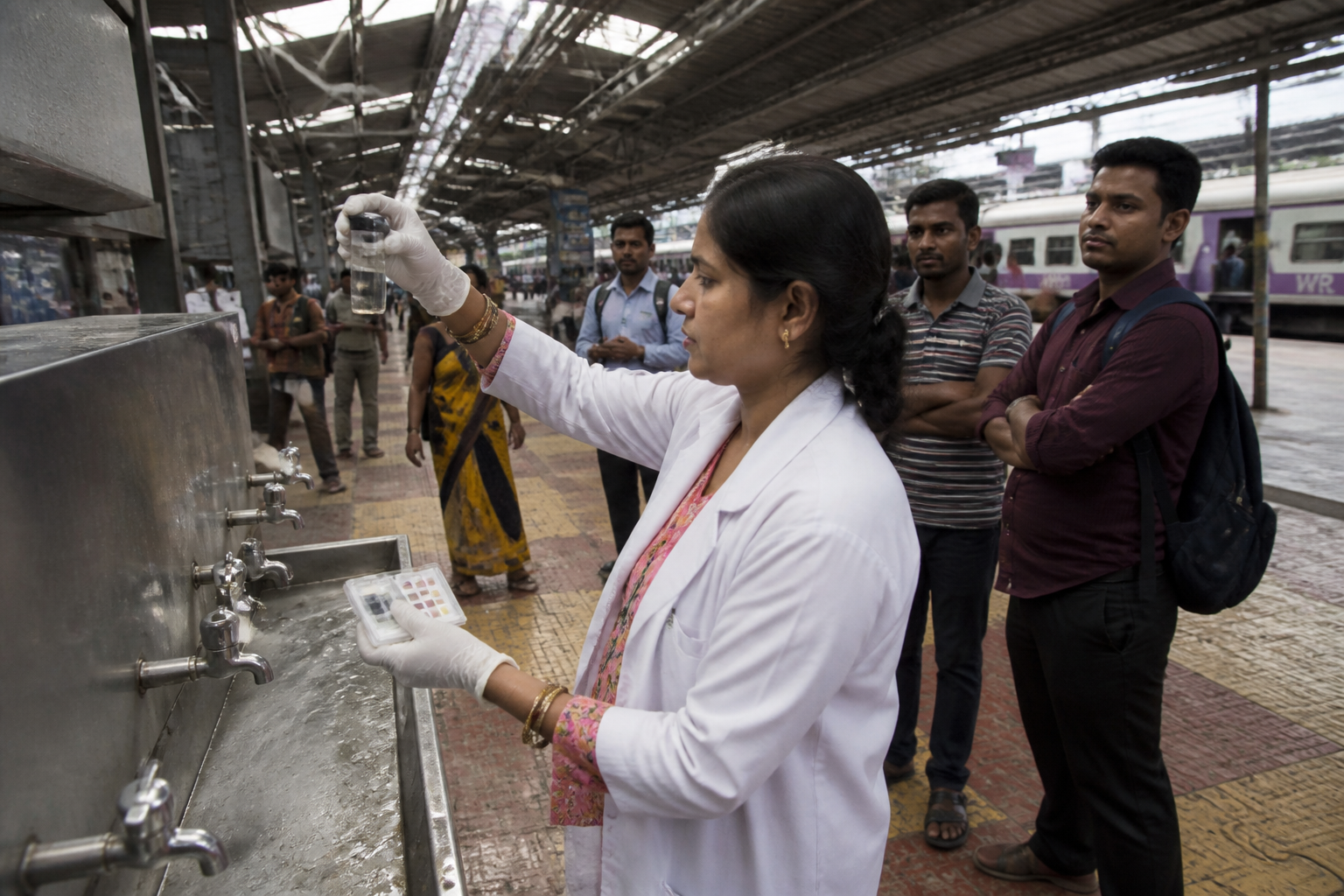
Western Railway’s medical department carried out more than 1,000 chlorine tests and checked 276 drinking-water samples at railway stations between 9 and 15 September, as concerns over the safety of station water came under scrutiny following a Comptroller and Auditor General of India report.
The seven-day inspection campaign was intended to assess the quality of drinking water available at Western Railway stations, according to a report by Loksatta. The report does not provide the results of the 276 sample checks or identify the stations where individual samples were collected.
The testing follows concerns raised in a recent CAG report about drinking-water quality at railway stations in different parts of the country. The report cited by Loksatta found harmful bacteria, including E. coli, in samples collected from water coolers at some stations. It also pointed to issues such as irregular cleaning of water coolers and sediment accumulation.
Among the locations identified in the report were Chhatrapati Shivaji Maharaj Terminus, Kalyan, Bhiwandi Road and Lonavala, all associated with the Central Railway network. These findings prompted attention to the maintenance of water coolers, storage tanks and the systems through which water reaches passengers.
The Western Railway campaign is significant because chlorine testing and laboratory sample checks serve different functions. Chlorine testing can be used to monitor disinfection levels, while sample analysis is required to assess broader water-quality parameters. The report supplied by Loksatta confirms that both forms of checking were undertaken, but it does not state whether any sample failed or what remedial action followed at specific stations.
The CAG-linked concerns have also led the Central Railway board to plan a tank-to-tap filtration system at 20,000 locations, according to the report. The proposed measures include installing systems to monitor water quality at water coolers and replacing old and deteriorated storage tanks in phases.
For railway passengers, the issue extends beyond the availability of drinking-water points. It involves the full maintenance chain: storage, filtration, disinfection, cooler cleaning, sampling and the communication of water-quality information. A functioning water point may therefore not by itself establish that the water is consistently safe unless maintenance and testing are carried out through a documented system.
The Western Railway inspection was completed on 15 September. The supplied report does not include the campaign’s final findings, details of corrective action or a station-wise account of the samples tested. Those results will determine whether the exercise leads to changes in maintenance practices or further testing across the network.
