


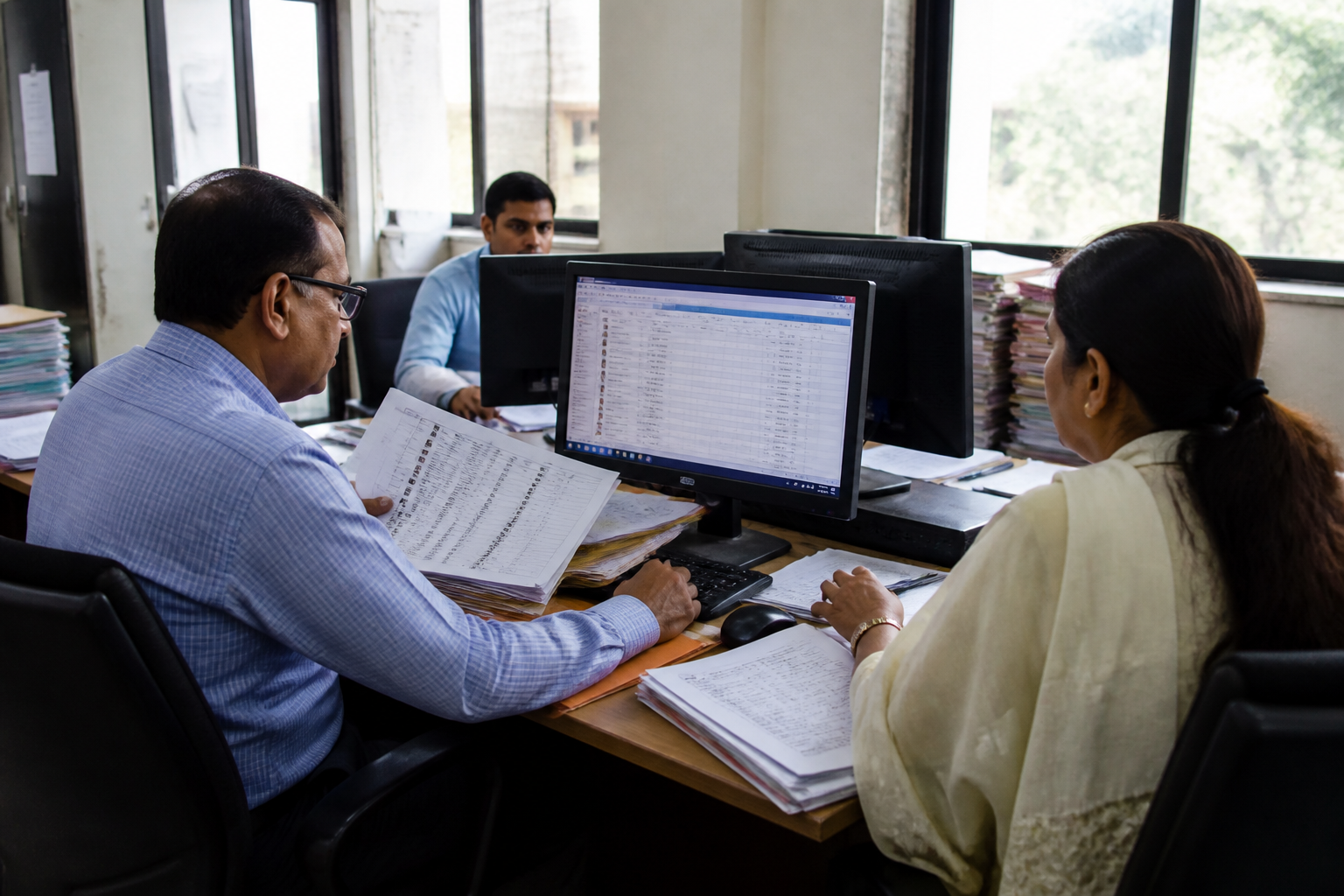
Maharashtra’s chief electoral officer has asked the Election Commission to give field officers greater discretion within ECINet, the software used to process electoral-roll cases. The request exposes a larger administrative fault line: the law assigns Electoral Registration Officers responsibility for deciding who appears on the voters’ list, but the digital system may determine which decisions they are technically able to make.
The issue has surfaced as Maharashtra undergoes a Special Intensive Revision of its electoral roll. The state’s draft roll, published on August 31, reduced the number of electors by 21.1 per cent, while the final roll is due on November 16. Against that backdrop, the design of the software is not a narrow technology question. It affects how citizens respond to notices, which documents they can submit, whether they must attend hearings and who ultimately exercises judgment over their eligibility.
According to The Indian Express, Maharashtra Chief Electoral Officer S Chockalingam wrote to the Election Commission last week seeking changes to ECINet. The communication, sent on September 24 to senior officials including Senior Deputy Election Commissioner Maneesh Garg and Director General of IT Seema Khanna, sought flexibility in four areas: hearings, document submission, case disposal and the mandatory uploading of an extract from the previous intensive revision roll. The letter also asked for written guidance to resolve queries among field officers.
The requests followed an Indian Express investigation that reported concerns recorded by Election Commissioners Sukhbir Singh Sandhu and Vivek Joshi. Sandhu had written on August 14 that chief electoral officers, district election officers and EROs were reporting that they could not perform their duties because their powers had been curtailed by centralised control of the electoral-roll system at the Director General of IT level.
The central question is not whether software should be used in electoral administration. A digital system can standardise workflows, create audit trails and reduce the scope for unauthorised changes. The question is where operational control sits when the legal responsibility remains with officers at the state, district and constituency levels. If an ERO is accountable for a decision but cannot access the relevant function without central intervention, responsibility becomes separated from capability.
That separation matters because a “logical discrepancy” is not, by itself, a finding that a person is ineligible to vote. It is a mismatch identified by ECINet while attempting to link an elector with a parent or grandparent in the roll from the previous intensive revision. The reported examples include differences in names, an age gap between parent and child of less than 15 or more than 50 years, an age progression that does not appear consistent, or the submission of no document or only Aadhaar.
Such automated flags can be useful for identifying cases that need examination. But a flag is the beginning of an administrative process, not its conclusion. The person must have a meaningful opportunity to respond, and the officer must be able to assess the evidence under the applicable rules. The distinction becomes especially important when old rolls contain spelling differences, incomplete family information or records relating to people whose official documentation has historically been weak.
The Maharashtra CEO’s first request concerns hearings. The rules give an ERO discretion to require a person to appear personally. However, the report says ECINet’s “Take Action” menu offered two options and did not allow an officer to waive a hearing. The proposed third option, “Exempted from Hearing”, would permit the officer to rely on valid and satisfactory documents where a personal appearance would create unnecessary difficulty for senior citizens, persons with disabilities and other vulnerable groups.
This is a small software feature with a substantial administrative consequence. A mandatory hearing can impose travel costs, lost wages and procedural anxiety, particularly on residents who live far from government offices or lack reliable transport. At the same time, a hearing may be necessary in cases where the documentation is incomplete or contradictory. The relevant principle is therefore not that hearings are always harmful or always necessary, but that the legally responsible officer should be able to determine which applies in a particular case.
The second request concerns documents. The 13 documents listed on the notice are described as indicative rather than exhaustive. Maharashtra’s CEO sought an additional “Other/Other Equivalent Document” option because members of tribal, homeless and sex-worker communities may not possess documents from the listed categories. Without such an option, the system could turn an illustrative list into a closed checklist, narrowing the evidence that an officer is able to consider even when the rules allow a broader assessment.
The third request deals with who can dispose of a case. In some situations, an ERO cannot resolve a discrepancy solely on the basis of a Booth Level Officer’s statement, and supporting documents must be sent to the District Election Officer for verification. The CEO asked that EROs be allowed to decide cases themselves when they are satisfied with the evidence. The request is based on the legal allocation of responsibility: the ERO prepares the roll, hears claims and objections, and decides whether a name should be included or retained.
The fourth request would make the upload of an “Extract of Last SIR” optional in every discrepancy case. The CEO’s position, as reported, is that the discrepancy has already been identified using the previous roll, making a mandatory upload unnecessary in all cases. A system requirement that adds no evidentiary value can slow disposal, particularly when the field officer already has access to the underlying data.
The letter also sought written instructions and frequently asked questions for EROs. The reported reason was that oral instructions from the Election Commission or the chief electoral officer were insufficient. This points to a basic administrative requirement: a process affecting millions of voters cannot depend on informal communication alone. Written rules provide a common reference for officers, create a record of institutional decisions and make later scrutiny more feasible.
The legal structure described in the report is deliberately decentralised. The Representation of the People Act, 1950 and the Registration of Electors Rules, 1960 assign responsibility for electoral rolls to EROs, generally officers such as sub-divisional magistrates or officials of equivalent rank. Their duties include preparing the roll, hearing claims and objections, and deciding which names remain or are deleted. District and state-level officers provide supervision, but the individual decision is not designed to be made by a single central authority.
That decentralisation is also an accountability mechanism. If decisions are distributed across constituency-level officers, it becomes harder for one person or one office to control the entire roll. The system may be slower and more administratively demanding, but it places judgment closer to the facts of individual cases. Digitisation can strengthen this arrangement when it records decisions and makes procedures transparent. It can weaken it when the software silently recentralises discretion through access controls and fixed workflows.
The Election Commission has defended its digital platforms on security grounds. In its first response to the earlier investigation, it said the platforms operate under strict data-security protocols to prevent unauthorised tampering and that EROs and DEOs function according to their statutory powers for registration and deletion. The difficulty highlighted by the Maharashtra communication is that security and discretion are not necessarily opposing objectives. A system can restrict unauthorised access while still giving authorised officers the functions required by law.
On September 26, after a meeting of the full Commission, the Election Commission announced that EROs would be allowed to exempt people flagged for logical discrepancies from personal hearings. It also said portal upgrades had already been made based on inputs from state chief electoral officers and that further flexibility required by field officers would be made operational. This partially addressed the Maharashtra request, but the report does not establish that all the requested changes had been implemented.
The Commission also announced a review of ECINet by a committee headed by a senior Deputy Election Commissioner and including an independent expert from an IIT or IIIT. Other decisions included circulating agendas before Commission meetings, issuing minutes afterwards, requiring approval for officers’ foreign trips, and routing new IT modules and portals through a committee before placing them before the Commission. The measures respond not only to software design questions but also to concerns about institutional oversight.
The sequence is significant. The Maharashtra CEO’s letter was sent a day after concerns by two Election Commissioners about centralised control became public through the investigation. The Commission’s subsequent decisions addressed several of those concerns, including independent review of the electoral-roll database, access for field officers and oversight of technology systems. The supplied report does not establish whether the changes will fully restore the discretion contemplated by the law, but it does show that the issue has moved from internal concern to formal institutional response.
For citizens, the practical test will be whether a person flagged by the system can understand the reason, submit appropriate evidence, avoid an unnecessary hearing where the documents are sufficient, and receive a decision from an officer empowered to assess the case. For administrators, the test will be whether the system provides enough flexibility without weakening auditability or data security. For the Commission, the test is whether accountability remains aligned with control.
Maharashtra’s final electoral roll is due on November 16. Until then, the central question is not simply how many names are added or removed. It is whether the process allows statutory officers to exercise the judgment assigned to them, and whether the software records that judgment rather than replacing it with a set of centrally determined options. The Commission’s announced ECINet review and the implementation of the Maharashtra CEO’s requests will determine how that balance is handled.
