


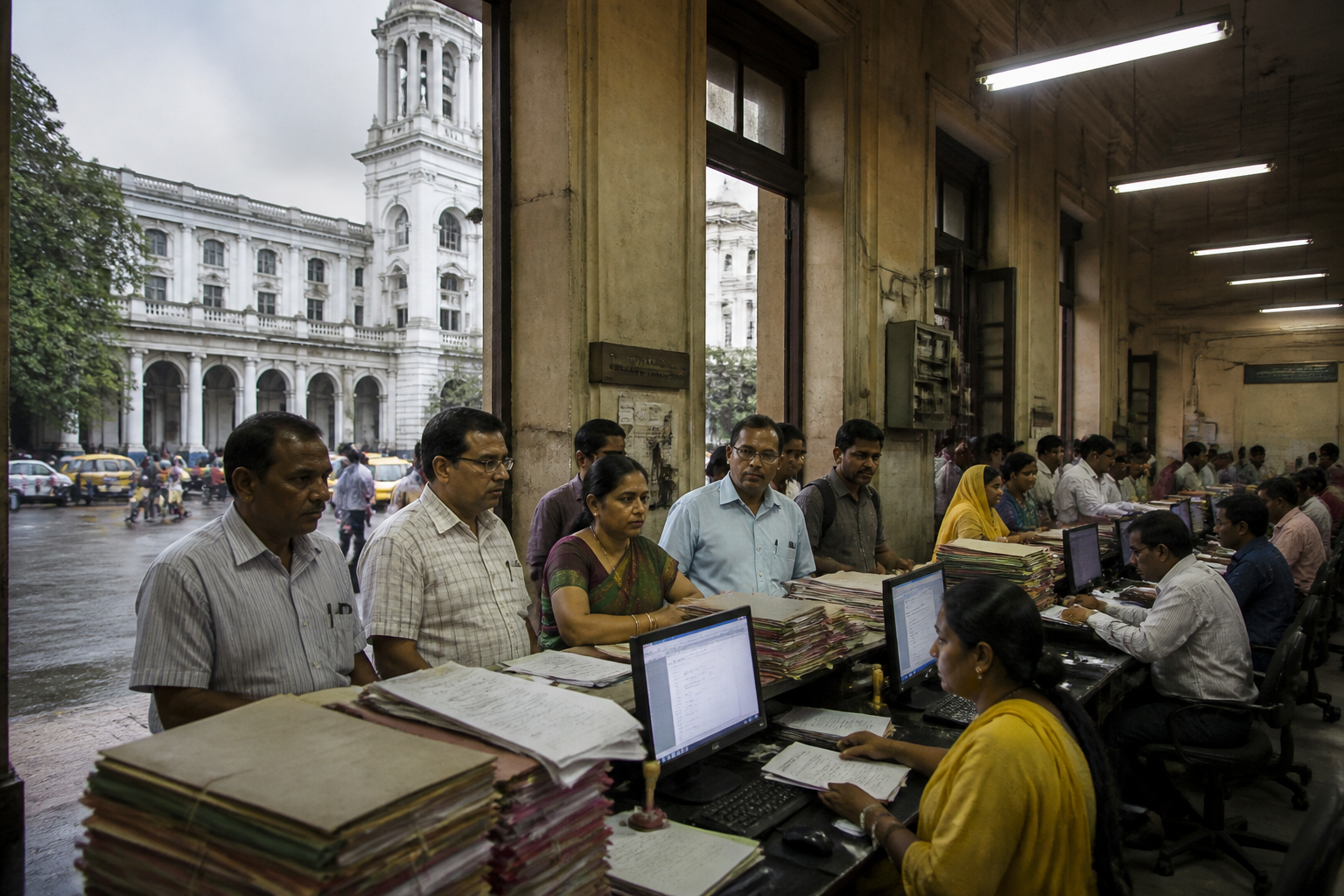
Kolkata Municipal Corporation’s tax collection has come under pressure from a combination of staff diversion, political and administrative disruption, prolonged digital-system failures and a large stock of unpaid property tax. A report by Sangbad Pratidin – Kolkata says the civic body’s revenue collection was at least Rs 110 crore lower year-on-year by the end of September, while data cited from a recent Comptroller and Auditor General report showed more than Rs 1,300 crore in outstanding property tax from municipal and government-private properties.
The figures matter because property tax and building-plan approval fees are described in the report as two of the Kolkata Municipal Corporation’s main own-source revenue streams. When either weakens, the impact is not confined to the accounts department. Municipal revenue supports the routine functioning of a civic body, including payments, maintenance and the processing of services that residents and businesses use to build, repair, connect to utilities or regularise property-related obligations.
The immediate collection shortfall has several overlapping causes. According to the report, a large part of the assessment department’s staff had been unable to work on property-tax files from December 2025 because they were assigned to election-related duties and other public programmes. The report attributes this account to a senior official in the KMC assessment department. It says staff were first occupied with election-related work, including the Special Intensive Revision, and later with welfare-programme implementation and house-to-house enumeration connected to the census process.
This is not simply a question of employees being temporarily reassigned. It illustrates how municipal revenue functions can become vulnerable when a civic body’s limited administrative capacity is repeatedly redirected to tasks controlled or mandated by other levels of government. The report says the election-related assignments were under the Election Commission’s control, while subsequent work included the implementation of Annapurna Yojana, Ayushman Bharat-related activities and house-to-house enumeration. The result, as described in the report, was a prolonged interruption in the routine work of assessing and collecting property tax.
The collection process also encountered resistance after the election period. The report says tax collectors faced residents who questioned assessments made by the previous government or preferred to wait for a new government before seeking a reduction and paying. These accounts are presented as explanations offered within the report for why field collection slowed and assessment staff subsequently returned to office-based work.
The second major weakness has been digital infrastructure. The KMC’s central server reportedly remained out of service for 16 consecutive days from 12 September, leaving its central portal, e-KMC 2.0, largely unusable. The report also says the CAP-1 and CAP-2 portals, used for payments linked to drinking water and drainage-related fees, had been unavailable for more than 15 days.
A municipal portal is not merely an information interface. In a system where payment, approval and record management have moved online, an outage can interrupt the entire chain between an applicant, a department and the treasury. Citizens and businesses arriving to pay property tax or other fees were reportedly turned away because online services were unavailable. The report says the disruption extended from the treasury to the assessment department.
The effect was particularly visible before the annual festive period, when the municipality normally receives a substantial volume of payments. The report says plumbers and licensed building surveyors typically use the CAP-1 and CAP-2 portals to pay for permissions connected with home repairs and other work before the festive season and during the monsoon. Smaller promoters and plumbers also pay fees for drinking-water connections. With the portals unavailable, the report says approvals were not issued and no revenue was deposited through these channels during the disruption.
This creates a double cost for the city. The municipality loses immediate fee income, while residents and businesses lose access to permissions needed for repairs and utility-related work. A delayed approval can also postpone construction or maintenance activity, even when the work itself is relatively small. The report does not quantify the total value of applications held up, but it identifies these payment and approval channels as regular contributors to the municipal treasury.
Building-plan approvals represent another area of lost revenue. According to the report, the KMC’s Municipal Building Committee had not held a meeting since March to approve plans for multi-storey buildings or housing projects. As a result, the report says no building-plan approval revenue had entered the municipal treasury through this process during the period under review.
The building-approval delay is important because it connects municipal finance with the city’s development pipeline. Approval fees are an own-source revenue stream, but the approval process also determines when construction can legally proceed. A committee that does not meet for months can therefore affect both municipal receipts and the timing of residential and commercial development. The supplied report does not establish whether all pending plans were delayed solely because of the committee’s non-meetings, so the specific administrative reasons for that interruption remain unclear.
The reported Rs 1,300 crore in outstanding property tax points to a longer-term problem beyond the current server outage. A large arrears base means that the municipality is not only trying to collect current-year dues; it is also managing accumulated unpaid liabilities across municipal, government and private properties. The report attributes this figure to information from a recent CAG report. It does not provide a property-wise breakdown, the age of the arrears, the division between public and private properties, or the amount considered recoverable.
Those missing details are central to understanding the quality of the municipal tax base. Outstanding tax can arise from different conditions, including disputes over assessments, incomplete property records, changes in ownership, exemptions, litigation or non-payment. The supplied report does not distinguish among these categories. It therefore establishes the scale of the arrears but not the precise administrative route required to recover them.
The report’s account also shows how collection performance depends on more than the tax rate or the willingness of residents to pay. It depends on updated assessments, field staff, functioning payment systems, approval committees and a treasury capable of recording receipts. A failure in any one part can reduce revenue; failures across several parts at the same time can magnify the loss.
For residents, the visible symptom may be a failed payment or a delayed approval. For the municipal administration, however, each interruption affects records and cash flow. If an assessment cannot be processed, a demand may not be updated. If a portal is unavailable, a payment cannot be captured through the normal channel. If a building committee does not meet, an approval fee cannot be collected at the expected stage. The report presents these disruptions as simultaneous pressures on the KMC’s two principal revenue sources.
The institutional question is how a municipal corporation protects essential revenue operations when staff are assigned to external or city-wide programmes. The report records the sequence of assignments and outages but does not state whether KMC had a contingency staffing plan, alternative payment mechanism, backup server or formal recovery schedule. Nor does it provide an official public explanation of the server failure, the cause of the portal outages or the timetable for restoring full services.
That uncertainty limits what can be concluded from the current figures. The reported Rs 110 crore shortfall by September-end should not automatically be treated as a permanent annual loss, because the year was still in progress and the report describes several operational disruptions rather than a final audited result. At the same time, the combination of a current collection decline and more than Rs 1,300 crore in reported arrears indicates that the problem cannot be reduced to a single 16-day server outage.
Kolkata’s municipal finance story is therefore also a story about administrative continuity. Digital systems can speed up payments and approvals, but they also create a single point of failure when no functioning alternative is available. Staff deployment can help deliver urgent public programmes, but it can weaken routine civic functions when assessment and collection work is not protected. Building approvals can generate revenue, but only when the institutional process meets regularly and decisions move through the system.
The evidence supplied in the report confirms a severe strain on KMC’s revenue collection and service-processing machinery. It does not yet establish the final size of the annual revenue loss, the recoverability of the reported arrears, the technical cause of the outages or the specific responsibility for the building committee’s inactivity. Those are the next facts that would determine whether the present crisis is a temporary disruption or evidence of a deeper structural weakness in Kolkata’s municipal administration.
