


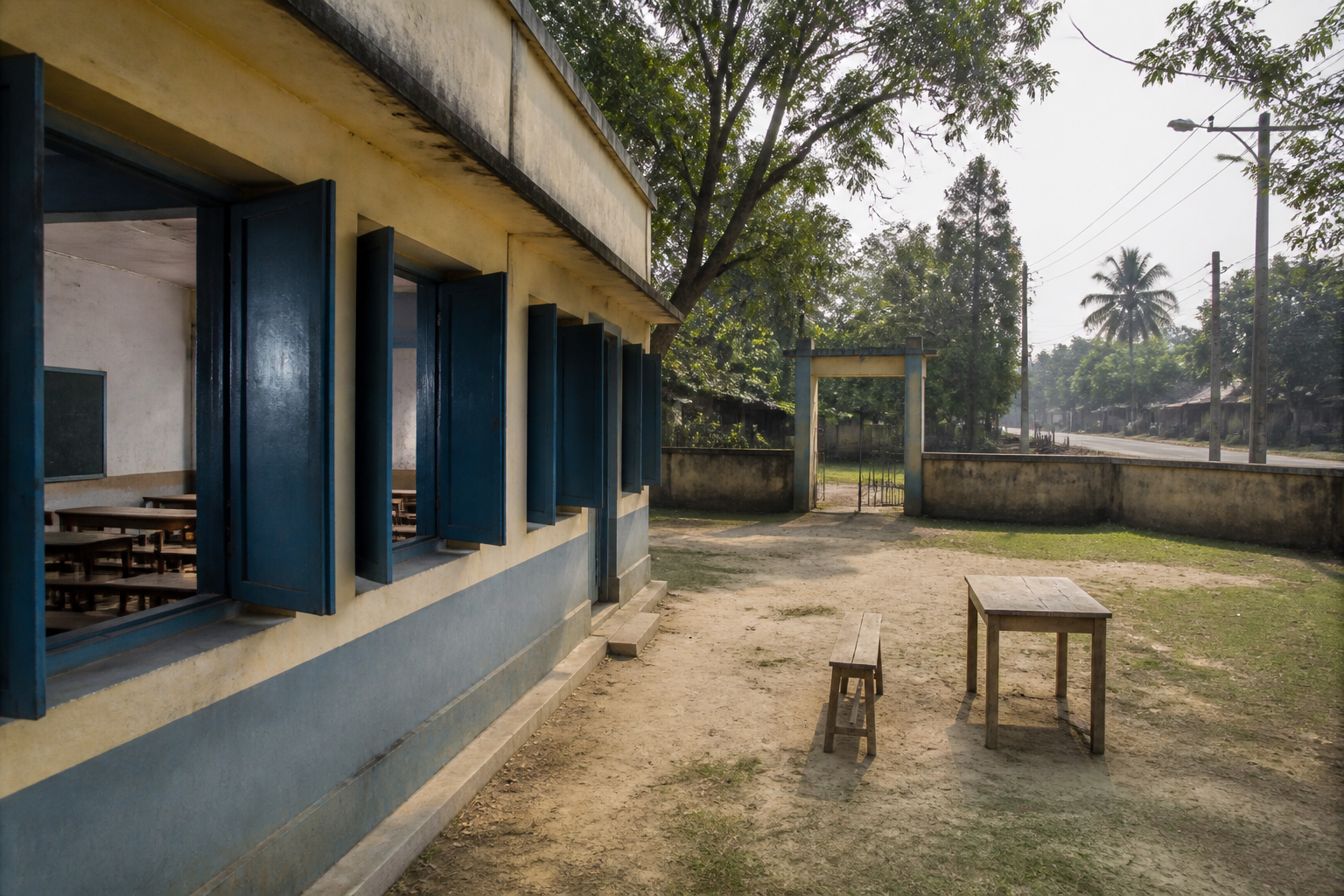
West Bengal’s studentless junior high schools are not merely a story about declining enrolment. They expose what happens when the organisation of public education changes faster than the institutions responsible for delivering it. A report by Sangbad Pratidin – Bengal describes schools where teachers and non-teaching staff continue to attend every day even though there are no students left to teach. The immediate question is how long such schools can remain open. The larger question is whether the state has a credible system for matching public infrastructure and personnel with changing patterns of demand.
The schools in question generally serve Classes V to VIII. The report traces the present crisis to a change introduced in 2019, when Class V was included in junior primary schools. That altered the role of junior high schools. Instead of receiving children after primary school, many of these institutions were left with only Classes VI, VII and VIII. Families also faced another school transition after Class VIII, adding to the uncertainty around the institutions’ long-term usefulness.
This is a planning problem as much as an education problem. A school is not only a building. It is a network of classrooms, teachers, support staff, land, maintenance, transport arrangements and public funds. When enrolment falls, the physical asset does not disappear, and neither do salary obligations. But the public purpose of the institution becomes harder to sustain. The report’s examples show that the state’s administrative structure has not yet fully reconciled these two realities.
The experience of Chitrashali Junior High School in Haripal block, Hooghly, illustrates the speed of the decline. Established in 1973, the school reportedly saw its student numbers fall sharply after 2018. A teacher, Tushar Bandyopadhyay, told the publication that enrolment declined further after the Covid-19 period and eventually reached three or four students before falling to zero. The school currently has four teachers but no students. Teachers reportedly went through the neighbourhoods in an effort to bring children back, without success.
The report says Hooghly has seven or eight schools facing a similar situation. That detail matters because it suggests the problem is not confined to a single institution with unusual local circumstances. A cluster of empty schools points towards a regional pattern involving school choice, administrative restructuring, demographic change or all three. The supplied report does not provide district-wide enrolment data or an official explanation, so the relative weight of each factor cannot be established from the available evidence.
Narayanpur Junior High School in Arambagh presents another version of the same trajectory. Teacher Sukirti Gupta said the school was established in 2011 and had only a small number of students when she joined in 2015. Enrolment later rose to 60, but gradually declined to zero. She now reportedly attends the school every day with one Group D employee. The example demonstrates that a school can recover temporarily and still lose its student base over time. A short period of higher enrolment is therefore not enough to establish institutional stability.
The report also refers to Nakhtala Bharati School in Kolkata, which became studentless around four years ago. Former teacher Uma Sarkar said that even bringing 22 students to the school did not save it. The teachers were subsequently transferred to other schools. This suggests that school closure or absorption is not only about buildings; it also requires decisions on staff redeployment, student transfers, asset use and future access for families in the surrounding area.
The institutional chain behind such decisions is significant. Changes to the structure of primary and junior high education can alter enrolment flows without immediately changing sanctioned posts, school buildings or administrative arrangements. If the education department does not regularly review school-level demand, the result can be a mismatch: staff remain attached to institutions that no longer serve students, while other schools may face different pressures. The report does not establish whether West Bengal has completed such a review, or what criteria it uses to merge, close or repurpose studentless schools.
The Right to Education framework also forms part of the background. The report says that many junior high schools were created after 2010 under the framework of the Right to Education Act, while others predate it. That history is important because the expansion of school access created a network designed for a particular distribution of children. Subsequent changes in school structure and family preferences can make that network inefficient if there is no corresponding rationalisation. The challenge is to preserve access without treating every existing school as permanently viable regardless of enrolment.
The Covid-19 period appears to have deepened the decline, according to the teachers quoted in the report. However, the available material does not quantify the pandemic’s effect separately from the 2019 restructuring or longer-term changes in parental preference. It does indicate that the fall in enrolment continued after schools reopened. That distinction is important: if the problem were only a temporary interruption, enrolment might be expected to recover. The reported cases instead show a prolonged decline ending in empty classrooms.
There is also a ground-level cost to leaving schools in administrative limbo. Teachers and support staff continue to travel to buildings where no children are present. Families, meanwhile, must decide where children will study and whether another transition will be required after primary education. If schools are formally closed without adequate alternatives, access could suffer. If they remain open without students, public resources may be locked into institutions that no longer correspond to local demand. The correct administrative response therefore depends on evidence about nearby schools, travel distances, transport and the distribution of children—none of which is provided in the report.
The cases also challenge the assumption that enrolment can be restored through local mobilisation alone. Teachers at Chitrashali reportedly tried to recruit students in nearby neighbourhoods, but failed. At Nakhtala Bharati, efforts to bring in 22 students did not prevent the school from becoming studentless. These accounts suggest that the problem may be embedded in the structure of the school network rather than caused simply by a lack of outreach. Parents may be responding to the number of classes available, the need for another school change after Class VIII, or the perceived advantages of larger institutions. The report records these pressures but does not include parent interviews or comparative data on nearby schools.
For policymakers, the immediate task is to distinguish between three different situations: schools with a temporary enrolment shock, schools serving a shrinking population, and schools made redundant by institutional restructuring. Each requires a different response. Temporary decline may require time-bound support. A shrinking catchment may require consolidation and transport planning. Redundancy caused by a change in class structure may require a formal redesign of the school network. Treating all three as identical risks either wasting resources or weakening access.
The staff question is equally important. The examples show teachers and Group D employees continuing to report to studentless schools, while the Kolkata case indicates that some teachers were eventually transferred. A transparent process would need to clarify when staff are redeployed, how vacancies are assessed elsewhere and what happens to school buildings. The supplied report does not provide the government’s position on these matters. That absence is itself a significant gap in public understanding because the outcome of the school crisis will depend as much on administrative decisions as on enrolment trends.
West Bengal’s studentless junior high schools therefore represent a test of whether public education infrastructure can adapt to demographic and institutional change. The evidence in the report confirms a pattern of empty schools in parts of Hooghly, Arambagh and Kolkata, along with continuing staff deployment in at least some cases. It does not establish the total number of affected schools, the annual public cost, the state’s closure policy or the availability of replacement schools. Those are the next facts required to understand the scale of the problem. Until then, the empty classrooms remain a visible sign of a system whose buildings, staffing arrangements and student pathways are no longer moving together.
