


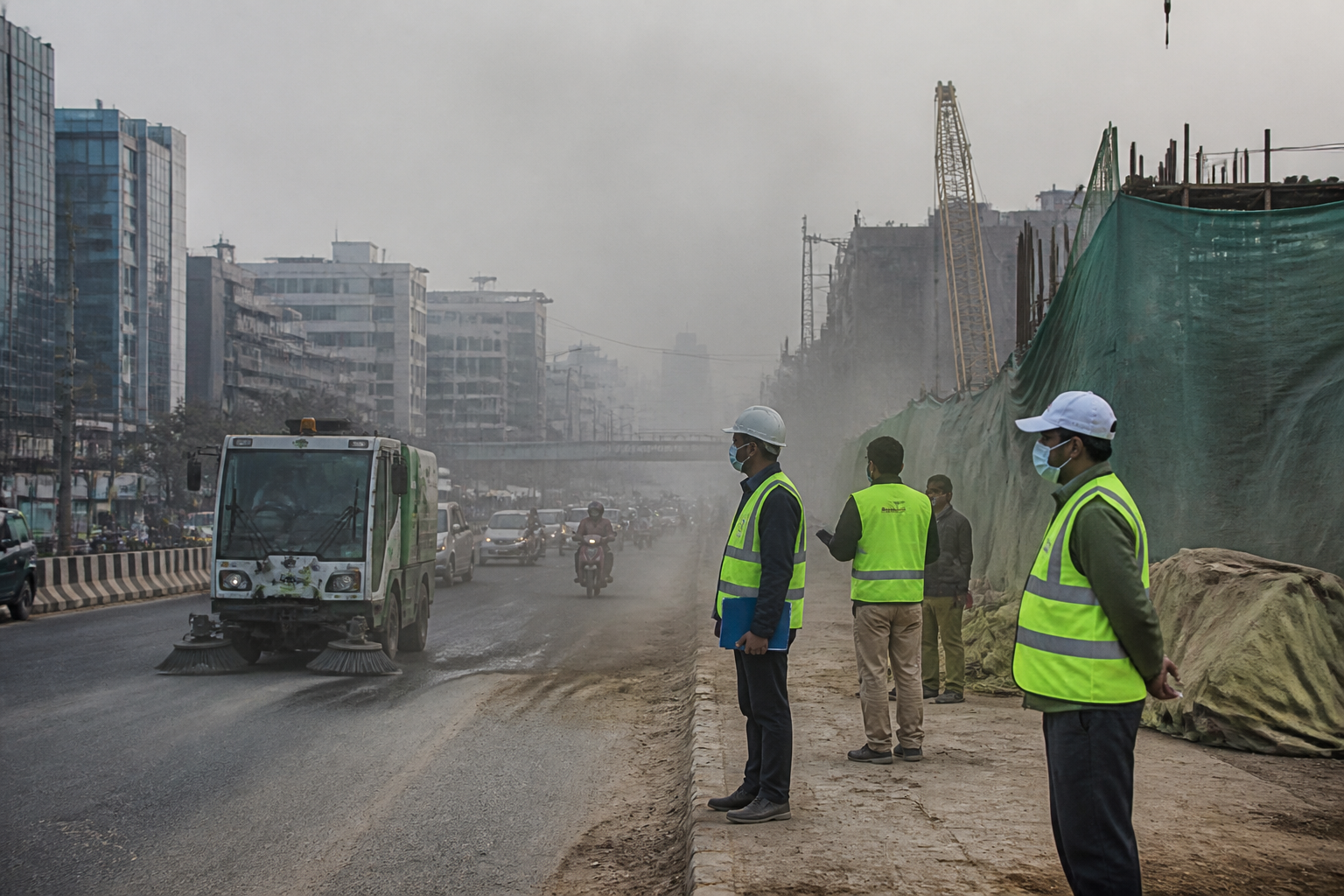
Delhi’s winter pollution plan is moving from announcement to execution, with 334 monitoring teams assigned to inspect 48 hotspots and act against road dust, waste burning, construction debris, industrial pollution and unauthorised fuel use. The scale of the deployment is significant, but the evidence in the government and civic preparations points to a harder urban problem: Delhi’s pollution response depends on whether several agencies can deliver routine enforcement and road maintenance before winter conditions worsen.
The new arrangement places two teams in each of Delhi’s 39 subdivisions for round-the-clock inspections. The Municipal Corporation of Delhi is to deploy 250 ward-level teams, while four teams will operate in the New Delhi Municipal Council area and two in the Delhi Cantonment area. Their responsibilities include monitoring the burning of waste and organic material, construction dust, industrial emissions, illegal dumping and the use of fuel without permission.
The structure reflects the geography of Delhi’s pollution problem. Hotspots are not confined to one type of land use or one administrative boundary. They include roads, construction areas, waste sites and locations affected by traffic and industrial activity. Assigning responsibility for each of the 48 hotspots is therefore intended to address a familiar weakness in urban enforcement: when several agencies share responsibility, it can become difficult to identify who must inspect, act and report progress.
The effectiveness of this system will depend on what the teams do after identifying a violation. The report cites former Central Pollution Control Board additional director S K Tyagi as calling for one responsible officer at every hotspot, daily inspections and public monitoring. He also stressed that road cleaning should not be assessed merely by whether a machine was operated, but by whether dust levels actually declined. This shifts the question from deployment to measurable outcomes.
Road dust is a particularly important test of that distinction. The government has approved a plan costing Rs 100 crore to operate 1,000 truck-based dust-control machines for three years. The vehicles are proposed to have GPS and daily work records. Such systems can establish where and when equipment was used, but the report also notes that water sprinkling alone will not be sufficient. Regular mechanical sweeping, cleaning of road edges and the paving or greening of exposed areas are identified as necessary measures.
That concern is linked to the condition of Delhi’s roads. The MCD has set a target of completing work on 870 kilometres of road by October 31. However, against a revised target of 1,230 kilometres, only 689 kilometres had been completed by September 14, according to the report. The gap matters because unfinished roadwork, exposed surfaces and poorly maintained edges can continue to generate dust even when dedicated anti-dust vehicles are operating.
The figures also reveal the administrative pressure built into the winter pollution calendar. The city’s agencies have a limited period in which to complete road-related work, prepare waste systems and establish hotspot monitoring before winter conditions make pollution more difficult to control. A target announced for October or November is not equivalent to a measure already functioning on the ground. The difference between the two is where implementation capacity is tested.
Waste management is another part of the same chain. The MCD has said it will strengthen waste collection and transport, prevent open waste burning and increase monitoring at construction and demolition waste sites. Of 125 such sites, 110 have been described as compliant with rules. The report does not establish how compliance was assessed or what action is planned for the remaining sites, but the number shows why inspections need to be connected to deadlines and follow-up rather than treated as one-time checks.
The evidence presented in the report also challenges the idea that Delhi can solve winter pollution through one visible intervention. An analysis by the Centre for Science and Environment is cited as identifying vehicles, industry, waste burning, household fuel, construction and regional pollution as combined contributors to the winter deterioration. This means that a road-cleaning programme may address one part of the problem while leaving other sources active. It also makes coordination between departments central to the outcome.
Transport illustrates the difficulty. A 2026 study associated with IIT Delhi and The Energy and Resources Institute is cited as estimating that the transport sector contributes about 18 to 24 per cent of Delhi’s PM2.5 pollution. The figure does not make transport the only or necessarily the largest source, but it establishes that vehicle emissions cannot be treated as peripheral. Action on heavy vehicles, traffic management and public transport therefore sits alongside dust control and waste enforcement rather than outside the pollution plan.
This has implications for how Delhi’s pollution response should be administered. The city government, the MCD, the NDMC, the Delhi Cantonment Board and pollution-control authorities have different jurisdictions and operational responsibilities. A hotspot may involve a road maintained by one agency, construction activity regulated by another and waste collection handled by a third. The 334-team structure can improve visibility, but only if information moves quickly from inspection to enforcement and if repeated violations trigger action beyond the issuing of notices.
The report cites a May meeting between the Centre and Delhi as having emphasised faster action on road-dust control, traffic management, electric vehicles and waste management, along with better coordination between departments. That list is important because it treats pollution as an urban systems problem. Road engineering, mobility, fleet composition, waste logistics and construction practices influence air quality through connected pathways. Administrative coordination is therefore not a supporting task; it is part of the pollution-control infrastructure.
Public monitoring is also presented as a component of enforcement. This matters because pollution-control measures are often experienced by residents at street level: dust accumulating along road edges, waste being burned in open areas, construction material escaping from sites or heavy vehicles moving through congested corridors. A monitoring model that records inspections but does not make outcomes visible would provide evidence of activity without necessarily demonstrating improvement.
The central data story is the distance between planned capacity and completed work. Delhi has 334 teams, 48 identified hotspots, a proposed fleet of 1,000 dust-control machines and a roadwork target of 870 kilometres. At the same time, only 689 kilometres had been completed against the revised 1,230-kilometre target by September 14. These numbers do not by themselves measure air-quality improvement, but they show that the city’s winter strategy is being implemented under significant operational pressure.
The remaining uncertainty is whether the measures will produce sustained reductions rather than short bursts of activity. The supplied report does not provide post-implementation pollution readings, a public dashboard of hotspot actions or a final account of roadwork completed by the October deadline. It also does not establish how many violations resulted in penalties, how quickly repeat offences were addressed or how the performance of the 1,000 proposed machines would be assessed beyond GPS and daily records.
Delhi’s winter pollution plan therefore represents less a shortage of announced measures than a test of municipal execution. The 48 hotspots and 334 teams provide a framework for responsibility, while the roadwork, waste-management and transport measures address several recognised sources. The outcome will depend on whether agencies can complete preparatory work on time, maintain inspections through the season, measure actual dust and pollution reductions, and make responsibility visible when rules are breached.
