


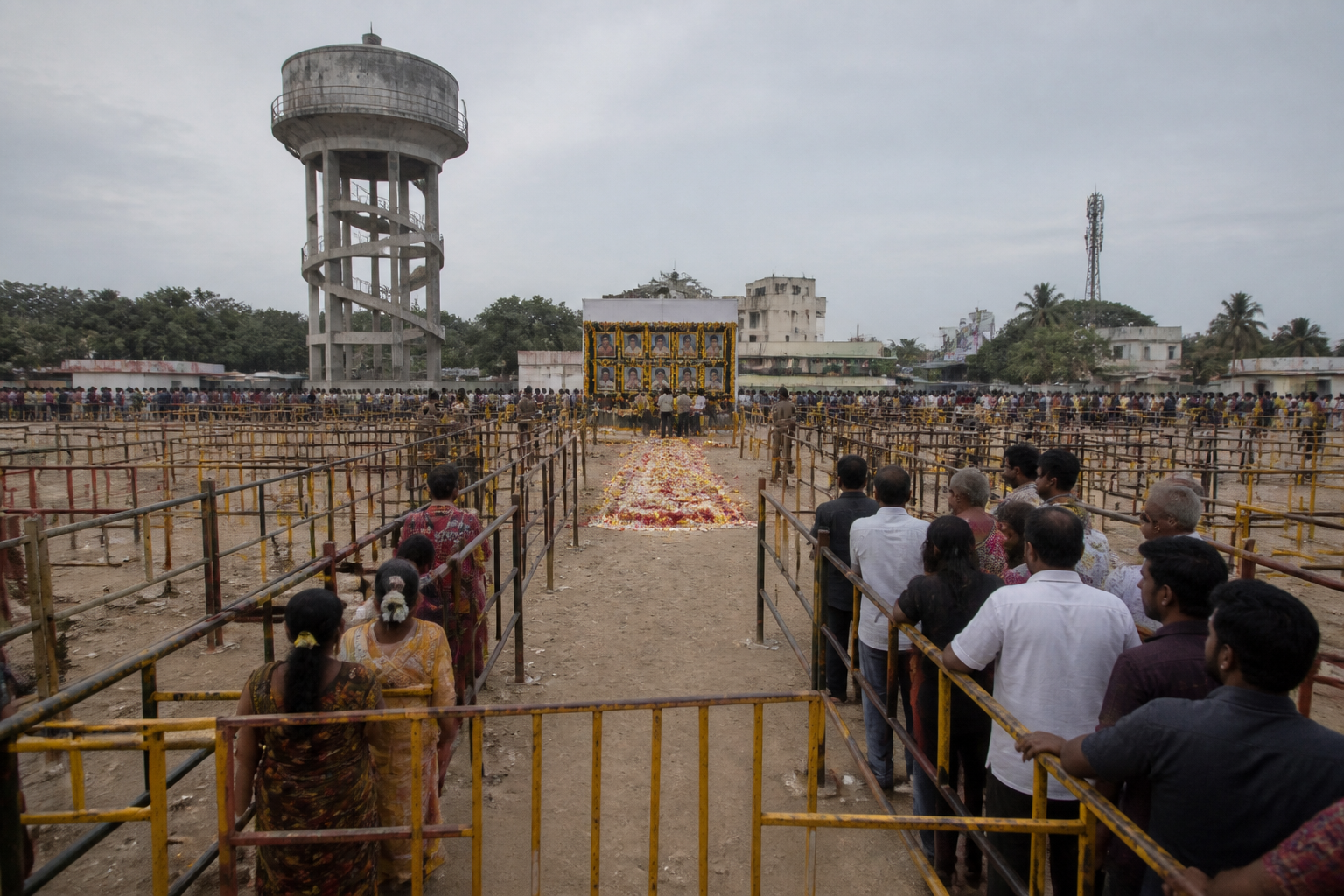
One year after the Karur stampede killed 41 people at a political rally, the tragedy has moved from the immediate questions of crowd safety and emergency response into a more difficult phase: how the state compensates affected families while staying within the constitutional framework governing public employment. The Supreme Court’s intervention over Tamil Nadu’s decision to offer government jobs to eligible family members has turned the aftermath into a test of how disaster relief is designed, justified and administered.
The stampede took place on September 27, 2025, during a rally addressed by Tamilaga Vettri Kazhagam chief and actor Vijay in Karur district. According to the report, several people were also injured. On the first anniversary, Vijay expressed grief in a post on X and said the loss remained an enduring wound for the families and the state. The anniversary gives the event renewed public attention, but the legal dispute shows that the consequences of a mass-casualty incident do not end when the crowd disperses or compensation is announced.
The central administrative question is whether public employment can be used as an exceptional form of relief for families who lose a breadwinner in a public disaster. The Tamil Nadu government treated appointments for eligible relatives of the victims as part of relief and rehabilitation. In July, the government distributed compassionate appointment orders to 32 legal heirs, according to the report. The policy was subsequently challenged before the Madurai Bench of the Madras High Court.
The High Court’s concern was not whether the families had suffered. It examined whether the government could create a special category of public employment for them without violating Articles 14 and 16 of the Constitution. Those provisions address equality before the law and equality of opportunity in public employment. The court held on July 27 that the government orders could not be sustained against those constitutional guarantees, particularly when other applicants were already waiting for compassionate appointments.
This distinction is important for urban and district governance. A state’s response to a disaster usually has several components: immediate rescue, medical treatment, compensation, legal accountability, rehabilitation and longer-term livelihood support. These measures are not interchangeable. Compensation can be paid under a relief policy; employment in the public service must also meet rules governing recruitment, eligibility and equal opportunity. The Karur litigation demonstrates how a measure intended as relief can become a question of administrative precedent once it enters the public employment system.
The Supreme Court stayed the High Court ruling in August and issued notice on the state’s challenge, according to the report. A bench of Justices JB Pardiwala and K Vinod Chandran questioned why the government should be prevented from going beyond monetary compensation and offering employment to a family member, especially where the deceased may have been the sole earning member. The observations do not settle the legal dispute, but they identify the practical problem that often follows urban and public-event disasters: the loss of household income can continue long after the official relief announcement.
The case therefore sits at the intersection of two different ideas of fairness. One is distributive fairness to families whose members died in an exceptional incident. The other is procedural fairness to people who have applied for government jobs under ordinary rules and may argue that a new category gives some applicants an advantage outside the established recruitment framework. The High Court and the Supreme Court have approached the same policy through these different constitutional and humanitarian concerns. The final legal position remains unresolved in the material supplied for this report.
The episode also exposes the fragmented nature of responsibility at large public gatherings. The stampede occurred at a political rally, but the consequences involve the state government, the police and local administration, the organisers, health services, courts and the affected families. Each institution addresses a different part of the chain. The immediate cause of a crowd disaster may be examined through event management and emergency response, while the aftermath is handled through welfare decisions and litigation. Without a single, clearly integrated framework, relief can become dependent on executive orders issued after the event.
That institutional separation matters because public safety is not limited to physical infrastructure. Roads, transport access, entry and exit routes, barricading, medical facilities and communication systems are all part of the built environment of a mass gathering. Administrative decisions determine how those spaces are used and how risks are managed. When a disaster occurs, the state must then decide whether existing relief mechanisms are sufficient or whether an exceptional package is necessary. The Karur case shows that the legal durability of such packages depends on how clearly the policy is authorised, defined and applied.
The numbers in the report underline the scale of the livelihood issue. Forty-one people died, and appointment orders were distributed to 32 legal heirs in July. The difference between the number of deaths and the number of appointments does not itself establish a policy failure: eligibility, family circumstances and applicable rules may differ. But it shows why relief decisions require transparent criteria. A scheme that does not clearly explain who qualifies, what evidence is required and how competing constitutional obligations are addressed can generate further uncertainty for families already dealing with loss.
Compassionate appointment has traditionally been linked to the sudden death of an employee and the resulting hardship faced by the employee’s family. The Karur policy, as described in the report, applies the concept to families of people who died at a public rally rather than to families of government employees. That makes the legal and administrative question sharper. The state is not merely implementing an existing employment benefit; it is attempting to create a special route into public service as a disaster-relief measure.
The government’s position, as reflected in the Supreme Court proceedings, rests on the exceptional circumstances of the tragedy and the possibility that some victims were sole earners. The High Court’s reasoning emphasised that executive power remains subject to constitutional limitations and that a policy decision cannot automatically override equality requirements. Both positions point to the same institutional gap: relief systems must be capable of addressing long-term livelihood loss without relying on ad hoc access to government employment.
For families, the immediate concern is not constitutional doctrine but whether support will arrive, remain available and provide a stable livelihood. For the administration, the challenge is to make assistance predictable without weakening recruitment norms. For courts, the task is to determine how humanitarian relief can be reconciled with constitutional equality. The Supreme Court’s eventual decision will have implications beyond this case because governments frequently respond to disasters through special packages designed for particular groups.
The first anniversary of the Karur stampede thus marks two unfinished processes. The first is the continuing grief of the families and the community. The second is the unresolved design of the state’s response. The supplied report confirms the deaths, the anniversary tribute, the government’s appointments and the legal challenge, but it does not establish the final outcome of the Supreme Court proceedings or the wider findings on event safety. Those developments will determine whether the aftermath produces only relief for individual families or also a clearer framework for managing public-event risk and post-disaster rehabilitation.
