


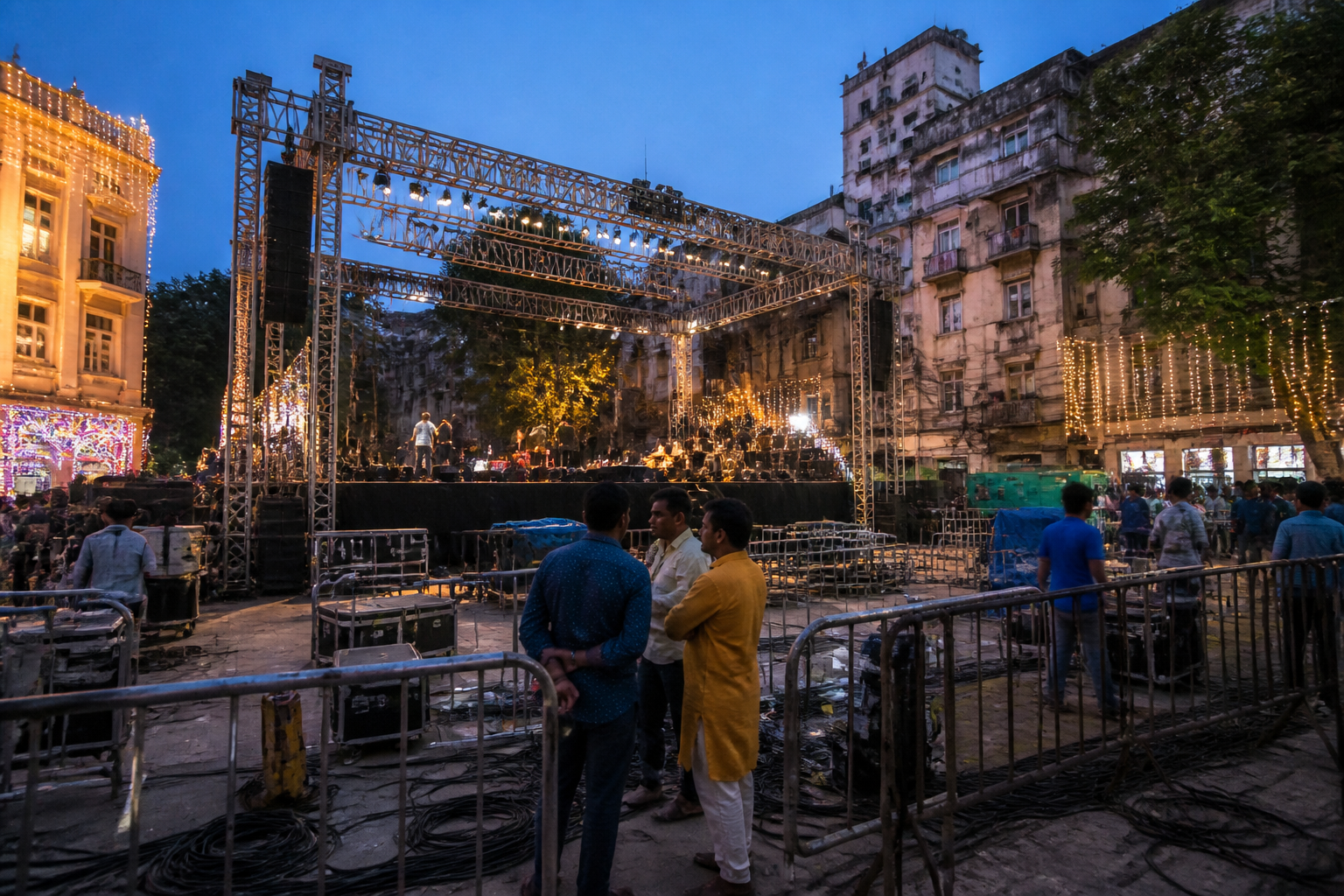
Kolkata’s Durga Puja concerts are facing an unusually weak season in 2026, with organisers yet to make the bookings that normally sustain a large network of music organisers, performers, hotels, transport providers, sound companies and neighbourhood committees. The decline is not being presented simply as a change in entertainment preference. Accounts from music organisers point to administrative uncertainty, concerns around fundraising, questions over police support and sharply higher costs for artists and event logistics.
The scale of the contraction is visible in booking patterns. Music organiser Tochan Ghosh said organisers had approached him for only three or four functions so far, and that none had been confirmed. At the same point last year, he said, eight or nine events had already been booked. With 21 days remaining before Puja at the time of the report, the gap suggests that the slowdown is affecting the planning cycle itself rather than only the final number of events.
Sajal Mitra, another established music organiser, described a similar uncertainty among Puja committees. His account also highlights the cost structure behind a large neighbourhood concert. Bringing artists from Mumbai involves not only performance fees but also accommodation in well-known hotels, expensive vehicles and modern sound systems. The report says artists have increased their fees by at least Rs 5 lakh to Rs 10 lakh compared with last year, citing inflation.
The reported fees illustrate how quickly a local cultural event can become a high-value urban operation. Shreya Ghoshal, Sunidhi Chauhan, Sonu Nigam, Shaan, Abhijeet and Monali are reported to command amounts ranging from Rs 60-70 lakh to Rs 1.5 crore, depending on the performer. The cost of bringing Javed Ali is reported to reach Rs 40-45 lakh. These figures are accounts from organisers cited by the source, not independently verified rate cards, but they show the financial exposure that Puja committees must consider before making a commitment.
When headline artists become too expensive, committees may turn to performers such as Vinod Rathod, Jolly Mukherjee or Purnima. Yet the reported slowdown has reached this segment too. That detail is important because it indicates that the pressure may not be confined to premium celebrity bookings. If committees are postponing or avoiding even lower-cost options, the problem is more likely to involve confidence, fundraising and permissions alongside artist pricing.
Neighbourhood concerts have long formed part of the wider Puja economy. Their organisation requires committees to coordinate with performers, event managers, equipment suppliers, emergency services and local administration. The report specifically identifies police, fire services and ambulance support as important for a function. A concert is therefore not only a stage and an audience; it is a temporary public assembly that depends on approvals, crowd management and emergency preparedness.
That institutional dimension becomes more significant when organisers are uncertain about how the administration will respond. The source attributes the hesitation partly to a change of government in the state and says many organisers remain unsettled about the administrative environment. It also points to official warnings and proposed action against extortion and coercive fundraising. For Puja committees, the result is a difficult calculation: raising money is necessary to finance an event, but the methods and risks associated with collection have become more sensitive.
The report does not establish that permissions have been formally denied across Kolkata, nor does it provide a citywide count of cancelled events. It instead records the views of organisers and the booking data they supplied. That distinction matters. The available evidence shows a sharp fall in confirmed engagements and a rise in anticipated expenditure, but it does not yet quantify the total impact on all neighbourhood committees or on the wider festival economy.
The fundraising issue also reveals the dependence of public cultural activity on informal local finance. A concert may be presented as entertainment, but its viability depends on whether a committee can collect sufficient contributions, secure operational approvals and absorb the possibility of cost overruns. Stronger action against coercive collection may be necessary from a law-and-order perspective, yet the transition can expose how heavily local festivals rely on fundraising practices that are difficult to regulate uniformly.
This is where the 2026 concert slowdown becomes an urban governance story. Large neighbourhood events occupy streets, grounds, community spaces and other shared environments. They require coordination between resident committees, police, fire services, ambulance providers, performers and municipal or administrative authorities. When any part of that chain becomes uncertain, the effect is felt not only by organisers but also by the businesses and workers who serve temporary festival activity.
The financial pressure is operating at several levels. Artist fees have risen, while hotel, vehicle and sound-system expenses add to the fixed cost of staging an event. At the same time, committees appear less willing or able to commit funds early. This creates a risk of delay: late bookings can reduce the choice of artists and suppliers, while higher prices make committees even more cautious. The report does not provide enough information to determine which factor is dominant, but the accounts suggest that cost inflation and administrative uncertainty are reinforcing each other.
The reported booking comparison—three or four approaches so far against eight or nine confirmed bookings at the same stage last year—offers a narrow but revealing indicator. It tracks the confidence of organisers who sit between artists and neighbourhood committees. Their role is sensitive to both demand and risk. If they do not receive firm commitments, artists lose dates, local suppliers lose contracts and committees lose one of the most visible elements of their Puja programming.
The situation also raises questions about who carries responsibility for making public events viable. Organisers need predictable information on permissions, police deployment, fire safety and ambulance arrangements. Committees need to understand the lawful boundaries of fundraising. Authorities need to ensure that action against coercive collection does not leave legitimate event planning without a clear operating framework. The supplied report does not describe a formal replacement system, so it would be premature to claim that one exists.
The reference by some organisers to the absence of a leader willing to take on the risks of a large concert adds another layer to the story. It suggests that big events may depend not only on money and permissions but also on individuals with the authority and appetite to coordinate multiple stakeholders. That is an informal governance structure, and its weakness can become visible when political conditions, policing expectations or event costs change.
For Kolkata, the immediate question is whether the current hesitation will continue through the Puja season. The source reports that organisers do not expect a substantial revival even during the winter and links the uncertainty to the period before municipal elections. That is an organiser assessment, not a confirmed administrative forecast. What can be established is that the 2026 season has begun with fewer confirmed bookings, higher reported artist demands and unresolved concerns over fundraising and event permissions.
The larger lesson is that neighbourhood festivals depend on an urban support system that is easy to overlook when events run normally. A concert requires money, public space, safety arrangements, mobility, suppliers and administrative coordination. When those conditions become uncertain at the same time, cultural programming contracts quickly. Kolkata’s reduced Puja concert calendar is therefore an early signal of stress in the local event economy, even though the supplied evidence does not yet show how far that stress extends across the city. The next developments to watch are confirmed bookings, official guidance on fundraising and event permissions, and whether organisers receive enough administrative clarity to revive large-scale programmes.
