


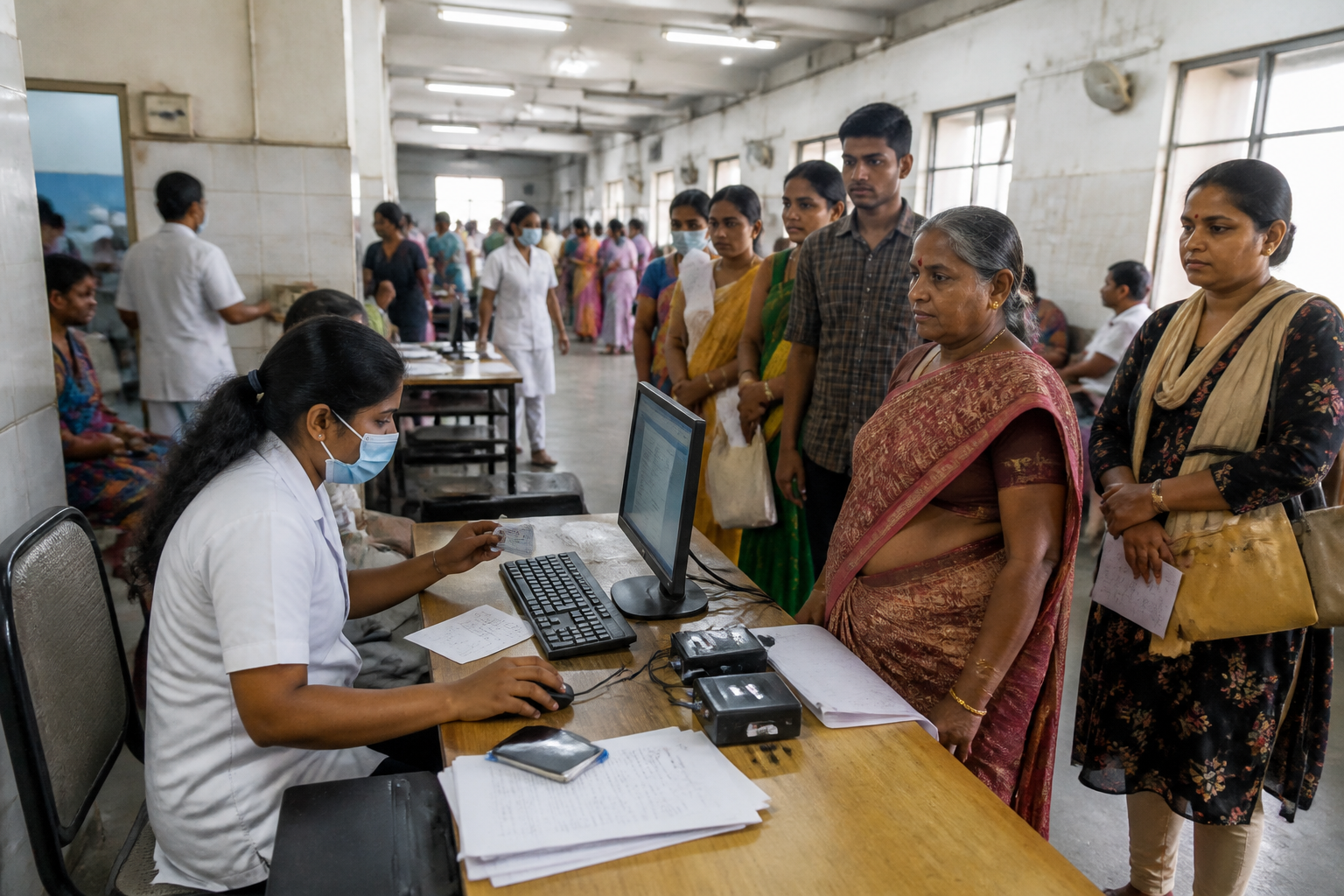
The rollout of ABHA registration in Tamil Nadu government hospitals is revealing a problem that digital systems cannot solve on their own: a long-running shortage of doctors, nurses and other healthcare workers. According to a report by Deccan Chronicle, government doctors say the State has managed staffing gaps through contractual appointments for nearly a decade, while patient footfall, seasonal fever cases and new documentation requirements continue to increase pressure on hospitals.
ABHA, or Ayushman Bharat Health Account, registration is intended to create unique digital health identities and support electronic health records. In the hospitals covered by the report, the process is being implemented through Health Management Information System 3.0. The stated purpose is administrative and clinical continuity: patient information can be linked to a digital identity rather than remaining confined to disconnected paper or institutional records.
But the implementation has brought the relationship between technology and staffing into sharper view. Registration requires people, time, data entry and coordination at the point where patients already meet an overstretched public health system. If the hospital does not have enough personnel to absorb the additional work, a digital reform designed to improve records can add to queues and waiting time. The issue is therefore not whether digital health identification is useful in principle. It is whether the public system has the capacity to operate it without diverting scarce clinical and support staff from patient care.
The report places this question within a manpower crisis that doctors say has persisted for almost 10 years. Their account is that both the Centre and the Tamil Nadu government have increasingly relied on contract-appointed doctors instead of filling regular vacancies. The doctors are demanding regularisation of contractual appointments, equal pay for equal work and better recognition for specialist doctors, including those with BDS and MDS qualifications.
A government doctor quoted in the report said contractual doctors do not receive the salary and service benefits applicable to regular employees. That distinction matters beyond employment conditions. A hospital workforce divided between regular and contractual staff can face differences in pay, benefits, career progression and institutional recognition while performing work in the same service environment. The supplied report does not establish the number of contractual doctors, the number of vacant posts or the financial cost of regularisation. It does, however, identify the employment model as a central part of the staffing dispute.
The shortage is also not limited to specialists. Doctors told Deccan Chronicle that even MBBS doctors are in short supply, particularly in government hospitals handling heavy outpatient loads. Nurses and other healthcare workers are also reportedly affected. This broadens the problem from a specialist recruitment issue to a system-capacity issue. A hospital’s ability to function depends on the combined availability of clinical staff, nursing personnel and workers who manage registration, records, patient movement and other operational tasks.
That distinction is important for understanding the effect of ABHA registration. A health ID may be created at a registration desk, but the process sits inside a chain that includes patient intake, identity verification, record creation and clinical consultation. The report does not provide waiting-time measurements or compare hospitals before and after HMIS 3.0. It therefore cannot establish the size of the delay caused by ABHA registration. It does show why doctors are concerned that the additional documentation could increase waiting time when hospitals are already dealing with heavy outpatient attendance and seasonal fever cases.
The report also highlights a separate recognition issue involving BDS and MDS-qualified doctors. Doctors said dental professionals, including those with specialisations, do not receive adequate recognition within the government healthcare system despite providing specialised dental care. The supplied material does not specify the service rules, sanctioned posts or promotion structures governing these qualifications. The concern nevertheless indicates that staffing policy is not only about headcount. It also concerns how different professional skills are classified, deployed and rewarded within a public institution.
This makes the dispute more complex than a demand for additional recruitment. The State’s response would have to address at least three connected layers: the number of vacant positions, the terms under which existing contract staff work, and the administrative recognition given to different categories of healthcare professionals. The current report does not state whether the government has announced a recruitment calendar, a regularisation policy or a response to the doctors’ demands. Those remain important gaps in assessing the next stage of the issue.
The institutional setting is equally significant. HMIS 3.0 places hospital-level registration within a wider health information system, while ABHA creates a standardised digital identity for health records. Such systems depend on implementation at the facility level. The technology may be centrally designed or supported, but the daily work of enrolling patients and maintaining records occurs in hospitals where staff are also handling consultations, queues and seasonal surges.
This is a familiar governance problem in public infrastructure: a reform is often measured by whether it has been launched, but its public value depends on whether the operating system beneath it can sustain the workload. In this case, registration numbers alone would not show whether the programme is improving care. A fuller assessment would need to examine how many patients are being registered, how long the process takes, whether records are usable across facilities, and whether the exercise changes the time available to doctors and nurses. None of those indicators is provided in the report.
The staffing dispute also exposes the limits of treating digital health as a standalone technology programme. A digital identity can make records easier to organise, but it cannot substitute for a doctor during an outpatient consultation, a nurse managing patient flow or a worker handling data accurately at the registration point. If staffing shortages have continued for nearly a decade, then every new administrative requirement enters a system already carrying accumulated pressure.
For patients, the effect is likely to be experienced not as a debate over employment categories or health-data architecture but as time spent waiting. The report links the concerns to hospitals with high outpatient loads and seasonal fever cases. It does not provide patient interviews or measured delays, so the citizen impact cannot be quantified from the supplied evidence. The operational risk is nevertheless clear in the doctors’ stated concern: when the same limited workforce must deliver clinical services and complete additional documentation, the hospital’s queue-management capacity becomes central to the success of the reform.
The evidence also points to a coordination challenge between policy objectives and workforce planning. ABHA registration seeks more structured health information. Government hospitals need enough personnel to deliver care and maintain that information. Contractual employment may provide a way to fill immediate gaps, according to the doctors quoted, but the report indicates that this arrangement has continued for years. A temporary staffing mechanism operating over such a long period raises questions about whether the workforce plan has kept pace with the permanent needs of the public hospital system.
Those questions cannot be answered fully without official vacancy data, sanctioned-strength figures, staffing ratios, recruitment records and implementation details for HMIS 3.0. The source report does not provide them. It also does not establish whether ABHA registration is being implemented uniformly across Tamil Nadu or whether the pressure is concentrated in particular hospitals. These limitations should prevent broad conclusions about the entire State’s health system.
What the report does establish is a useful warning about sequencing. Digital administration is most effective when the institutions adopting it have the staff and processes required to use it well. In a hospital system facing shortages across doctors, nurses and other workers, the introduction of another layer of documentation can become a test of capacity rather than simply a test of software.
Tamil Nadu’s government hospital staffing debate now sits at the intersection of employment policy, public-service delivery and digital infrastructure. The immediate demands from doctors concern regularisation, equal pay and professional recognition. The wider administrative question is whether the State can expand health-information requirements while resolving the manpower weaknesses that make each new process harder to absorb. The next meaningful developments will be an official response to the demands, details of vacant and sanctioned posts, and evidence showing how ABHA registration is affecting waiting times and hospital operations.
