


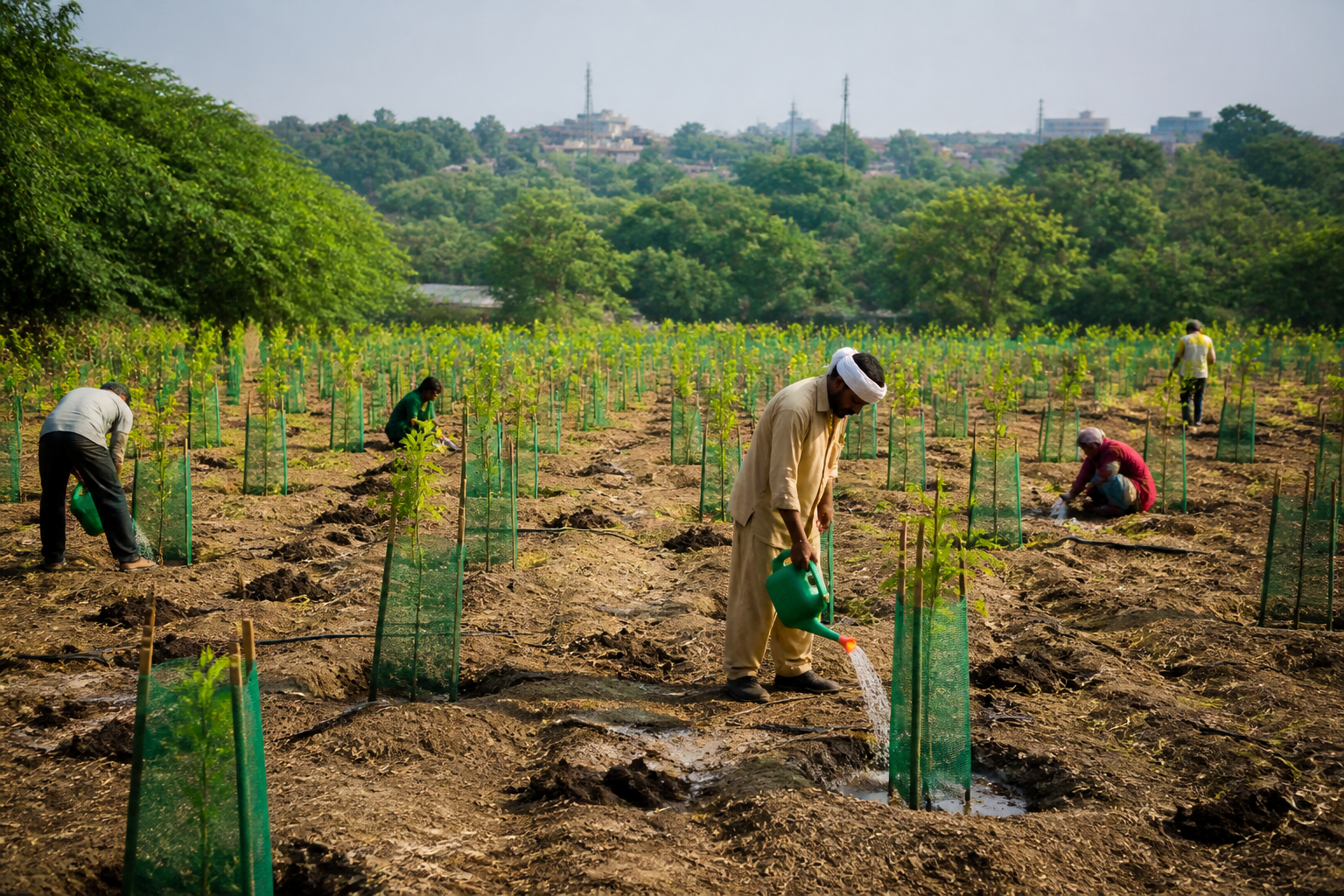
Delhi’s sapling plantation drive has exceeded its numerical target, but the next phase will determine whether the achievement becomes lasting urban green infrastructure or remains a seasonal planting exercise. The Delhi government has reported that 71,12,429 saplings were planted under Mission Green Delhi against a target of 70,73,295, with the administration now shifting its stated focus from planting to conservation and survival.
That shift is significant because the programme’s headline number records an activity, not the eventual ecological outcome. A planted sapling contributes to Delhi’s green cover only if it is protected, watered and allowed to mature. The government has not provided a survival figure in the material available for this report. Its next challenge, therefore, is to build an effective system for nurturing the plants already put into the ground.
The Mega Plantation Drive-2026 began on July 7 during Van Mahotsav and was implemented across the city with the participation of government departments, green agencies, local bodies, educational institutions, resident welfare associations, non-governmental organisations and citizens. The breadth of participation shows that the programme was not assigned to the forest department alone. It depended on a network of public agencies and community institutions, each with a role in expanding and protecting Delhi’s vegetation.
That distributed model also creates an administrative question: who remains responsible after the plantation event ends? The reported figures show that 22 government agencies participated, but their performance against assigned targets was uneven. The forest department planted 32,03,558 saplings against a target of 27,29,200, making it the largest contributor and exceeding its target. The Delhi Development Authority, Municipal Corporation of Delhi and Public Works Department, however, each planted fewer saplings than assigned.
The DDA planted 20.11 lakh saplings against a target of 23.48 lakh. The MCD planted 3.43 lakh against a target of five lakh, while the PWD planted 2.38 lakh against a target of 3.05 lakh. These differences do not by themselves establish whether any agency performed effectively or poorly, because the supplied information does not explain the reasons for the shortfalls, the locations involved or the condition of the planted saplings. They do, however, demonstrate that a single citywide total can conceal different levels of institutional delivery.
For citizens, the practical outcome will be visible not in the plantation register but in neighbourhoods, road edges, institutional campuses and open landscapes. A sapling that survives can eventually provide shade, strengthen local biodiversity and contribute to the city’s green network. A sapling that does not survive adds to the cost of the programme without producing the intended long-term benefit. The government’s appeal to citizens to care for and protect saplings they planted or received therefore places part of the programme’s implementation burden beyond formal agencies.
The Ridge is the most important landscape identified in the reported figures. The government said 24,94,505 saplings were planted across the Central Ridge, DDA Ridge and South Ridge. These areas are being treated as a major focus for ecosystem restoration and biodiversity conservation. The concentration of nearly 25 lakh saplings in the Ridge areas means that the programme is not only a city beautification exercise; it is also connected to the condition of Delhi’s remaining natural green areas.
The Ridge’s role in the programme raises a further institutional issue. Different public bodies operate across Delhi’s land and infrastructure systems, and the plantation figures themselves refer to the forest department, DDA, MCD and PWD as separate participants. The supplied material does not set out the precise maintenance responsibilities for each Ridge location. That information will matter if the government is to assess survival consistently and identify which agency must intervene when a sapling is damaged, lacks water or fails to establish itself.
Chief Minister Rekha Gupta described the achievement as more than the completion of a numerical target. According to the report, she said the programme was intended to expand Delhi’s green cover, strengthen its ecosystem and contribute to cleaner air. She also said the next phase would focus on conservation and nurturing, and that protecting saplings would be as important as planting them.
This change in emphasis moves the programme from a campaign model towards a maintenance model. Plantation drives are comparatively easy to communicate because they produce a clear number: the number of saplings placed in the ground. Survival requires repeated action and monitoring. It involves knowing where each sapling is located, determining who is responsible for it, ensuring that it receives care and recording whether it has matured. The source material confirms the government’s intention to focus on survival, but it does not establish whether a citywide monitoring framework, survival benchmark or public reporting system has been announced.
The data available also shows why the total target needs to be read carefully. The combined figure of 71,12,429 saplings is 39,134 above the target of 70,73,295. That is a numerical achievement of roughly 0.55% above the assigned goal. Yet the reported excess is small in relation to the total programme, making the condition of the saplings more consequential than the margin by which the target was exceeded.
The agency-level figures reinforce the same point. The forest department’s contribution exceeded its target by 4,74,358 saplings, while the DDA, MCD and PWD remained below their respective targets. The citywide total was therefore achieved through different patterns of delivery across agencies. Without survival data broken down by agency, location, species or planting period, it is not possible to determine whether the highest planting numbers will also translate into the strongest ecological outcomes.
The policy landscape described in the report combines government-led plantation, participation by local bodies and public involvement. The forest department, DDA, MCD and PWD represent different parts of Delhi’s administrative and physical landscape, while schools, colleges, RWAs, NGOs and citizens broaden participation beyond government. This arrangement can extend the programme’s reach, but it also makes coordination central to the next phase.
The government’s stated focus on conservation and nurturing will need to be reflected in the way the programme is evaluated. The reported material does not specify a deadline for the next review, a survival rate to be achieved, or the mechanism through which citizens can report damaged or dead saplings. It also does not provide details on watering arrangements, species selection or location-wise maintenance. These are not minor operational details: they determine whether plantation spending produces durable green assets.
Delhi’s green cover is therefore being measured at two different stages. The first is the input stage, represented by the number of saplings planted. The second is the outcome stage, represented by the number that survive and grow into mature trees. Mission Green Delhi has reported progress on the first measure. The government’s own emphasis on survival acknowledges that the second measure remains the more important test.
The central urban question is whether Delhi can convert a large, time-bound plantation campaign into a sustained system of ecological maintenance. The available evidence confirms that the city has exceeded its planting target and that the Ridge received a substantial share of the reported plantation. It does not yet show how many saplings have survived or how responsibility for their care will be tracked across the participating agencies and communities.
The next phase of Mission Green Delhi will therefore be judged less by another planting total than by transparent evidence of survival, maintenance and ecological restoration. Until that information becomes available, the 71.12 lakh figure should be understood as the beginning of the programme’s longer test, not its final outcome.
