


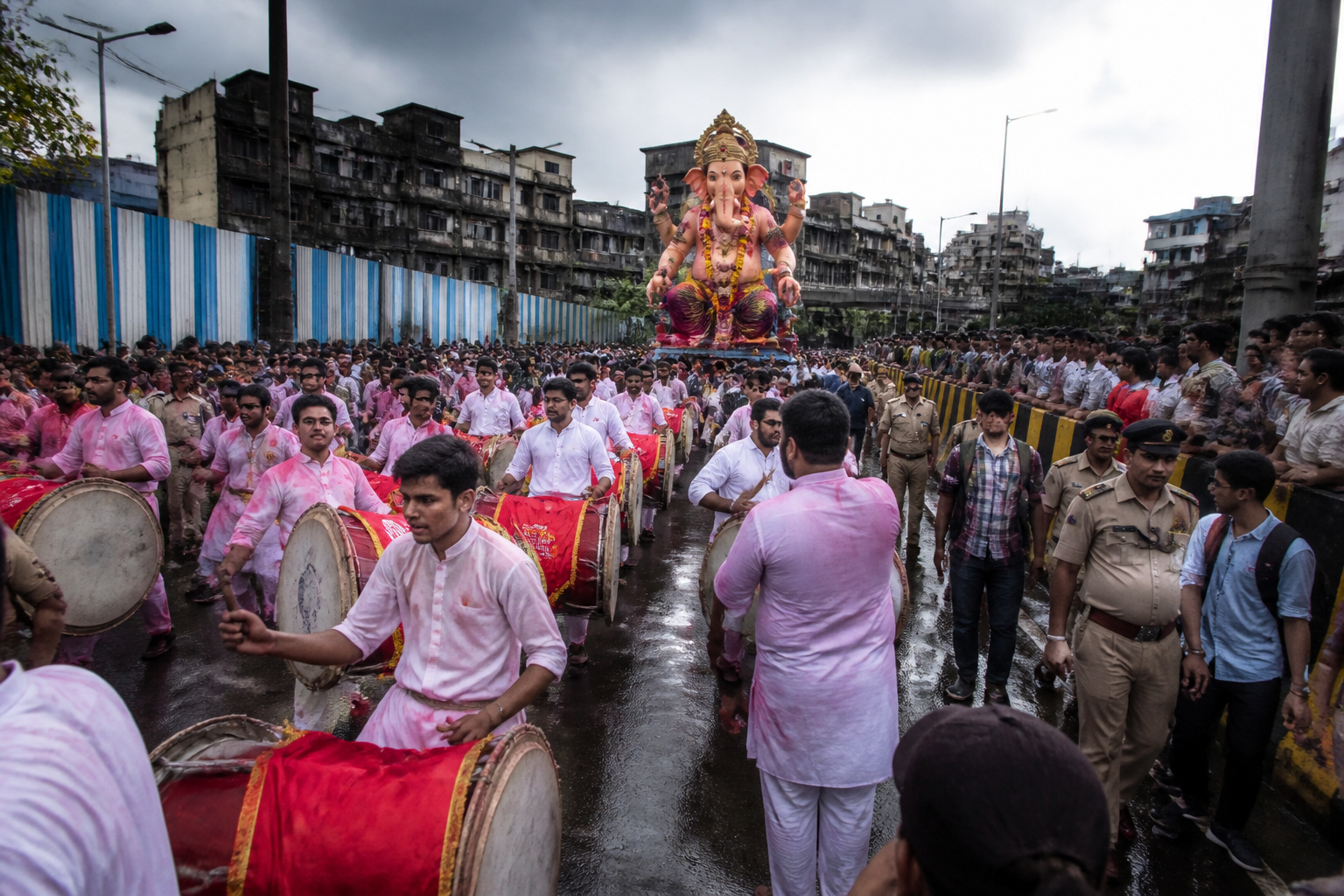
Mumbai’s Ganesh visarjan processions have exposed a familiar weakness in urban governance: regulations can exist on paper, yet fail on the street when authorities do not communicate them clearly or enforce them consistently. A report by Loksatta said immersion processions held on Anant Chaturdashi continued with loud drums, tasha instruments and lezim performances despite directions from the Bombay High Court aimed at controlling noise and air pollution during festivals and processions.
The report said the court had prohibited firecrackers in public places and on roads, along with the use of DJs, laser lights and beams during Ganesh festivals and other religious processions. It also said the police largely remained spectators as processions moved towards immersion sites from Friday morning, with participants using high-volume musical instruments and coloured powder.
The immediate question is whether festival groups deliberately ignored a known legal order. The more important institutional question is how the order reached the people expected to comply with it. According to the report, local police stations delivered copies of the court directions to public Ganesh mandals only late on Thursday night, shortly before the Friday processions. Several organisers reportedly struggled to understand what the order required, while others were uncertain about permissions and financial conditions connected to loudspeaker use.
That timing matters. A regulation communicated hours before a major, pre-planned urban event is not the same as a regulation communicated during the planning period. Ganesh visarjan processions involve route planning, police deployment, traffic management, musicians, sound equipment, volunteers and arrangements at immersion points. By the time the order was circulated, mandals had already made operational and financial commitments. The report said some groups had paid musicians in advance and were therefore placed in a difficult position when the court directions reached them.
The reported confusion also concerned a security deposit of Rs 1 lakh linked to permission for the use of loudspeakers. Organisers were said to be asking where this amount had to be deposited and what the permission process required. The report does not establish whether every mandal was required to pay the amount, whether the condition applied uniformly, or which authority was responsible for receiving it. That lack of clarity is itself significant: urban regulation becomes difficult to enforce when the regulated party cannot identify the applicable procedure, authority or deadline.
This is not simply a dispute between festival organisers and residents affected by noise. It is a test of how courts, state departments, municipal institutions, police stations and community organisations share responsibility for a city-wide public event. The High Court may issue the legal direction, but implementation depends on an administrative chain that must translate the order into understandable instructions, permissions, route-level restrictions and enforcement protocols.
The report indicates that this chain did not function effectively. It said the state government was expected to issue clear instructions to public Ganesh mandals after the court’s order, but that local police stations circulated copies only late on the eve of immersion. The account therefore points to a gap between judicial direction and executive implementation. The order may have been legally binding, but its practical effect was weakened when communication arrived after arrangements had been finalised.
The role of the police is central because the restrictions concerned public roads, sound levels, processions and the use of equipment in spaces shared by millions of residents. Police authorities are responsible not only for crowd control but also for ensuring that legally binding conditions are followed during public events. Yet the report described the police as taking a bystander-like role while the processions continued with loud instruments.
That alleged passivity creates a second governance problem. If enforcement is absent during the event, compliance becomes dependent on the voluntary interpretation of mandals and procession participants. This produces unequal outcomes across neighbourhoods. Groups that spend time understanding and following the rules may face greater constraints than those that proceed as planned. Residents affected by excessive noise, meanwhile, cannot rely on the existence of a court order alone; they need visible, timely and consistent enforcement.
The episode also shows why the regulation of festivals cannot be treated as a last-minute policing exercise. Mumbai’s public celebrations are planned events with predictable dates, routes and operational demands. The report said the festival had continued for 12 days before concluding on Anant Chaturdashi. That calendar provided authorities with a substantial planning window, even if the specific court order arrived later. Instructions, permissions and enforcement arrangements could have been translated into public notices and mandal-level guidance before the final procession day.
The distinction between a legal prohibition and an implementable rule is important. A court may prohibit DJs, laser lights, beams and firecrackers, but organisers still need to know how those restrictions apply to traditional drums, tasha groups, loudspeakers and other instruments. They also need to know who will inspect equipment, what constitutes a violation, how complaints will be recorded and what action will follow. Without that operational layer, enforcement can become arbitrary or symbolic.
The report does not provide sound-level measurements, the number of violations, the number of processions affected or details of police action against particular mandals. It also does not reproduce the full High Court order. Those limitations mean the scale of the breach cannot be independently assessed from the supplied account. What can be established is narrower but important: the report described continued use of loud instruments, late circulation of the order, confusion among organisers and an absence of visible enforcement.
The institutional lesson is that court orders affecting large public events require a coordinated implementation mechanism. The state government, police, municipal administration and event organisers must receive the same instructions early enough to act on them. Public communication must explain both the restriction and the compliance route. A copy of an order delivered at the last moment is not an adequate substitute for a preparedness plan.
Mumbai’s immersion processions also reveal the difficulty of managing competing claims over public space. Festivals occupy roads, require traffic diversions, generate noise and air pollution, and bring large numbers of people into common areas. These activities can be socially important while still being subject to public-health and environmental restrictions. The administrative challenge is not to treat regulation as an afterthought, but to build it into the event from the beginning.
The reported events leave several questions for the authorities: when did the government and police receive the High Court directions; why were mandals informed only late on Thursday; what exactly did the Rs 1 lakh security-deposit condition apply to; how were traditional instruments distinguished from prohibited sound systems; and what enforcement record was created during the processions? The supplied report does not answer these questions.
What it does show is that Mumbai’s noise-control framework failed at the point where law meets implementation. The High Court’s directions addressed pollution and public-event practices, but the reported response was late communication followed by weak enforcement. Future festivals will be governed not only by the wording of court orders, but by whether authorities can convert those orders into clear instructions, timely permissions and accountable action before processions begin.
