


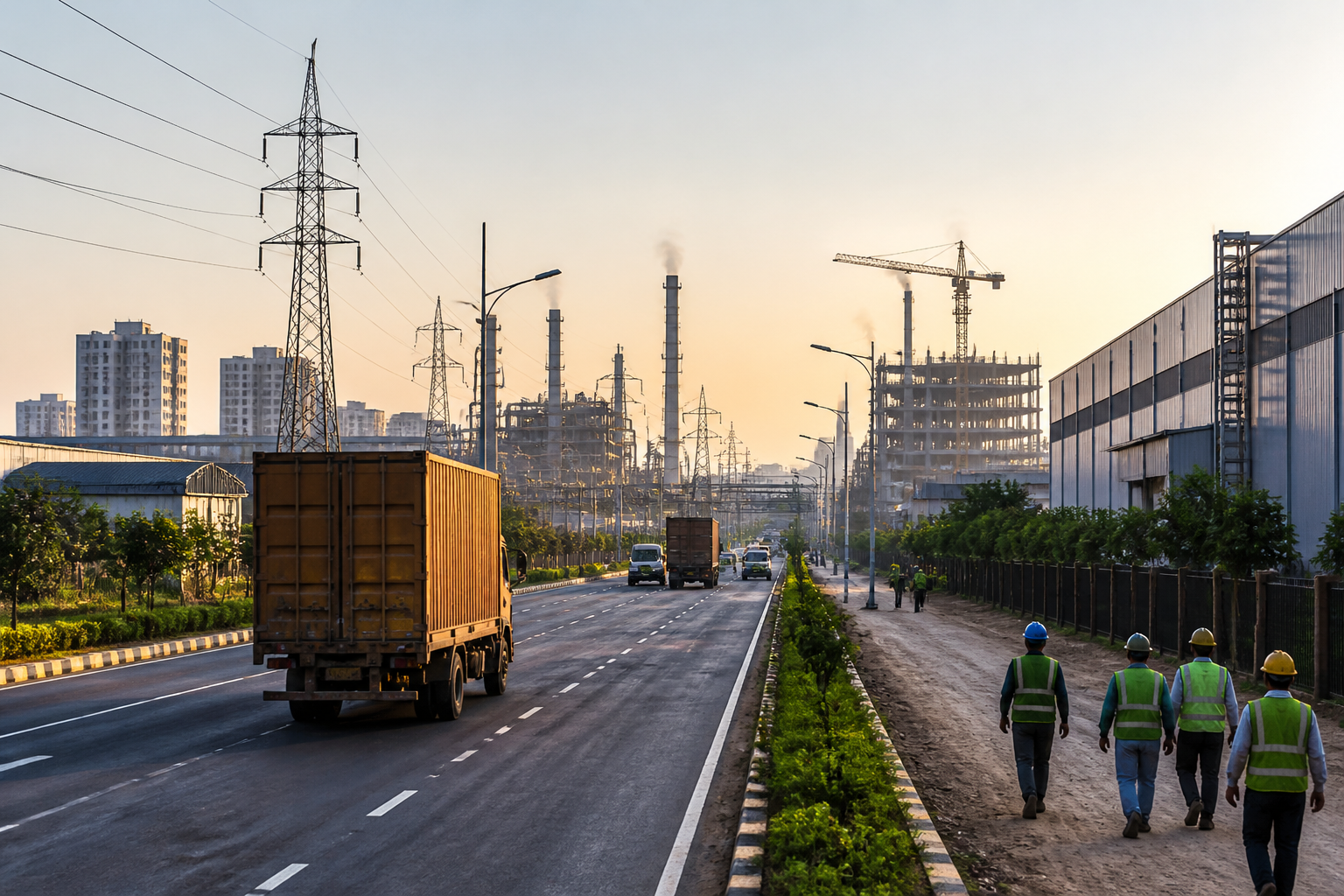
India’s record foreign direct investment inflow of $94.53 billion in FY 2025-26 is being presented by the government as evidence that its investment and manufacturing strategy is gaining traction. But the larger urban significance of the figure lies elsewhere: foreign capital, production incentives and industrial-corridor infrastructure are increasingly being tied to the creation of new economic geographies beyond established metropolitan centres.
Commerce and Industry Minister Piyush Goyal said the annual FDI inflow was the highest ever, taking cumulative receipts between FY 2014-15 and FY 2025-26 to $843 billion. He linked the figures to the government’s manufacturing push and to the 12-year milestone of the Make in India campaign, marked on September 25.
The number is important, but it does not by itself explain how investment is changing Indian cities. FDI receipts are a financial measure. Urban transformation depends on what follows: where capital is deployed, whether it creates durable production capacity, how industrial land is serviced, whether workers can reach employment centres, and whether local governments can support the population and infrastructure needs that accompany new manufacturing activity. The supplied figures establish the scale of inflow, but do not provide a state-wise or city-wise breakdown.
That distinction matters because industrial investment does not remain confined to factories. It generates demand for roads, power, water, logistics, housing, public transport, schools, healthcare and waste management. When these systems are planned together, industrial development can support a more balanced urban economy. When they are not, investment may produce isolated enclaves of production alongside congested roads, informal housing and overstretched civic services.
The government’s account connects the FDI record with the Production Linked Incentive, or PLI, schemes. As of March 31, the schemes had attracted Rs 2.40 lakh crore in actual investment and generated Rs 23.8 lakh crore in production and sales, according to Goyal. PLI-supported sectors recorded Rs 15.2 lakh crore in exports and generated more than 14.6 lakh direct and indirect jobs, he said.
These figures suggest that the policy framework is intended to move beyond attracting capital into India and towards building domestic production ecosystems. Electronics and telecom, pharmaceuticals, medical devices, automobiles, IT hardware and speciality steel were identified as sectors that had benefited significantly from the incentives. Each has different land, logistics, energy, workforce and environmental requirements, making the infrastructure challenge more complex than simply allocating industrial plots.
The distinction between investment and production is central to understanding the policy. An investment commitment can signal future capacity, while actual investment indicates money deployed. Production and exports provide a further measure of activity, and jobs indicate a potential connection with household incomes. The figures cited by the minister cover all these stages, but the report does not provide sector-wise or location-wise data that would show how evenly the gains are distributed.
Nor does the available information establish the quality of the jobs created, their geographical distribution or the extent to which indirect employment has been measured. More than 14.6 lakh direct and indirect jobs is a substantial headline figure, but the supplied report does not distinguish between permanent and temporary work, formal and informal employment, or jobs located within industrial cities and those generated elsewhere in supply chains. Those details are essential for assessing the urban consequences of the manufacturing push.
The government is also developing greenfield industrial smart cities under the National Industrial Corridor Development Programme. The stated objective is to create infrastructure that can support globally competitive manufacturing. This approach reflects a broader policy shift: instead of treating industrialisation as a factory-level activity, the state is attempting to build planned production districts with supporting infrastructure from the outset.
A greenfield industrial city, however, is not defined only by its roads, utilities or factory sites. Its performance will depend on whether the surrounding urban system can accommodate workers, suppliers, transport services and public institutions. Industrial corridors may connect production centres to ports, highways and markets, but the last-mile relationship between employment and housing remains a crucial urban question. The supplied report does not provide details of the cities, their implementation stages, financing arrangements or planned residential and civic infrastructure.
That absence does not weaken the significance of the policy. It identifies the next layer of scrutiny required. The success of an industrial corridor cannot be assessed only through capital inflows or the value of goods produced. It must also be assessed through the reliability of power and water, the time and cost of moving goods, access to affordable worker housing, and the capacity of municipal institutions to manage growth. None of these outcomes can be assumed from the FDI figure alone.
The government has placed ease-of-doing-business reforms alongside industrial incentives and corridor development. Goyal said reforms had simplified regulations and reduced the compliance burden, while sectoral reforms had opened further opportunities for investment and manufacturing. For companies, regulatory simplification can reduce the time and uncertainty associated with establishing operations. For cities, however, faster investment must still operate within land-use, environmental, building and public-service systems.
This creates an institutional challenge. Investment facilitation is often driven by central and state agencies, while many daily urban services are delivered by municipal bodies. Industrial land and trunk infrastructure may be planned at a regional or state level, but local authorities must deal with traffic, drainage, solid waste, housing pressure and public health. The report does not specify how responsibilities are divided across the projects mentioned by the minister, leaving an important governance question open.
The FDI figure also needs to be read alongside the changing role of manufacturing in India’s urban economy. The sectors cited by the government range from electronics and IT hardware to automobiles, pharmaceuticals and speciality steel. They do not require the same kinds of infrastructure or generate the same employment patterns. Electronics and medical devices may depend heavily on reliable power, specialised suppliers and skilled labour. Automobiles require extensive component networks and freight connectivity. Pharmaceuticals and speciality steel bring their own requirements for compliance, utilities and industrial land.
This sectoral diversity means that there is no single model for an industrial city. A manufacturing centre built around automobile production will have different transport and housing needs from one focused on electronics or pharmaceuticals. Planning that treats every corridor as a standardised investment zone may fail to match infrastructure with the requirements of the industries it is meant to attract. The available report identifies the sectors but does not provide the information needed to compare their urban footprints.
The government’s figures nevertheless point to a connected policy chain: foreign investment is being linked to manufacturing incentives; manufacturing is being linked to exports and employment; and industrial activity is being linked to planned infrastructure through industrial corridors and smart cities. The strength of that chain will depend on whether each link produces measurable outcomes rather than only announcements or aggregate totals.
The reference to more than 470 crore orders placed through the Open Network for Digital Commerce adds another dimension to the government’s account. ONDC is presented as evidence of expanding digital commerce, although the report does not explain how the orders relate to manufacturing investment or industrial-city development. Its inclusion indicates the government’s effort to present physical production, digital markets and ease-of-doing-business reforms as parts of one broader economic transformation.
For urban policymakers, the practical question is how these national programmes translate into local capacity. A rise in manufacturing can bring new jobs and business activity, but it can also increase pressure on transport networks and land markets. The evidence supplied confirms investment, production, exports and job figures at the national level. It does not yet confirm whether industrial cities are receiving matching improvements in affordable housing, public transport, civic services or local administrative capacity.
That is why the $94.53 billion FDI figure should be treated as a starting point rather than a complete account of industrial transformation. It establishes a record inflow and supports the government’s claim that its investment and manufacturing policies are producing measurable economic activity. It does not, on its own, reveal the spatial distribution of that activity or the quality of the urban systems being built around it.
The next phase of scrutiny will need to focus on project-level data: where the investment is located, how much of it has become operational, what infrastructure has been delivered, and how employment is being measured. Until those details are available, the clearest conclusion is that India is tying foreign investment more closely to a planned manufacturing and infrastructure agenda, while the urban consequences of that agenda remain unevenly documented.
