


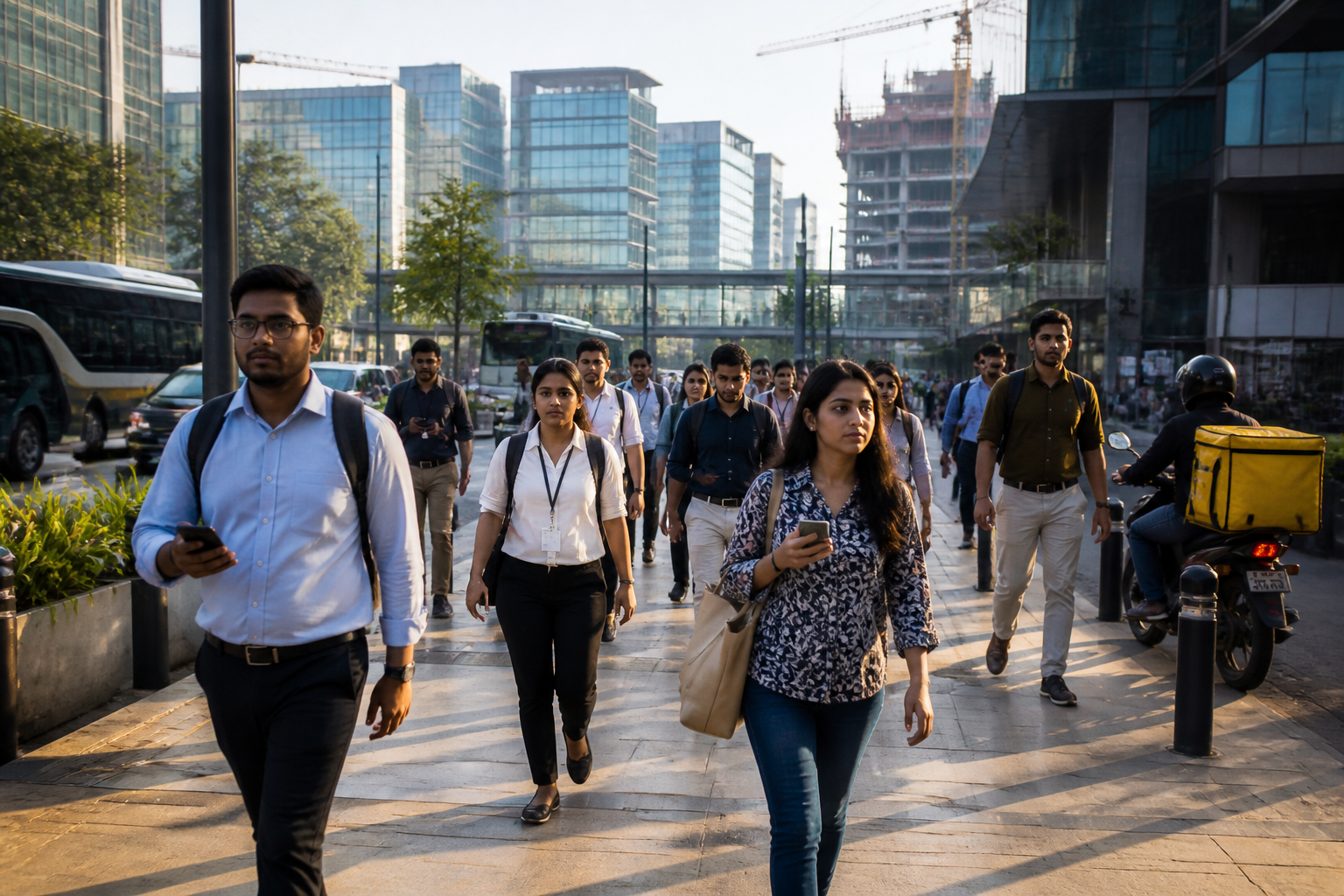
India’s hiring outlook is improving, but the latest employment surveys point to a labour market that is becoming more selective rather than broadly secure. TeamLease Services projects a 5.4 per cent net employment change between October 2026 and March 2027, up from 4.7 per cent six months earlier. Yet the same evidence shows that employers are concentrating opportunity in specific sectors, cities and skill profiles, while many graduates remain unprepared for entry-level work.
That makes the employment story an urban story. The strongest hiring intentions are clustered in cities that already function as technology, services and business hubs. Bengaluru is the leading target location, named by 68 per cent of employers surveyed, followed by Hyderabad at 61 per cent and Pune at 60 per cent. The figures suggest that the geography of opportunity remains concentrated even as companies report renewed confidence in hiring.
The TeamLease survey covered 1,239 employers across 23 industries and 20 cities. Six in ten employers said they planned to expand their workforce in the coming months, while 16 per cent expected to reduce headcount and the remainder anticipated no change. Large enterprises recorded the strongest hiring intent, at 66 per cent, followed by startups and small businesses at 59 per cent.
The headline improvement, however, does not mean that employment growth is evenly distributed. E-commerce and technology startups recorded the highest projected net employment change, at 12.6 per cent. Travel and hospitality followed at 12.3 per cent, while retail, automotive and electric vehicles completed the five leading sectors. At the other end, BPO and educational services were close to flat.
This pattern matters for cities because sectoral hiring creates demand for particular kinds of urban infrastructure and services. Expanding technology, e-commerce, retail, travel and automotive activity can increase demand for office space, logistics facilities, transport connections, rental housing and social infrastructure. But the supplied survey does not establish how many jobs will be created in each city, whether they will be formal or informal, or whether existing housing and transport systems can absorb the additional workforce.
What it does establish is that employers continue to favour a limited group of urban labour markets. Bengaluru, Hyderabad and Pune occupy the top three positions in the location preferences reported by the survey. Their prominence reflects the continuing strength of established technology and business ecosystems, even as companies experiment with distributed work and seek talent beyond the largest metropolitan centres. The figures do not show that smaller cities are excluded, but they do show that the most frequently identified destinations remain established urban hubs.
The occupational data adds another layer. Sales and marketing roles are in the highest demand, followed by IT and engineering. Blue-collar positions also show solid interest, at 24 per cent. This combination challenges a simple reading of the employment recovery as a technology-only phenomenon. The demand spans customer-facing work, technical occupations and operational roles. In urban terms, it points to a labour market that requires both highly specialised workers and a large workforce capable of supporting consumption, logistics, mobility and service delivery.
The challenge is that the supply of workers is not matching employer expectations. A separate Gi Group Holding survey cited in the report found that 64 per cent of employers said fewer than 40 per cent of entry-level candidates cleared initial skill and domain assessments. Among Tier-2 and Tier-3 graduates, 49 per cent said they felt completely unprepared on their first day of work. The contrast between expanding opportunity and weak work readiness is central to understanding the employment outlook.
The gap is not simply a question of the number of degrees awarded. Forty-two per cent of employers said candidates failed interviews because they could not apply practical skills. At the same time, 91 per cent of employers did not regard a Tier-2 or Tier-3 degree as proof of capability. Yet 35 per cent still preferred degree holders over skill-certified candidates for entry-level jobs. This produces an inconsistent hiring system in which degrees remain important, but are no longer sufficient evidence of readiness.
Government skilling programmes also face a credibility problem in the employer market described by the survey. Forty-seven per cent of employers assigned little or no hiring weight to government skilling certificates. The finding does not establish why employers discount these credentials, but it indicates a weak connection between training systems and recruitment decisions. A certificate that does not provide a clear signal of practical capability has limited value in a competitive urban job market.
The implications extend beyond recruitment offices. When employers cluster in cities but training outcomes remain uneven, workers may need to migrate to access better opportunities without having a reliable way to assess whether they are job-ready. That can increase pressure on rental housing, transport networks and household finances. The supplied material does not quantify migration or housing demand, but the concentration of hiring intentions in Bengaluru, Hyderabad and Pune provides a clear indication that employment geography will continue to shape urban growth.
The skills employers want also appear to be changing. Digital literacy was the most frequently cited requirement in the TeamLease survey, named by 59 per cent of employers. Communication skills and teamwork followed. Hard technical skills such as data analysis and automation ranked lower than adaptability and critical thinking. This suggests that employers are seeking workers who can function across changing workflows, rather than relying only on narrow technical qualifications.
Artificial intelligence adds uncertainty to that transition. About 85 per cent of employers said they were already using AI or GenAI tools in some part of their workforce. However, only 13 per cent had scaled AI use across more than half of their workforce. The evidence therefore points to widespread experimentation but limited organisational adoption.
For cities, the important issue is not only whether AI will replace jobs. The supplied figures do not support a conclusion about job losses or gains attributable to AI. They do show that employers are adopting the tools unevenly and that most have not yet integrated them across a majority of their workforce. This creates a parallel demand for digital literacy, adaptability and critical thinking, particularly in cities where firms compete for workers who can operate through periods of technological change.
The labour-code transition introduces another institutional variable. Thirty-nine per cent of employers expected higher compliance and payroll administration costs, while 35 per cent anticipated revisions to basic pay and allowance structures. Some employers also expected salary increments to slow. These findings show that hiring decisions are shaped not only by demand for products and services, but also by the administrative and financial consequences of employment regulation.
Economic conditions were identified as the single biggest factor influencing hiring decisions, cited by 80 per cent of employers in the second half of the 2026 financial year, compared with 67 per cent six months earlier. This rise is important because it places the reported hiring confidence within a broader constraint. Companies may intend to recruit, but their decisions remain sensitive to the economic environment and the cost of expanding payrolls.
Taken together, the surveys describe a labour market with three simultaneous movements. Hiring intent is recovering, but it is concentrated in particular sectors and cities. Employers want broader workplace capabilities, but many graduates do not meet practical assessment standards. Companies are experimenting with AI, but most have not scaled adoption. These are not separate trends: they reinforce one another by increasing the value of workers who can combine digital familiarity with communication, teamwork, adaptability and critical thinking.
The central urban question is whether cities can convert concentrated hiring into inclusive employment growth. The evidence supplied here cannot answer whether Bengaluru, Hyderabad and Pune have sufficient affordable housing, transport capacity or public services for future workforce expansion. It also cannot establish whether Tier-2 and Tier-3 cities will capture a larger share of new jobs. What it does show is that the current opportunity structure remains closely tied to established urban hubs, while the education and skilling systems are struggling to provide employers with credible signals of capability.
India’s hiring outlook is therefore positive in headline terms but conditional in practice. Employers are preparing to recruit, particularly in e-commerce, technology startups, travel, hospitality, retail, automotive and electric vehicles. The next test will be whether training credentials become more trusted, whether workers can adapt to AI-enabled workplaces, and whether cities beyond the leading hubs can connect their graduates to expanding sectors. Those developments will determine whether the employment recovery becomes a wider urban opportunity or remains concentrated among firms, workers and locations already best positioned to benefit.
