


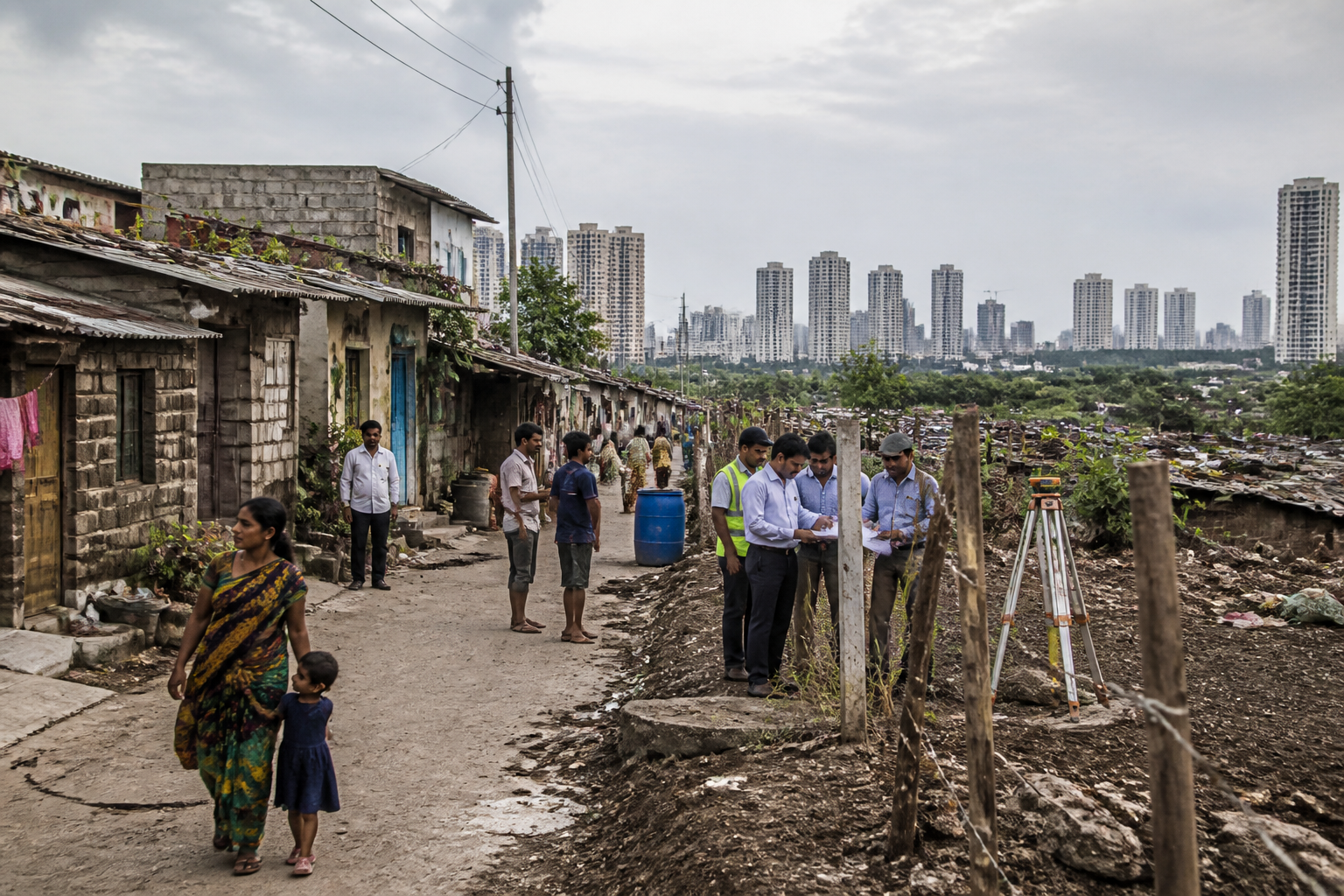
The Maharashtra government’s decision to examine regularisation of residential encroachments on state and central government land in Mumbai, Pune and Pimpri-Chinchwad is more than an administrative extension of an earlier policy. It opens a difficult question for the state: how can long-standing occupation be brought within a formal housing and land-governance framework without turning public land into an unstructured entitlement?
The decision does not yet regularise every eligible encroachment. Instead, it creates a 10-member committee under the Konkan divisional commissioner to prepare a comprehensive policy for the three metropolitan areas and submit recommendations to the Revenue Department within three months. The distinction is important. The government has announced the policy direction and institutional mechanism, but the precise eligibility rules, documentation requirements, treatment of central government land and implementation process are still to be determined.
The areas covered are Mumbai city, Mumbai suburban district, Pune and the Pimpri-Chinchwad municipal corporation regions. The government’s stated cut-off is residential encroachments on state and central government land that existed up to 1 January 2011. That date creates an administrative boundary between older occupation that may be considered for regularisation and later construction that may fall outside the proposed framework. However, the supplied announcement does not specify how the date will be established on the ground, what documents residents will need or how disputed claims will be handled.
Mumbai-Pune encroachment regularisation and the missing policy details
The immediate background is a Revenue Department policy decision dated 25 March 2026 concerning residential encroachments on government land across Maharashtra before 1 January 2011. Mumbai, Pune and Pimpri-Chinchwad municipal areas had been excluded from that decision. The latest move brings those excluded urban areas into a separate policy exercise rather than automatically applying the earlier framework to them.
That separation reveals the administrative complexity of the three regions. The committee is expected to examine land controlled by both the state government and the Union government, while also considering areas connected to municipal bodies and housing authorities. The committee will include the collectors of Mumbai city, Mumbai suburban district and Pune, representatives of the Mumbai and Pune Slum Rehabilitation Authorities, and representatives of the municipal corporations of Mumbai, Pune and Pimpri-Chinchwad. The Konkan divisional commissioner will chair it.
This composition matters because regularisation is not solely a revenue decision. The Revenue Department may determine the legal and administrative treatment of government land, but land parcels in large cities are also tied to municipal planning, rehabilitation policy, public infrastructure and the responsibilities of different land-owning agencies. The inclusion of collectors, municipal representatives and Slum Rehabilitation Authority representatives indicates that the government expects the policy to cut across these institutional boundaries.
The committee has been asked to study existing policies of the Slum Rehabilitation Authority, the Maharashtra Housing and Area Development Authority and other authorities before recommending a comprehensive framework. The source report does not state which provisions will be adopted or modified. It also does not establish whether regularisation will involve ownership, long-term tenure, lease arrangements, rehabilitation benefits or another legal form. Those questions will determine whether the eventual policy provides durable housing security or only a limited administrative recognition of occupation.
The government has also assigned the committee the responsibility of making special recommendations for encroachments on land belonging to the central government or agencies under it. This is likely to be one of the most consequential parts of the exercise, because the state government’s committee may be able to recommend a framework but cannot, on the basis of the supplied information, be assumed to have unilateral authority over every parcel held by a central agency.
What the three-month process can and cannot settle
The committee’s three-month deadline creates a clear first milestone: a report with recommendations to the Revenue Department. It does not, by itself, establish a final regularisation mechanism. Further government decisions, notifications or approvals would be required before residents could know whether a particular settlement, structure or household qualifies.
The first challenge will be defining the unit of eligibility. The announcement refers to residential encroachments existing up to 1 January 2011, but the supplied material does not clarify whether eligibility will be assessed building by building, household by household, settlement by settlement or according to the status of the land parcel. Each approach would produce different administrative consequences. A household-based process could require extensive individual records. A settlement-based process could be faster but would need safeguards for residents whose claims differ from the broader settlement’s status.
The second challenge will be evidence. Establishing that a residence existed before the cut-off date requires records that may not be uniformly available. The announcement does not list acceptable documents or explain how cases without formal records will be assessed. That gap is not a minor procedural detail. It could determine who benefits from the policy, how disputes are resolved and whether residents face repeated verification exercises.
The third challenge is the relationship between regularisation and urban planning. The decision concerns residential occupation, but the committee is also expected to study policies administered by housing and rehabilitation authorities. The supplied report does not say whether regularisation will be permitted only where settlements meet planning, safety or infrastructure conditions. It also does not specify how the policy will address locations required for roads, public facilities, utilities or other government purposes.
These unresolved questions are especially relevant because the policy covers four major urban jurisdictions rather than a single settlement or district. Mumbai city, Mumbai suburban district, Pune and Pimpri-Chinchwad have different administrative structures and land-owning agencies. A single framework may provide consistency, but its implementation could still require different procedures for different authorities and land categories.
The numbers currently available describe the process rather than the scale of the problem: a 1 January 2011 eligibility cut-off, a 10-member committee and a three-month deadline. The supplied report does not provide the number of affected homes, settlements or residents, nor does it estimate the area of state or central government land involved. Without those figures, the public significance of the decision is clear, but its financial, spatial and administrative scale remains unestablished.
A shift from exclusion to negotiated governance
The government’s move changes the status of Mumbai, Pune and Pimpri-Chinchwad within the broader policy conversation. These areas were left outside the 25 March Revenue Department decision and are now being considered through a dedicated committee. That sequence suggests that the urban regions require a more tailored framework, although the government has not publicly stated in the supplied material why they were originally excluded or why a separate process is now preferred.
The institutional design also places coordination at the centre of the exercise. The committee brings together district administration, municipal corporations and rehabilitation authorities, while being chaired by a divisional commissioner and reporting to the Revenue Department. Its recommendations will therefore have to reconcile land records, municipal responsibilities, rehabilitation policy and the claims of residents occupying government land.
For residents, the immediate outcome is not a confirmed title or guaranteed regularisation. It is the opening of a policy process that may eventually define eligibility and procedure. For public agencies, the process creates an opportunity to establish common rules across major urban areas, but it also requires them to clarify which agency controls each parcel and how conflicting public objectives will be handled.
The next decisive document will be the committee’s report, due within three months. Its recommendations will need to show how the 1 January 2011 cut-off will be applied, how state and central government land will be treated, which existing authority policies are relevant and what subsequent approvals will be necessary. Until those details are released, the decision confirms a new policy direction but not the final legal or housing outcome for individual occupants.
