


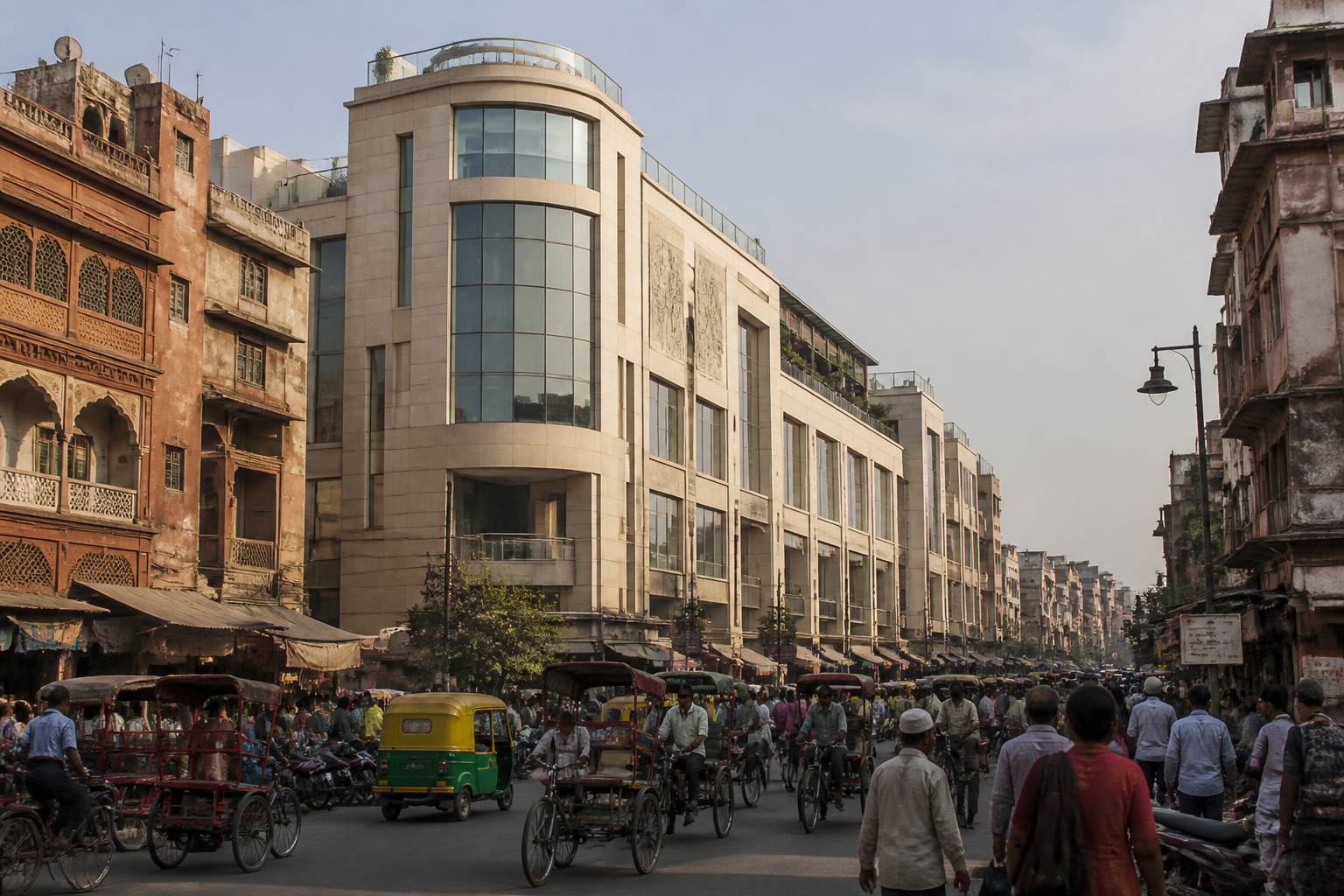
The dispute over Omaxe Mall sub-leasing in Chandni Chowk is not only about 10 shops in a complex with 850 units. It raises a larger question about how the Municipal Corporation of Delhi manages valuable public land when a private concessionaire receives development and operating rights under a 99-year lease.
AAP councillors raised the issue during an MCD standing committee meeting, alleging that shops at the mall were being sub-leased without the approvals required under the Delhi Municipal Corporation Act. They said 10 shops had already been sub-leased and sought a halt to the process until the legal and administrative position was clarified.
MCD officials gave a different account. According to the report, they said the lease deed allowed the concessionaire to sub-lease shops and that the arrangement could generate Rs 30 crore in revenue for the civic body. Omaxe’s media team also said the provision for leasing and sub-leasing had been included in the request for proposal and bid documents governing the public-private partnership project.
The disagreement therefore centres on two separate questions. The first is whether the project documents permitted sub-leasing. The second is whether a separate approval from the relevant MCD authority was still mandatory before the concessionaire could exercise that right. The supplied report does not establish the wording of the lease deed, the approval record or the precise statutory provision at issue. That missing documentary layer is central to understanding the dispute.
The institutional problem is familiar in public land projects: rights are distributed across contracts, laws and administrative procedures, while public accountability is often judged through a different channel. A concession agreement may define what a private operator can do, but municipal law may prescribe how those rights must be approved or supervised. When the two are not read together, a project can appear contractually authorised and procedurally questionable at the same time.
That distinction matters because the land was reportedly given to the concessionaire on a 99-year lease. A lease of that duration is not an ordinary short-term commercial arrangement. It creates a long period in which decisions about occupation, transfer, licensing and revenue can shape how a public asset is used. In such cases, approval procedures are not merely internal paperwork. They determine which public authority has visibility over changes in control and how the city records the financial value generated from its land.
The allegations made by AAP councillor and standing committee member Praveen Kumar focus on this institutional control. Kumar alleged that the executive wing of the civic body permitted sub-leasing without following the mandated approval process under the Delhi Municipal Corporation Act. He further argued that approval would be necessary even if the underlying agreement permitted sub-leasing.
The MCD’s response, as reported, focuses on the commercial and contractual basis of the arrangement. An official said that the lease deed allowed sub-leasing and that issuing licences and sub-leasing shops would generate Rs 30 crore in revenue for the corporation. Omaxe similarly maintained that the relevant provision was already contained in the request for proposal and bid documents.
These positions are not necessarily mutually exclusive, but they point to different standards of accountability. The corporation’s revenue estimate addresses the financial return from the arrangement. It does not, by itself, settle whether the approval process was followed. Conversely, an allegation that approval was absent does not establish that the sub-leasing provision was invalid. The answer depends on the documents and the division of powers between the project agreement and the municipal approval system.
The standing committee’s intervention reflects that uncertainty. Chairperson Satya Sharma sought clarity, particularly because no committee was in place in 2023. Councillors demanded that the sub-leasing process be stopped until the issue was resolved. The reference to the absence of a committee adds an administrative dimension to the dispute: the question is not only what the concessionaire was allowed to do, but also which body was authorised to examine or approve the decision at the relevant time.
For cities, this is an important feature of public-private partnership governance. PPP projects are often presented as a way to combine public land or public authority with private investment and operational expertise. But the contract is only one part of the governance structure. Municipal bodies must still maintain records, enforce statutory requirements, monitor the use of the asset and protect the public value embedded in the land.
The Omaxe Mall case, based on the reported positions, shows how that governance can become contested after the project is already operational. The disagreement emerged when sub-leasing activity was being considered or undertaken, rather than at the initial stage of awarding the project. By then, the key questions had shifted from whether the concessionaire could develop the site to whether it could allocate individual commercial spaces and under what authority.
The number of shops involved is also relevant. The report says 10 of 850 shops had already been sub-leased. That figure indicates that the dispute was identified at an early stage of the reported process, but it does not resolve the broader issue. If the arrangement is legally and procedurally valid, the number may simply represent the beginning of a permitted commercial process. If approvals were required and absent, the same early stage may be the point at which the corporation can still prevent the practice from expanding.
The reported Rs 30 crore revenue figure further illustrates the competing pressures facing municipal administration. Civic bodies need revenue, and monetising commercial activity on municipal land can appear financially attractive. Yet revenue generation cannot substitute for a clear approval chain. A municipal asset may produce income while still being managed through a process that councillors consider inadequate. The institutional question is whether the corporation can demonstrate both the legality of the arrangement and the basis of the projected return.
The controversy also highlights the importance of transparent project documentation. In a long-term lease, the request for proposal, bid documents, lease deed, licences and municipal approvals form a connected record. Each document may answer a different question: what was offered to bidders, what was contractually accepted, what rights were granted, and what approvals were required before those rights could be exercised. Without access to that record, public discussion remains dependent on competing interpretations.
This is particularly significant in a dense and commercially important area such as Chandni Chowk, where redevelopment and formal retail infrastructure affect land use, trading patterns and the relationship between municipal authority and private operators. The supplied report does not provide details on the mall’s full redevelopment history, the terms of the concession or the distribution of lease revenue. Those facts should not be inferred. But the reported dispute is enough to show that the management of commercial space in a public-asset project has consequences beyond individual shop transactions.
The administrative timeline is another unresolved element. AAP councillors questioned the process in light of the absence of a standing committee in 2023, while the current committee sought clarity. The report does not state when the sub-leasing approvals were issued, which authority signed them, or whether the committee’s role was mandatory at that stage. Those details would determine whether the controversy concerns a procedural omission, a disagreement over jurisdiction or a conflict between the contract and municipal law.
The immediate significance of the case therefore lies in the records that the MCD and the concessionaire can produce. The lease deed and project documents would establish whether sub-leasing was contemplated. The municipal file would show whether approvals were sought and granted. The statutory basis would clarify whether the executive wing could act independently or whether committee approval was required. The revenue calculation would explain how the Rs 30 crore figure was derived.
Until those questions are answered, the Omaxe Mall sub-leasing dispute remains a contest between a contractual explanation and a procedural objection. The MCD and Omaxe say the project framework permitted the activity, while AAP councillors argue that permission under the project documents did not remove the need for statutory approval. The reported decision to seek clarity, alongside the demand to pause the process, places the next step with the civic authorities and the relevant committee.
What the case ultimately tests is whether a 99-year municipal land arrangement can be governed through clearly documented, publicly accountable rules when commercial rights are transferred within the project. The available reporting establishes the competing claims and the proposed revenue benefit, but not the final legal position. That position will depend on the lease, bid documents, approval records and the MCD’s determination of the applicable procedure.
