


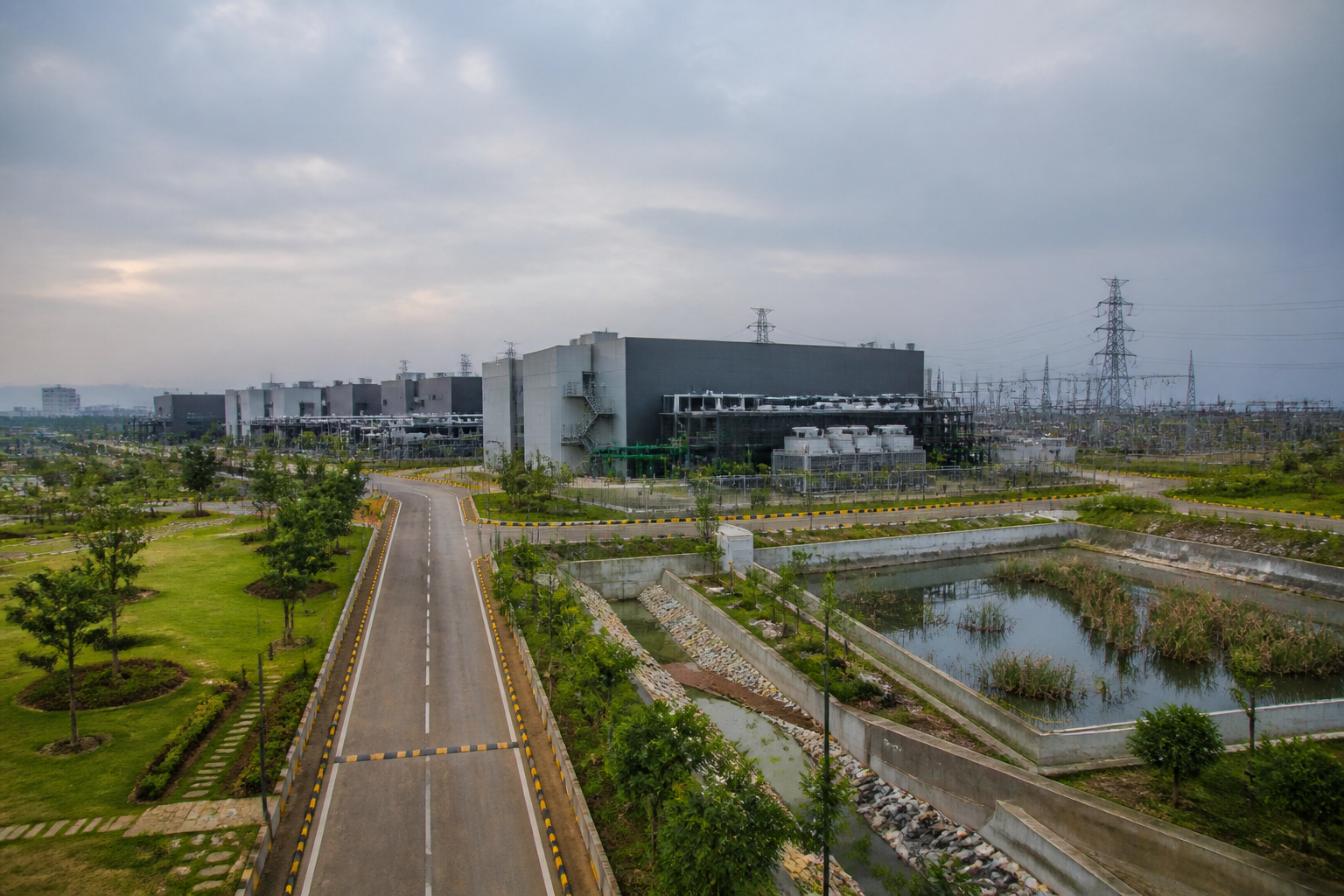
Telangana’s plan to reach 5 GW of data centre capacity by 2029 places Hyderabad and the wider State at the centre of India’s rapidly expanding digital infrastructure economy. It also brings a difficult urban question into sharper focus: how can a city attract hyperscale computing facilities while managing the water, electricity and environmental systems on which those facilities depend?
IT Minister D Sridhar Babu announced the target while inaugurating Microsoft’s India South Central datacenter region in Telangana. The Minister said the State aimed to attract around $30 billion in investment alongside the planned capacity expansion. According to the report, more than 300 MW of data centre capacity is already operational across Telangana, while a further 2 GW is under development.
The figures show that the 5 GW ambition is not an isolated project announcement. It is a proposed industrial-scale expansion of a specialised urban infrastructure network. Data centres require large buildings, reliable electricity, cooling systems, high-capacity telecommunications links and access to land and supporting services. Their growth therefore affects more than the technology sector: it influences utility planning, industrial land use, environmental management and the way the State measures economic development.
Microsoft’s new region is being presented as a strategic hub for Asia and the Global South. The company’s expansion adds a major global technology operator to Telangana’s existing information-technology ecosystem, which the Minister said was also seeing growth in artificial intelligence infrastructure, global innovation centres and global capability centres. The reported investment ambition suggests that the State is treating data centres as a platform for a broader technology cluster rather than merely as standalone facilities.
That distinction matters because the physical footprint of digital services is often less visible than the services themselves. A cloud application may appear to users as a virtual product, but the computing behind it depends on power-intensive facilities operating continuously. The State’s target therefore converts a digital-economy ambition into a question of physical capacity: whether electricity networks, land, connectivity, water systems and environmental safeguards can expand at the same pace.
The supplied report does not provide a projected electricity requirement for 5 GW of data centre capacity, nor does it specify the locations, construction schedules or financing arrangements for all projects included in the target. It also does not identify the institutional mechanism through which the State will coordinate power supply, water management, land allocation and environmental oversight. Those details will be important in assessing whether the target represents committed capacity, a development pipeline or an investment aspiration.
Water is already part of the public discussion around the sector. The report notes concerns about water and power consumption by data centres, while Microsoft says its India South Central region operates with effectively zero water use for cooling. The company is also working with local partners on groundwater recharge, rainwater harvesting and watershed resilience. By June 2026, its Elikatta groundwater-recharge programme had added approximately five million litres of recharge capacity, according to the company’s press release.
The cooling claim is significant, but it does not by itself resolve the wider water question. A data centre may reduce or avoid direct water use for cooling while still operating within a city and region that face competing demands for domestic, industrial and ecological water. The report does not establish the total water balance of the proposed 5 GW ecosystem, the water requirements of other facilities under development, or how recharge capacity will be measured against extraction and consumption. These are central gaps in understanding the resource implications of the target.
The same applies to electricity. The report confirms that the State is targeting 5 GW of data centre capacity and that 300 MW is operational, with 2 GW under development, but it does not state how much generation or grid capacity will be required to support the full pipeline. Nor does it specify the planned energy mix, the role of renewable power, or the arrangements for managing demand at facilities that are expected to operate continuously. Without these details, the investment figure is easier to assess than the infrastructure burden behind it.
For Telangana, the institutional challenge is therefore not simply to approve more facilities. It is to align technology promotion with utility planning. The IT department may lead investment attraction, but data centre growth also involves electricity authorities, water agencies, urban and industrial land regulators, environmental bodies and local administrations. The report does not describe a single coordination framework, making the governance architecture behind the 5 GW target an issue that remains to be clarified.
The scale of the numbers helps explain why. More than 300 MW is already operational, and 2 GW is under development. If the State reaches 5 GW by 2029, the additional capacity beyond the reported operational and under-development figures would still be substantial, depending on how the categories overlap and how projects are counted. The supplied material does not clarify whether the 2 GW under development is included in the 5 GW target, although the wording indicates that the operational and planned facilities form part of Telangana’s expanding ecosystem.
This makes transparent measurement especially important. Capacity can refer to a facility’s designed power load, commissioned IT load or another industry measure; the report does not define the term. A public dashboard showing approved, under-construction, operational and planned capacity would help distinguish announced investment from built infrastructure. It would also allow residents and policymakers to track whether resource commitments are keeping pace with project approvals.
Microsoft’s community programmes provide another part of the picture. The company said initiatives around the Hyderabad datacenter region had reached more than 22,400 people, covering livelihoods, skills, governance and environmental sustainability. These programmes indicate an attempt to connect a highly specialised infrastructure sector with local communities. However, the report does not provide a breakdown of beneficiaries, programme outcomes or the geographical area covered, so their wider social effect cannot be assessed from the available information.
The proposed expansion also raises questions about how the economic benefits will be distributed. The Minister linked the target to around $30 billion in investment, while the company cited community work and the growth of technology infrastructure. The source material does not state how many direct jobs the data centres are expected to create, how many construction jobs may result, or how much of the investment will remain within the local economy. Those distinctions matter because hyperscale facilities can involve very high capital expenditure without generating employment at the scale associated with more labour-intensive industries.
The State’s policy challenge is to capture the benefits of digital infrastructure without treating resource consumption as an external cost. That requires clarity on project-level permissions, power procurement, water sources, cooling technologies, groundwater monitoring, recharge obligations and emergency resilience. The report confirms some measures associated with Microsoft’s facility, including effectively zero water use for cooling and groundwater-recharge work, but it does not establish whether equivalent standards will apply across the wider pipeline.
The announcement also illustrates how urban growth is changing. Hyderabad’s technology economy was historically associated with office districts, business parks and skilled employment. The next phase includes large, secured and power-intensive facilities that may have a different relationship with the city. Data centres can support cloud computing, artificial intelligence and digital public and private services, but their infrastructure needs are concentrated in specific locations and networks. This makes planning decisions around substations, transmission, connectivity and land as important as the buildings themselves.
What the evidence currently confirms is a strong policy ambition, an operational Microsoft region, more than 300 MW of capacity already functioning in Telangana, 2 GW under development and a stated goal of reaching 5 GW by 2029. It also confirms that water and power consumption are recognised concerns and that Microsoft has reported measures focused on water-free cooling, recharge, rainwater harvesting and watershed resilience.
What remains uncertain is how the State will define and verify the 5 GW target, how much electricity and water the full ecosystem will require, which projects are financially and administratively committed, and how local communities will share in the resulting economic gains. The next important evidence will come from project-level capacity disclosures, utility planning, environmental conditions and monitoring of groundwater and recharge outcomes. Telangana’s data centre strategy will ultimately be judged not only by the investment it attracts, but by how clearly it accounts for the urban systems that make that investment possible.
