


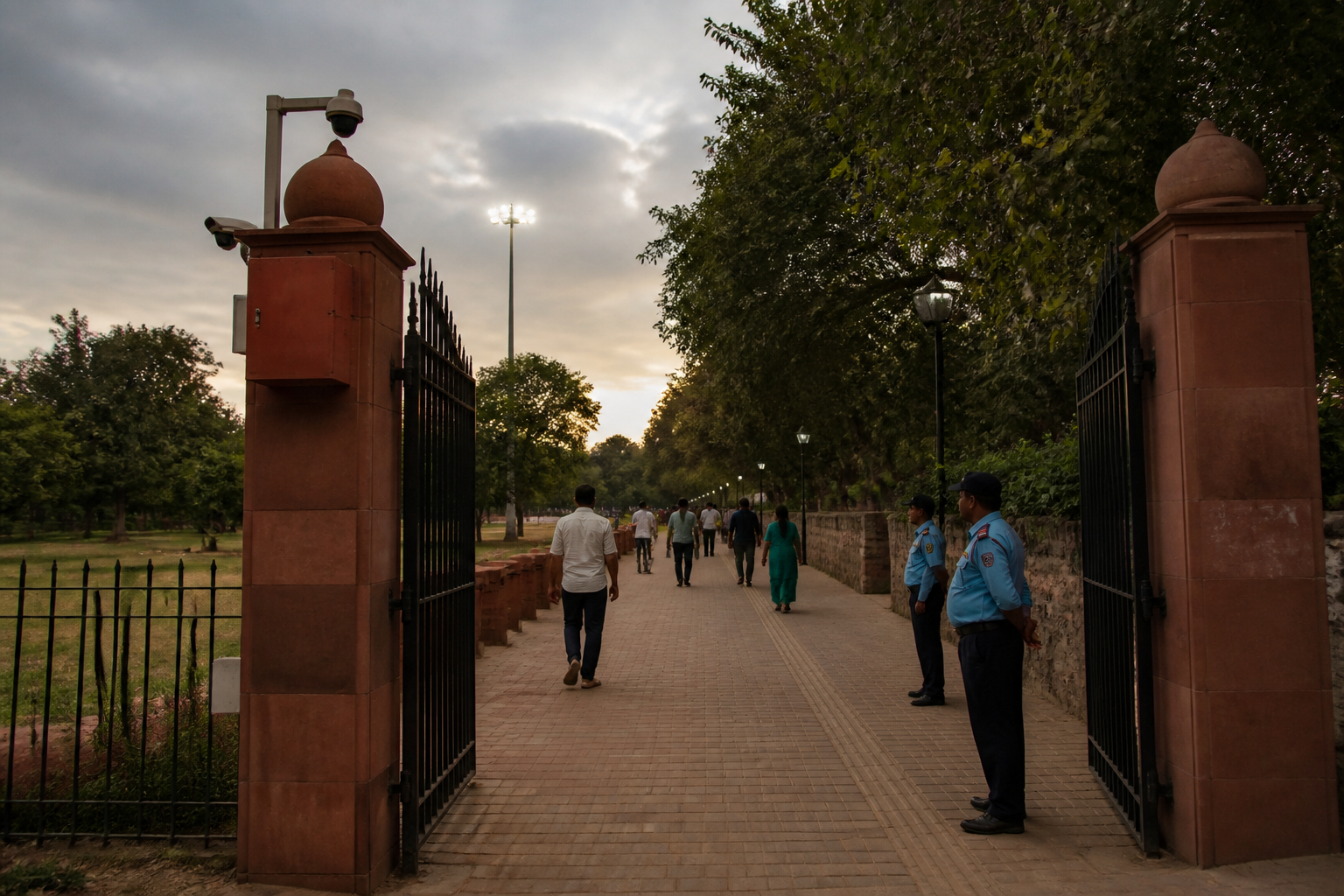
Delhi’s park safety audits have exposed a basic urban contradiction: green spaces may be publicly accessible and heavily used, yet remain difficult to secure once lighting, surveillance, boundary walls and patrol access fail. The inspections were intensified after the gang rape of a teenager in south Delhi’s Aastha Kunj Park, bringing renewed attention to how the city manages safety across its parks rather than at a single site.
The audits show that park security is not determined by the number of guards alone. Swarn Jayanti Park, also known as Japanese Park, in Prashant Vihar illustrates the gap. Spread across 170 acres and receiving between 500 and 1,000 visitors during peak hours, it has four gates and 27 guards providing round-the-clock security. Yet police found insufficient lighting and CCTV coverage, along with several dark spots. The park has also recorded cases of motor vehicle theft and snatching.
The finding is significant because large parks are not single, easily observed public rooms. They contain multiple gates, internal paths, vegetation, corners and edges that can be difficult to monitor from a central point. A guard presence at the entrance does not automatically provide visibility across the entire site. The audit’s focus on dark spots, overgrown bushes, boundary walls and gate-closing times indicates that park safety depends on the relationship between physical design and daily operations.
The District Park in Sector 1, Avantika, Rohini, presents a different version of the same problem. The 100-acre park attracts around 400 to 500 people during morning and evening periods, has five gates and security guards, but no CCTV cameras. Police also found that its boundary wall was damaged. Cases under the Arms Act, Gambling Act and Narcotic Drugs and Psychotropic Substances Act, as well as cases of hurt, have been reported inside the park.
The Rohini example shows why safety audits must examine more than crime statistics. A park may have guards and regular visitors, but damaged boundaries can create uncontrolled entry points, while the absence of cameras limits the ability to monitor vulnerable areas or investigate incidents. The presence of reported cases does not by itself establish that infrastructure caused them. It does, however, underline the need to assess how access, visibility and surveillance are arranged in heavily used public spaces.
Conditions differ across Delhi’s parks. Roshanara Bagh in Shakti Nagar, spread across nearly 50 acres, has 21 CCTV cameras and 12 guards. It receives 500 to 700 visitors daily, mainly between 4.30am and 8.30pm. Police reported no crime from the park and found its lighting, boundary and connecting road to be in good condition. DDU Park in IP Estate, which covers 16 acres and receives 150 to 250 visitors during its main gathering periods, was also assessed to have satisfactory lighting, boundaries and road conditions.
Amruth Park in Mandawali, east Delhi, covers around 9 lakh square metres and has two gates and four guards. It has no CCTV coverage, but police reported no crime from the park and said its lighting, boundary and road conditions were satisfactory. Around 150 to 200 people visit during peak hours. These variations make the audit more useful than a citywide claim that all parks are unsafe or safe. They point instead to uneven infrastructure and management standards across locations.
The scale of the exercise is itself important. In Dwarka, police audited 113 parks and wrote to the agencies concerned about the safety lapses identified. More than 200 parks in West district were also audited. Delhi Police has directed its units to inspect all major parks measuring one acre or more on priority and submit reports to the joint commissioners of police of the respective ranges within a week.
The audit framework covers the availability and shortage of guards, lighting arrangements including high-mast lights, CCTV coverage, the height and condition of boundary walls, overgrown bushes and trees, and gate-closing timings after sunset. This list treats safety as a multi-agency urban management issue. Police can identify risks and increase patrolling, but the condition of lights, walls, vegetation, roads and gates depends on the agencies responsible for maintaining the parks and surrounding infrastructure.
That division of responsibility is central to understanding the problem. A police audit can identify a dark stretch or a damaged wall, but the audit itself does not repair the asset. The report says police wrote to the agencies concerned after inspections in Dwarka, indicating that the next stage depends on whether those agencies act on the findings. The available material does not establish which agency is responsible for each individual park or whether a repair deadline has been fixed.
The numbers also reveal the pressure placed on park infrastructure. Japanese Park can receive up to 1,000 visitors during peak hours, while Roshanara Bagh sees between 500 and 700 visitors daily. Other parks have smaller but concentrated periods of use, particularly early mornings and evenings. DDU Park’s main gathering hours are 6am to 10am and 4pm to 7pm, while the District Park in Avantika is busiest from 6am to 9am and 4pm to 7pm. These patterns matter because safety requirements are not constant throughout the day.
Peak-hour concentration can improve natural visibility when many people are present, but it can also increase the need for controlled access, clear circulation routes and visible patrols. Outside those periods, lower footfall may leave parts of a park more isolated. The audit’s attention to gate closure after sunset suggests that operating schedules are part of the security system, not merely an administrative detail.
The police response has included increased patrolling in and around major parks. Personnel are using horses to cover areas that are difficult to patrol on foot or by vehicles. The stated aim is to increase police visibility and monitor crowded stretches, isolated corners and other vulnerable spots, particularly during peak visiting hours. This adds a mobile layer of surveillance, but the report does not indicate whether the arrangement is permanent or how patrol coverage will be measured.
The findings also raise a broader question about the meaning of access to public space. Parks are among the city’s most widely available urban amenities, used for walking, exercise, recreation and daily social activity. Their value depends not only on planting and open land, but also on whether residents can reach and use them with reasonable confidence. Roads leading to a park, boundary walls, gates, lighting and internal visibility form part of the public-space experience even when they fall under different administrative responsibilities.
Delhi’s audit programme is therefore more than a policing exercise. It is a test of whether the city can convert a safety assessment into coordinated maintenance and management. The reported gaps are concrete: insufficient lights, missing CCTV cameras, damaged walls, dark spots and areas that are difficult to patrol. The reported strengths are equally specific: functioning cameras, adequate lighting, sound boundaries and roads in some parks.
What remains uncertain is how quickly the identified deficiencies will be corrected, which agencies will carry out the work and whether future audits will show sustained improvement. The immediate official step is the completion of priority audits of major parks measuring one acre or more and the submission of reports to the relevant joint commissioners within a week. The effectiveness of the exercise will ultimately depend on what follows those reports: repairs, better lighting, improved surveillance, managed access and continued monitoring across the city’s parks.
