


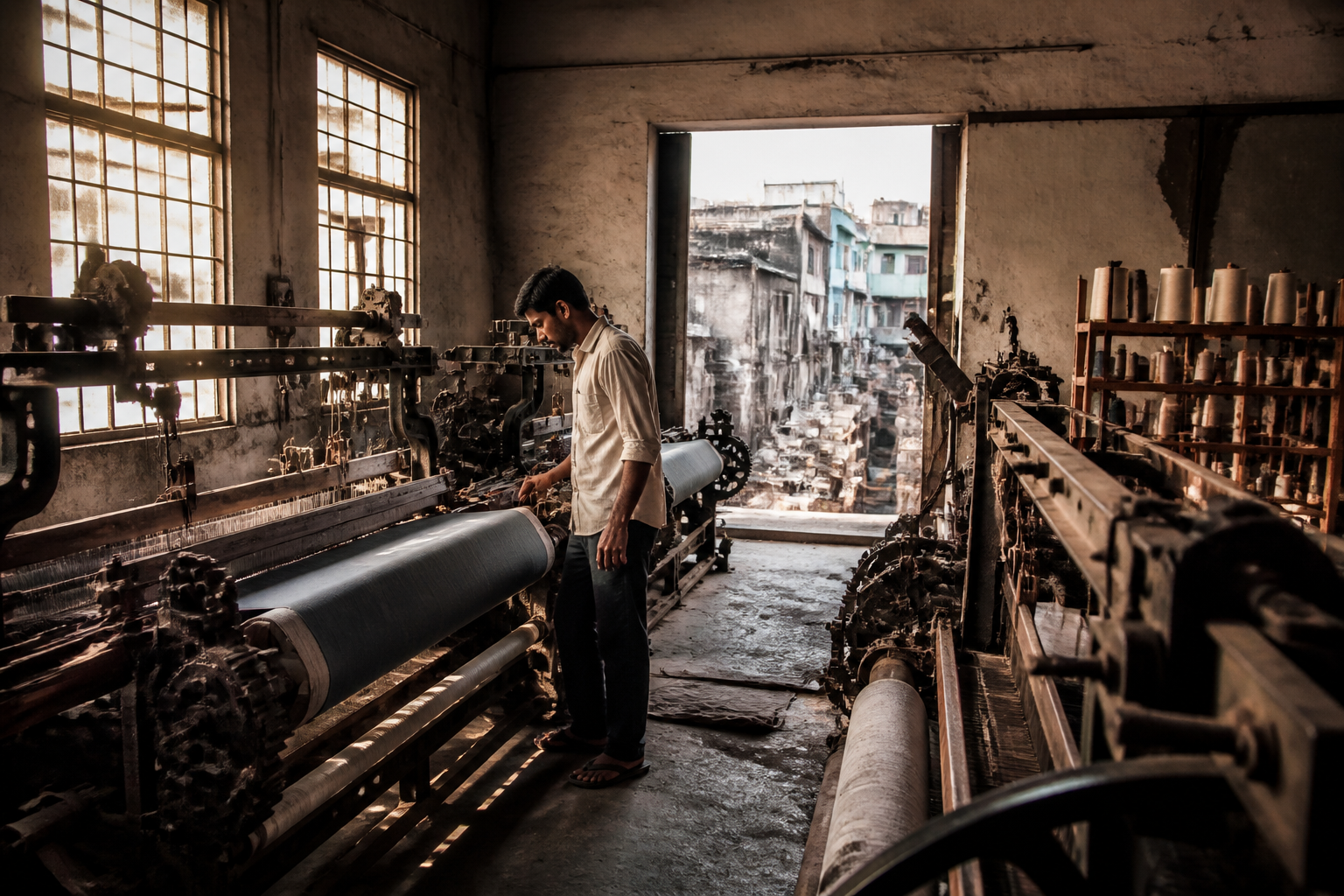
The silence spreading across power-loom centres in Kumarapalayam and Pallipalayam is not simply a story about machines stopping. It signals stress moving through one of Tamil Nadu’s most interconnected industrial systems, where yarn, electricity, weaving, processing, transport, packaging, merchanting and export-linked production depend on one another. As rising input costs and weak returns push Namakkal weavers to sell productive assets as scrap, the crisis is exposing how vulnerable the Kongu region’s textile economy is when value is distributed unevenly across the chain.
The Times of India reported that the rhythmic operation of power looms in Kumarapalayam and Pallipalayam has faded as yarn prices, electricity bills and stagnant textile markets combine with poor returns. T Saravanan, a second-generation weaver in Pallipalayam, said a loom valued at Rs 60,000 could fetch only about Rs 23,000 when sold as scrap. That difference is not merely a loss of machinery value. It represents the destruction of productive capacity for families whose skills and incomes have been tied to weaving for generations.
The source also records the depth of household vulnerability. A Arumugam, a weaver quoted in the report, said debt had forced him to sell a kidney a decade ago after he found that weaving was his only skill and he could no longer feed his family. The account is presented as an individual testimony, not as a quantified measure of the wider industry, but it illustrates the severe financial pressure described by workers in the region.
Tamil Nadu’s textile economy is geographically broad but operationally interdependent. According to the figures cited by the report, handlooms, power looms and automatic looms in 28 districts produce about 3 crore metres of fabric every day. Around 70% of these looms are located in the Kongu region. The concentration gives the region industrial importance, but it also means that disruptions in a few major production centres can affect multiple businesses and districts.
The chain is further complicated by the movement of fabric beyond the region. The report states that 80% of the fabric produced in the Kongu region is sent to northern states for value addition, including dyeing, bleaching and printing. Erode and Namakkal themselves host a range of processing activities, including bleaching, dyeing, yarn dyeing, wet processing, screen printing, rotary printing and finishing. These activities serve textile hubs such as Tirupur, Coimbatore, Karur, Salem, Namakkal and Erode.
This structure means that weaving cannot be treated as an isolated production activity. A loom operator may be based in one district, a processor in another, a garment manufacturer in a third and a buyer or export channel elsewhere. The report quotes B Kandavel, general secretary of the Federation of Tamil Nadu Weavers Associations, as saying that when processing delays break the chain, clothing production stalls, shipments are delayed, foreign orders are lost and employment suffers. The claim is an industry assessment, but it describes the practical consequence of a sector that relies on tightly connected stages rather than independent local markets.
The employment numbers cited by the federation underline the scale of that interdependence. The organisation counts more than 350 member companies, supporting about one lakh direct jobs and six lakh indirect jobs, for a total livelihood dependency of roughly 7 lakh people and their families. The indirect network includes transportation, chemical distribution, engineering services, packaging, textile merchanting and small and medium enterprises. These figures are supplied by the federation and are not independently audited in the source, but they indicate why the disruption has significance beyond individual weaving households.
The central policy problem is therefore not only whether a weaver receives temporary relief. It is whether support reaches the full production network at the point where costs, demand and processing capacity are constraining the industry. The report says the Tamil Nadu government has introduced schemes for weavers in Erode district, including free electricity, subsidies and continuous employment through state-sponsored production programmes. Yet it also reports that the industry remains in a poor condition. This contrast suggests that welfare measures may be cushioning households without resolving the commercial conditions that make weaving viable.
The distinction matters for public administration. Electricity support can reduce one operating cost, while subsidies can protect income during a difficult period. State-sponsored production can provide continuity of work. None of these measures, on the evidence supplied, demonstrates that yarn procurement, market demand, processing access, pricing power or downstream value addition has been structurally repaired. The report does not provide the financial size, duration or coverage of each scheme, so their comparative effectiveness cannot be assessed here. What is clear is that the existence of support programmes has not prevented the reported closure or disposal of looms.
The state and Centre are now being asked to respond through a wider package of proposals. Tamil Nadu minister for handlooms, textiles and khadi Vijay Balaji recently submitted a 20-point application to Union textiles minister Giriraj Singh. The proposals included financial assistance for a power-loom park in Erode, a silk export trade facilitation centre in Kancheepuram, handloom development initiatives, technical textile export promotion support, wood-carving support in Kallakurichi and grants for national and international marketing events. Balaji said the Union minister had assured him that the appeals would receive due consideration.
The proposals cover different parts of the textile and craft economy, from production infrastructure to export facilitation and marketing. A power-loom park could address industrial infrastructure in Erode, while marketing and export measures could seek to improve access to buyers. However, the source does not establish whether funding has been approved, what the implementation schedule would be, or how the proposals would directly assist distressed weavers in Kumarapalayam and Pallipalayam. At this stage, they remain requests under consideration rather than an implemented rescue programme.
The figures in the report also reveal a structural imbalance in the regional value chain. Kongu Nadu houses a large share of loom capacity, while much of its fabric moves elsewhere for value addition. That arrangement can connect the region to national markets, but it may also leave producers exposed when the bargaining power and higher-value stages of production lie outside the initial weaving location. The supplied material does not quantify margins at each stage, so it cannot establish which participants capture the greatest share of value. It does show, however, that disruption in processing and downstream production can transmit quickly across district boundaries.
For cities and towns such as Kumarapalayam, Pallipalayam, Erode and Namakkal, the consequences are not confined to factories. Textile work supports transport operators, repair and engineering services, chemical suppliers, packagers, merchants and small businesses. When looms are sold as scrap, the impact can therefore include the loss of local demand and the weakening of an industrial ecosystem built over decades. The source does not provide migration, unemployment or business-closure data, but the reported dependence on textile-linked livelihoods makes the urban-economic risk evident.
The evidence confirms a sector under pressure from a combination of input costs, electricity expenses, weak markets and low returns. It also confirms that the problem is being addressed through a mix of state welfare measures and proposed central assistance, while the industry continues to report distress. What remains uncertain is the scale of current closures, the geographic spread of the slowdown, the effectiveness of existing schemes and whether the 20-point proposal will receive funding and an implementation timetable. Those details will determine whether the response protects a declining occupation temporarily or rebuilds the textile chain that Kongu Nadu’s towns depend on.
