


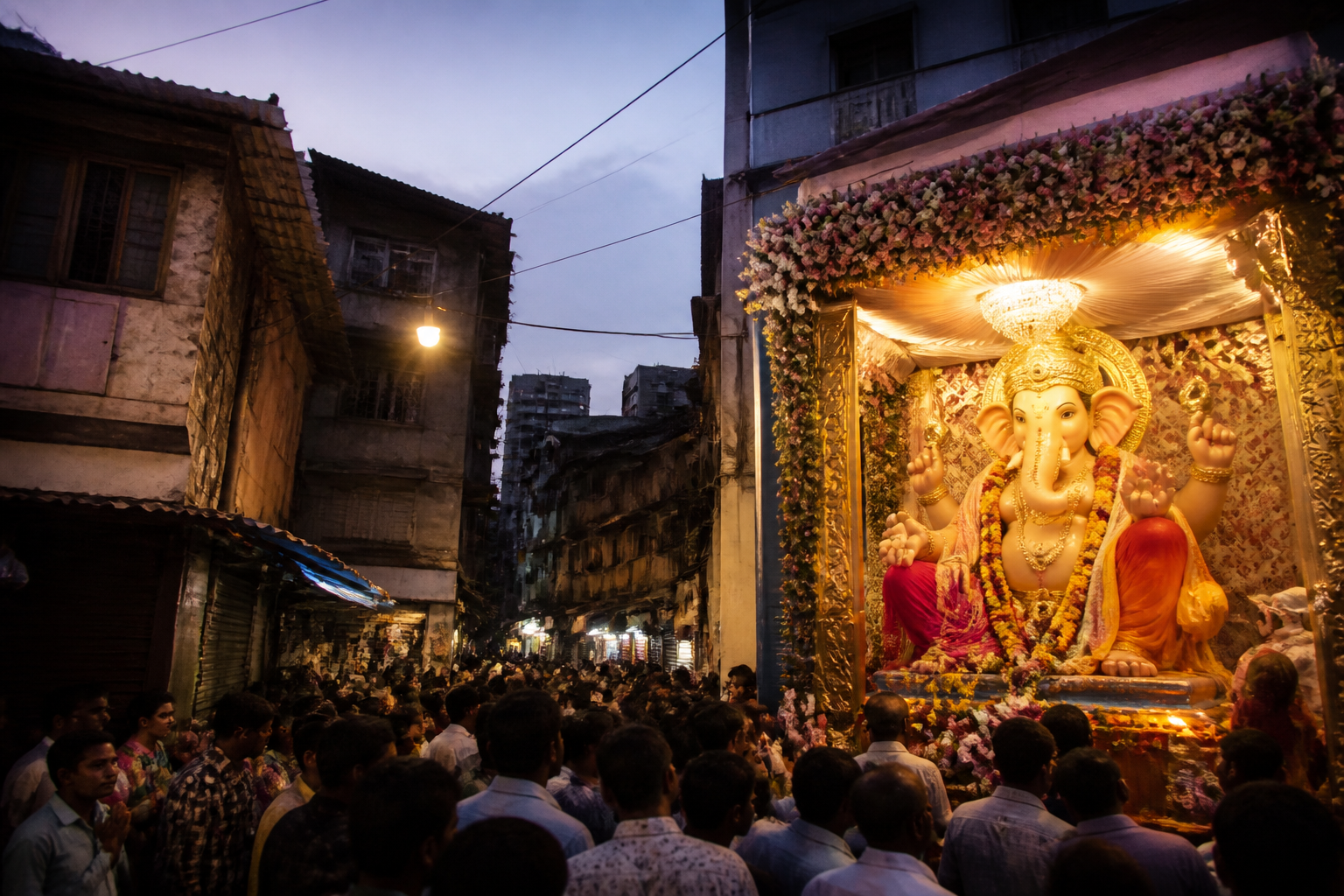
Kamathipura’s Ganeshotsav is doing more than celebrating a festival. Across 16 cross lanes in South Mumbai, 45 mandals—some between 80 and 100 years old—are trying to redraw the public image of a neighbourhood still defined by its former red-light identity. Their effort combines an old community tradition with a new communications strategy: inviting visitors, using Instagram reels and presenting Kamathipura as a safe, active and historically important part of the city.
The scale of the festival cluster is central to that argument. The mandals are located close to one another, with each idol reportedly about two minutes away from the next. Yet the area attracts less footfall than better-known Ganeshotsav destinations such as Lalbaug-Parel and Khetwadi, even though it has more idols within the cluster. The gap between the number of mandals and the number of visitors points to a problem that is not religious or cultural, but spatial and reputational: a neighbourhood’s identity can determine whether people enter it, spend time there and support its local institutions.
Kamathipura’s history makes that problem unusually visible. Anil Lakkabathini, who heads the Mumbai Cha Ganadhyaksh mandal of 10th Lane, said the area was named after kamathis, or labourers, from Telangana and Andhra Pradesh who migrated after 1795. According to him, those workers helped construct landmarks including Chhatrapati Shivaji Maharaj Terminus, the Brihanmumbai Municipal Corporation building, Bombay High Court and Rajabai Tower. The locality later became known as Mumbai’s red-light district, although traders also lived there.
That layered history is now being brought forward by a younger generation of residents. The organisers described in the report include chartered accountants, doctors, engineers, bankers, graphic artists and people working in government sectors. Some mandals have removed “Kamathipura” from their names, an indication of how strongly the label is perceived to influence public response. The choice is also revealing: while the organisers want to preserve their festival institutions, some believe the neighbourhood name itself has become a barrier to participation.
The issue is not limited to visitors. The report says funds are scarce, and commercial sex workers cannot freely go out to seek donations because they face ridicule. This affects the ability of mandals to sustain a tradition that depends on local fundraising, volunteer work and contributions from residents and visitors. Sachin Shetty of Mumbaicha Chintamani, earlier known as Kamathipura cha Chintamani, said his mandal owed its idol-maker Rs 40,000. The financial pressure raises a practical question about the survival of community institutions in neighbourhoods that receive cultural attention but limited corporate support.
The mandals are responding through visibility. Women from the locality reportedly make reels at midnight and post them on Instagram to show that Ganeshotsav in Kamathipura is safe and visually vibrant. This is not simply festival promotion. It is an attempt to replace an inherited image with a resident-generated account of the area. Social media allows organisers to bypass the older descriptions through which outsiders have traditionally understood Kamathipura and to show the lanes, idols and public activity on their own terms.
The visual scale of the celebrations strengthens that effort. The 81-year-old Ganadhyaksh mandal has a 22-foot Vishnu Avatar idol. The 77-year-old Ganadhisha Mumbaicha in 11th Lane has a 22-foot baal swaroop Ganadhisha standing on a lotus held by an elephant’s trunk. The 15-foot Kamathipura Cha Krupalu in Lane 7 has been attracting crowds, while the 72-year-old Bappa Barfani in Lane 8 has a 33-foot Natraj-style Ganesh with five snakes around its body.
These details matter because they shift the neighbourhood from being seen only through its stigmatised past to being recognised as a place with its own artistic, organisational and social history. The mandals are not new cultural assets created for a tourism campaign. Several have existed for decades, and one of them was started in 1941 by a Muslim policeman named Patel Bawa after a vow was fulfilled. Shetty said the mandal was later managed by five Muslim gang lords before passing to him. The account presents Ganeshotsav as a local institution shaped by changing communities and leadership, rather than as a simple marker of religious identity.
The report also describes forms of cooperation between mandals, commercial sex workers and transgender persons. Dhaval Pitale, a filmmaker associated with Ganadhisha Mumbaicha, said commercial sex workers and transgender persons actively help the Aadishakti mandal. At Bappa Barfani, organisers said women contribute modaks and naivedya plates, while the mandal conducts sexual-health awareness activities, arranges health camps and tries to help women find jobs. Shriram Nair, the mandal’s media in-charge, said 12 women had left commercial sex work within the past year.
Those activities place the festival within a wider urban question: how can a neighbourhood’s cultural institutions support people who are often excluded from the formal economy and public respectability? The source does not establish the scale or long-term results of these initiatives, but it does show that the mandals are functioning as more than event committees. They are also acting as informal networks for health outreach, social contact and attempts at livelihood transition.
At the same time, the organisers’ descriptions of safety and access need to be understood as claims made by local representatives. Aatish Patil, secretary of Kamathipura Cha Krupalu, said many people remain reluctant to visit because of old misconceptions, but described the area as safe and accessible even at night. He also said commercial sex workers remain concentrated in three lanes, while the broader area covers 16 cross lanes and 34 acres. The report attributes these figures and assessments to the organisers; it does not provide an independent safety audit, official land-use map or current administrative survey.
That distinction is important for understanding the governance challenge. A neighbourhood cannot be substantially redefined through branding alone if its residents continue to face stigma, uneven access to money and uncertainty over redevelopment. The festival organisers are attempting to perform a form of place-making from below, but their capacity depends on contributions, public participation and the willingness of institutions outside the locality to engage with it.
Corporate reluctance is one sign of that institutional gap. Nair said Kamathipura is an area that no corporate would like to enter. The statement points to a familiar urban pattern in which sponsorship and formal support follow established reputations, while neighbourhoods carrying a social stigma struggle to convert cultural value into financial resources. In that environment, the survival of a mandal may depend heavily on a small group of residents, volunteers and local donors.
Redevelopment adds another layer of uncertainty. Aniket Hiramani, a vice-president associated with the festival cluster, said the redevelopment plan may launch around Diwali. The supplied report does not specify the plan’s approving authority, design, financing structure, rehabilitation terms, land parcels or implementation timeline. Those missing details are crucial because redevelopment can affect the physical lanes, rental and ownership arrangements, livelihoods, festival spaces and the informal networks that currently sustain the mandals.
The possibility of redevelopment also explains why the festival is being presented as part of the neighbourhood’s heritage. The mandals’ age, the concentration of idols and the history of residents and workers give Kamathipura an identity that is not reducible to its past use. But preservation of cultural memory will depend on whether future physical change recognises these institutions as part of the area’s social infrastructure. A festival route requires accessible lanes, gathering space, permissions, safety arrangements and the continued presence of communities that organise it.
The story therefore reveals two parallel efforts. One is symbolic: residents are using idols, reels, renamed mandals and public invitations to challenge a fixed image of Kamathipura. The other is material: organisers are trying to raise funds, support health interventions, help women find jobs and sustain mandals that have existed for generations. The first can change how outsiders see the area, but the second determines whether the neighbourhood’s institutions can continue to function.
What the evidence confirms is that Kamathipura remains a dense cultural cluster with a substantial but under-recognised Ganeshotsav tradition. It also confirms that the locality’s reputation affects footfall, fundraising and the willingness of organisations to engage with it. What remains unclear is how the proposed redevelopment will be structured, whether the 45 mandals will be protected or relocated, and whether the social initiatives described by organisers can be sustained. Those are the developments that will determine whether this year’s visibility becomes a lasting change in how Mumbai understands Kamathipura.
