


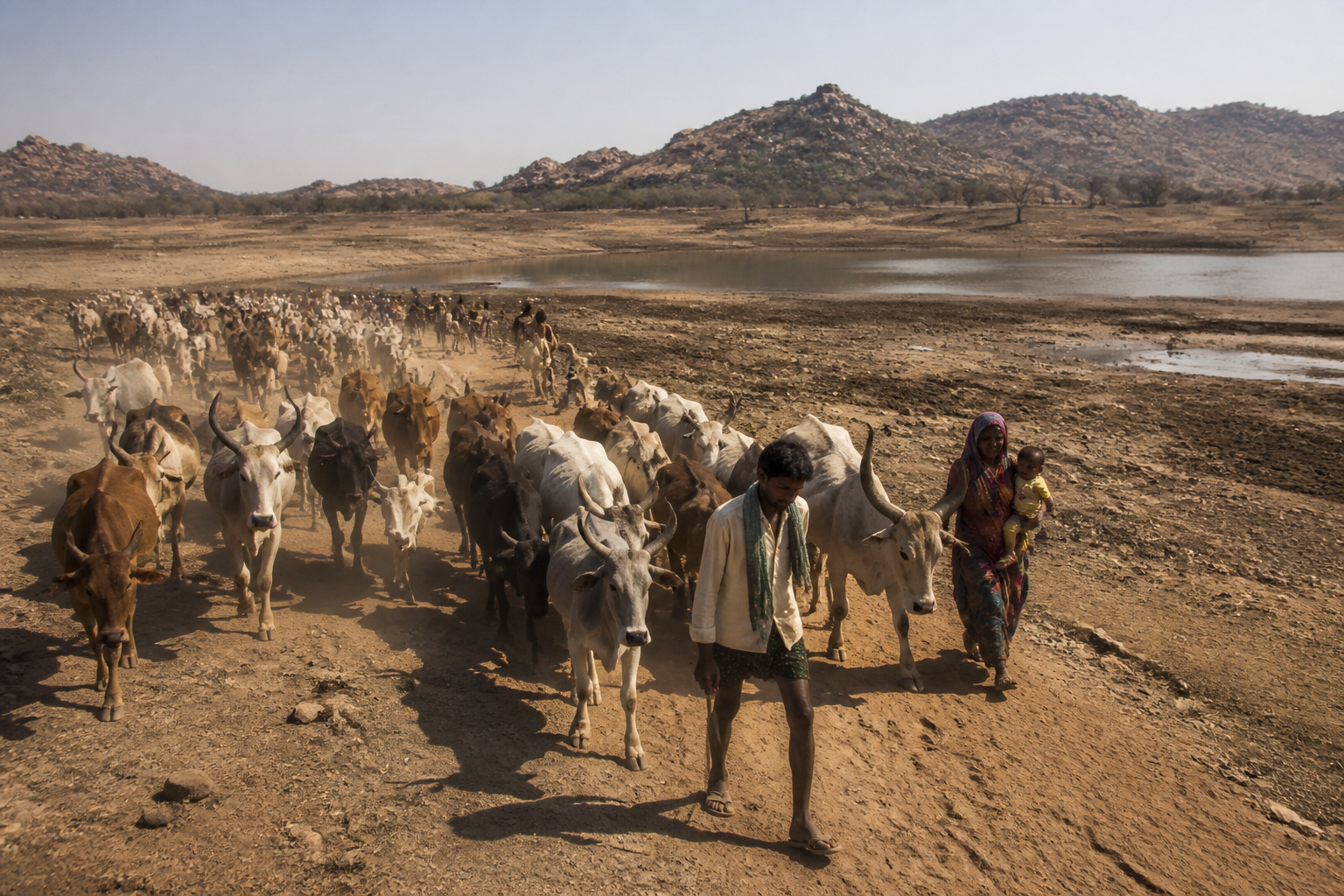
Drought has driven shepherds from Karnataka’s Koppal district to Haveri with thousands of cattle, as dry lakes and shrinking access to fodder and water force pastoral families to move between villages in search of places where their animals can survive.
Herds belonging to shepherds from Koppal have been reported in villages including Agadi, Karjagi, Devihosur, Bankapur, Masanakattti, Hothanahalli and Yallur across Haveri, Shiggaon and Hanagal taluks. The families are staying near the remaining water in lakes and low-lying areas while moving from one settlement to another to find grazing grounds.
The migration is linked to a shortage of rainfall in Koppal. The report said lakes in several villages have dried up, leaving pastoral households without the water and fodder they normally depend on during the grazing season. Many of the shepherds keep between 500 and 2,000 cattle each, making local access to water and pasture central to both animal welfare and household income.
For generations, these families have raised cattle as their traditional occupation. Venkappa Badler, a shepherd from Chikkabenakallu village in Gangavathi taluk, said his family had previously found water and fodder near their home. This year, he said, the shortage forced them to travel through the Kappattagudda route towards Haveri with their cattle.
Badler said a large lake near Lingadahalli, where the family used to stay during winter, had dried up. The family now lives wherever water is available and spends roughly from 8 a.m. to 6 p.m. grazing the animals in fields and hill areas, according to the report.
The movement illustrates how a rainfall deficit can extend beyond drinking-water shortages to disrupt the seasonal geography of livestock rearing. When village tanks and grazing areas fail, pastoral families must transport themselves and their herds across district boundaries, relying on scattered water sources and temporary grazing access.
The shepherds have described the migration as a search for basic support rather than a request for financial compensation. Badler said the families did not seek relief for themselves, but needed water and fodder for their cattle. He also described the difficulty of responding to the suffering of animals that cannot communicate hunger and thirst.
The reported cattle herds are currently spread across parts of Haveri district, including areas of Haveri, Shiggaon and Hanagal taluks. The families’ next movements will depend on where water and fodder remain available, as the drought continues to limit the resources required for livestock rearing in their home villages.
