


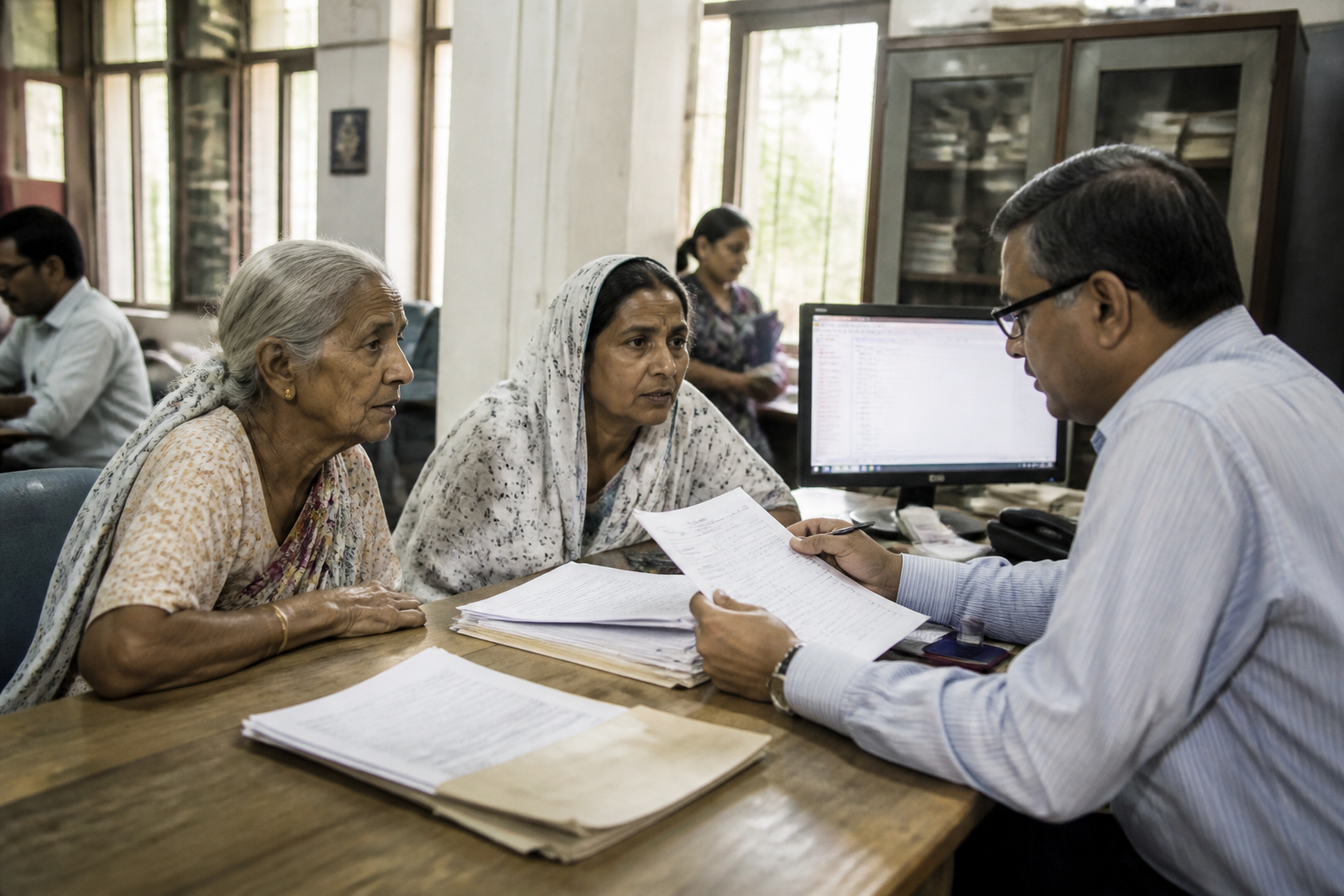
West Bengal’s decision to stop beneficiaries from receiving Annapurna Yojana and widow pension together has turned an administrative clarification into a significant welfare-design question: when two schemes serve vulnerable residents, should support be combined or limited to one benefit? A directive issued by the state Women, Child and Social Welfare Department secretary requires beneficiaries currently receiving both payments to choose one, with their option to be recorded by 29 September.
The change affects the way welfare eligibility is administered across the state. The instruction has been sent to the Kolkata Municipal Corporation commissioner and all district magistrates, placing responsibility on both urban and district administrations to identify overlapping beneficiaries, obtain their written choices and update the records on the Samarth portal.
According to the report by Sangbad Pratidin – Kolkata, the state provides Rs 3,000 a month under the Annapurna Yojana and Rs 1,500 a month under the widow pension scheme. Beneficiaries who currently receive both will therefore have to decide which payment remains active. The directive does not describe the decision as a temporary suspension or a reduction in the stated value of either individual scheme. Instead, it establishes that the two benefits cannot be drawn simultaneously by one person.
That distinction matters because the practical effect on a household depends on which benefit is selected. A beneficiary choosing Annapurna Yojana would receive the higher monthly amount reported in the article, while one retaining widow pension would receive the lower amount. The source report does not provide the number of people receiving both benefits, the total annual expenditure involved or the criteria that authorities will use to identify cases beyond the existing beneficiary list on the Samarth portal.
The immediate administrative task is therefore not simply to issue a new rule. Officials must convert an eligibility decision into a verified, recorded choice by each affected person. The directive requires beneficiaries to complete a specified form stating which assistance they wish to continue and which they wish to surrender. The Kolkata Municipal Corporation and district administrations have then been instructed to upload those options to the portal by 29 September.
This creates a clear chain of responsibility. The state department has set the policy condition. The municipal commissioner and district magistrates are responsible for communicating the choice requirement and ensuring that the options are collected. The Samarth portal becomes the system through which the revised beneficiary status is recorded. Any gap between those three stages—communication, consent and digital updating—could affect whether payments continue under the beneficiary’s preferred scheme.
The overlap problem in welfare delivery
The directive illustrates a recurring administrative challenge in social protection: separate schemes may be designed for different categories of vulnerability, but the same person can qualify for more than one. In this case, the reported overlap is between Annapurna Yojana and widow pension. The government’s response is to prevent concurrent payment rather than permit the benefits to be combined.
The source report says the state government had earlier indicated that one beneficiary would not receive both payments. The latest instruction converts that position into a formal process. Instead of leaving the matter at the level of a policy statement, the department has asked local authorities to obtain a written option from every affected beneficiary and update the official record.
That process is important because an overlap list is not the same as a final decision. The report states that the names of beneficiaries receiving both forms of assistance are available on the Samarth portal. However, the list identifies the cases requiring action; it does not, by itself, establish which benefit a person wants to retain. The written form is meant to supply that missing decision.
For municipal and district officials, this also means the exercise will involve more than data management. Beneficiaries must be informed that they have to choose, understand the different payment amounts, complete the required form and submit it through the prescribed administrative channel. The supplied report does not specify whether the government has announced outreach arrangements, assistance desks, a helpline, a process for people unable to complete forms or an appeal mechanism for disputed records.
Those omissions are not proof that such arrangements do not exist. They show only that the report does not establish them. They are nevertheless important implementation questions because the people affected are already enrolled in welfare systems and may face difficulty navigating a new administrative requirement without support.
The financial choice facing beneficiaries
The payment difference reported in the article makes the option consequential. Annapurna Yojana provides Rs 3,000 per month, while widow pension provides Rs 1,500. A person who chooses the former would retain a monthly amount twice as large as the latter, based on the figures cited in the report. But the article does not explain whether the two schemes differ in eligibility conditions, duration, payment reliability, renewal requirements or access to any additional services.
Those details could influence a beneficiary’s decision, but they should not be assumed. The current instruction, as reported, requires a choice between the two cash benefits and does not provide a comparative explanation of their wider entitlements. The administrative form may contain more information, but the supplied material does not reproduce it.
This makes the communication of the rule a central part of implementation. A beneficiary who receives a form without a clear explanation of the consequences may treat the choice as routine paperwork. Yet the choice determines which monthly assistance remains available. The state’s deadline adds urgency: options are to be uploaded by 29 September, leaving local authorities a defined period to identify cases and collect responses.
The report also states that Annapurna Yojana can be received alongside disability pension and the Krishak Bandhu benefit, even though it cannot be combined with widow pension. That distinction indicates that the government is not applying a blanket ban on all concurrent assistance. The restriction is specific to the combination of Annapurna Yojana and widow pension described in the directive.
The reason for treating these combinations differently is not explained in the supplied report. It therefore cannot be established whether the distinction is based on the schemes’ eligibility rules, budgetary design, administrative duplication or another policy rationale. That missing explanation is significant because it is the institutional logic behind the new choice requirement.
What the directive changes for urban administration
Although the policy applies across West Bengal, Kolkata has a direct administrative role because the Kolkata Municipal Corporation commissioner has received the instruction alongside district magistrates. This places welfare coordination within the working responsibilities of a major urban local body, alongside the state’s district administration.
The Kolkata component also highlights how social protection is delivered through multiple levels of government. The state department issues the instruction and defines the scheme relationship. The municipal corporation handles affected residents within its jurisdiction. District administrations perform the equivalent role elsewhere. The portal provides a common digital record for compiling the final choices.
That arrangement can improve consistency if the same rule, form and deadline are applied across locations. It can also create unevenness if communication, staffing or data-updating practices differ between the municipal corporation and districts. The source report does not provide evidence of such unevenness, but the structure of the implementation makes coordination essential.
The directive’s reliance on an existing digital list is another important feature. The portal is being used to identify beneficiaries who appear to receive both payments and to record the option they submit. The report does not state whether the list has been recently reconciled with payment records, whether beneficiaries can challenge an incorrect entry or how duplicate or inactive records will be handled.
These are operational questions rather than reasons to dispute the directive. They determine whether the policy reaches the correct people and whether a beneficiary’s written preference is accurately reflected in future payments. The formal deadline provides an administrative milestone against which the state can later assess completion.
What remains unclear
The supplied report establishes the rule, the payment amounts, the authorities receiving the directive, the requirement of a written option and the 29 September upload deadline. It does not establish the number of affected beneficiaries, the financial savings or reallocation expected from ending the overlap, the geographic distribution of cases or the total value of payments currently made under both schemes.
It also does not include the text of the directive itself, details of the form, instructions for beneficiaries who do not respond, or information on whether payments will be paused while choices are collected. Those details will be important to understanding how the policy operates beyond the announcement.
For now, the clearest conclusion is that West Bengal is moving from a stated non-overlap rule to an administrative exercise requiring individual beneficiary choices. The immediate developments to monitor are whether the Kolkata Municipal Corporation and district administrations complete the collection process, whether all options are uploaded by 29 September and how the government handles cases in which records are disputed or beneficiaries do not submit a choice.
