


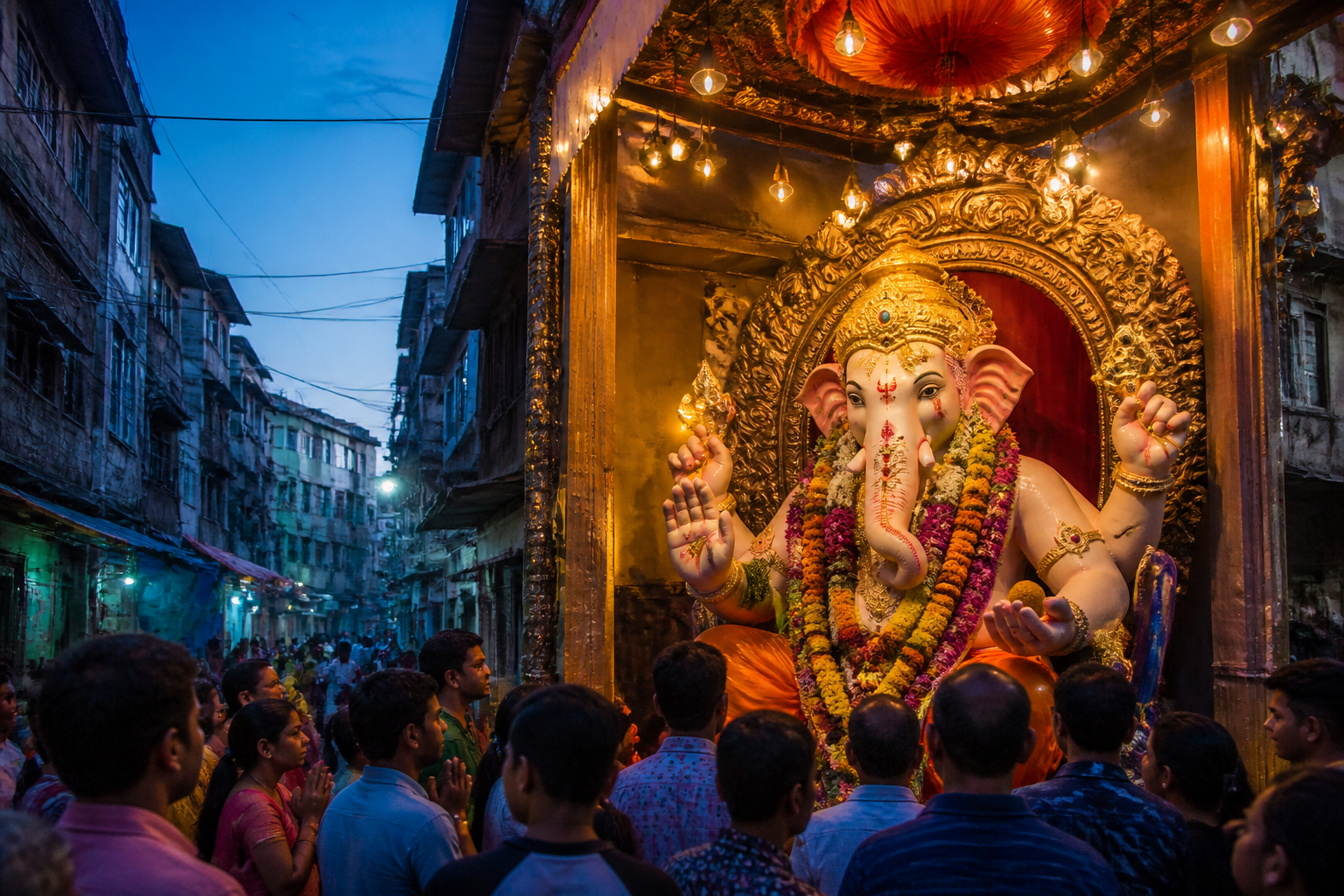
Kamathipura’s Ganeshotsav is doing more than displaying some of South Mumbai’s largest idols. Across 16 cross lanes and 34 acres, 45 mandals—several between 80 and 100 years old—are using the festival to challenge the neighbourhood’s long-standing identity as Mumbai’s red-light district and to invite the wider city into a locality many people still avoid.
The effort is led by a new generation of residents who are better educated, professionally employed and determined to separate Kamathipura’s present from the reputation attached to its past. According to a report in the Times of India, these residents include chartered accountants, doctors, engineers, bankers, graphic artists and people working in government. Their intervention is not only cultural. It is also an attempt to influence how the neighbourhood is perceived, visited and eventually redeveloped.
The distinction matters because Kamathipura is not a single-use district. The report describes a neighbourhood in which traders and long-term residents have lived alongside the commercial sex trade. Commercial sex workers are now concentrated in three lanes, according to residents quoted in the report, while the Ganesh mandals occupy a much wider network of lanes. Yet the old label continues to shape how outsiders understand the area, how easily mandals collect donations and how willing visitors are to attend its celebrations.
That gap between the physical neighbourhood and its public image is the central urban issue in Kamathipura’s Ganeshotsav. The festival provides a rare moment when a locality’s internal social networks become visible to the rest of Mumbai. It also exposes how stigma can affect the everyday functioning of civic and cultural institutions, from fundraising and public participation to the ability of local groups to attract corporate support.
A festival spread across a historic workers’ neighbourhood
Anil Lakkabathini, who heads the Mumbai Cha Ganadhyaksh mandal of 10th Lane, told the Times of India that Kamathipura was named after kamathis, or labourers, who migrated from Telangana and Andhra Pradesh after 1795. According to his account, these workers were involved in constructing some of Mumbai’s most important historic structures, including Chhatrapati Shivaji Maharaj Terminus, the Brihanmumbai Municipal Corporation building, the Bombay High Court and Rajabai Tower.
The historical detail places Kamathipura within Mumbai’s wider story of migration and construction. The neighbourhood was not created only by the activity for which it later became known. It was also shaped by labour, settlement and the movement of people who helped build the colonial city. That history remains important because current residents are trying to replace a single, reductive image with a more complete account of the area.
The mandals themselves are part of that continuity. The 81-year-old Ganadhyaksh features a 22-ft Vishnu Avatar idol. Ganadhisha Mumbaicha of 11th Lane, established 77 years ago, presents a 22-ft baal swaroop idol standing on a lotus held by an elephant’s trunk. Bappa Barfani of Lane 8, which is 72 years old, is known for a 33-ft Natraj-style Ganesh idol with five snakes around its body. Kamathipura Cha Krupalu in Lane 7 has a 15-ft idol.
These are not isolated installations. Residents describe a dense festival geography in which one idol is roughly two minutes away from another. That proximity gives Kamathipura a distinctive urban form: a compact cluster in which visitors can move between multiple mandals through the neighbourhood’s cross lanes. The concentration of idols could make the area a significant destination during the festival, but residents say visitor numbers remain below those of Lalbaug-Parel and Khetwadi despite Kamathipura having more moortis in its cluster.
The cost of an inherited reputation
The problem, as described by residents, is not a lack of cultural activity. It is the difficulty of converting that activity into public participation and financial support. Funds are scarce, and some mandals have removed Kamathipura from their names in an attempt to distance themselves from the locality’s reputation.
Residents also say that commercial sex workers face ridicule if they go out to seek donations. This restricts their participation in the public-facing part of the festival, even when they remain involved within the neighbourhood. The report says women associated with the area contribute modaks and naivedya plates, while some mandals organise health camps and awareness programmes on sexual health.
At the Aadishakti mandal, residents say commercial sex workers and transgender persons actively help with the festival. The account complicates the usual outsider view of Kamathipura as a place divided between the festival and the sex trade. Inside the neighbourhood, the relationship appears more layered: people who are often treated as symbols of the area’s stigma are also participants in its social and religious life.
The response of the younger generation has been to make the neighbourhood more visible on its own terms. Women residents create Instagram reels late at night to show that the festival is active and safe. Mandal organisers invite Mumbaikars to visit. Social media becomes a form of neighbourhood representation, allowing residents to present streets, idols and public activity without relying entirely on how external coverage has historically described Kamathipura.
This does not erase the social problems associated with the area. Nor does it establish that every part of the neighbourhood is free from risk. But it does show how residents are contesting a generalisation that treats the entire 34-acre locality as identical to the three lanes where commercial sex work is now concentrated, according to the residents quoted.
Ganesh mandals as local institutions
The mandals described in the report perform functions that extend beyond festival decoration. Bappa Barfani’s representatives say the mandal has helped 12 women leave commercial sex work within the past year. It also conducts health camps, raises awareness about sexual health and tries to connect women with employment. These claims are attributed to the mandal’s representatives and are not independently quantified in the supplied report, but they indicate how local religious institutions can become channels for welfare activity where formal systems may not reach easily.
Their role is also visible in the way the mandals preserve neighbourhood memory. Mumbaicha Chintamani, earlier known as Kamathipura cha Chintamani, was started in 1941 by a Muslim policeman named Patel Bawa after a vow was fulfilled, according to its secretary. The mandal was later led by five Muslim gang lords before passing to its present management. That history reflects the changing social and institutional composition of the locality rather than a single fixed community identity.
The mandals therefore operate as cultural archives, fundraising networks, welfare platforms and public-facing representatives of the neighbourhood. Their future depends partly on whether they can sustain these roles under financial pressure. One organiser told the newspaper that his mandal owed its idol maker Rs 40,000, while some residents fear that the current Ganeshotsav could be the last for certain mandals.
The funding problem reveals a wider weakness in the city’s cultural infrastructure. Neighbourhood festivals depend heavily on local contributions, goodwill and informal labour. When a locality is stigmatised, the ability to mobilise these resources is reduced. Corporate participation is also limited, with a mandal representative saying that Kamathipura is an area no corporate would like to enter.
Redevelopment could change the stakes
The festival’s attempt to reshape Kamathipura’s image is taking place as residents anticipate redevelopment. Aniket Hiramani, a vice-president of one of the mandals, said a redevelopment plan may be launched around Diwali. The supplied report does not provide details of the plan, including its authority, financing, legal status, boundaries, rehabilitation terms or implementation schedule.
That lack of detail is significant. In a neighbourhood with historic mandals, long-term residents, commercial activity and vulnerable populations, redevelopment would not be only a construction exercise. It could affect the lanes through which the festival operates, the locations of community institutions, the relationship between residents and commercial establishments, and the ability of existing cultural groups to remain in place.
The question is not simply whether new buildings will replace old ones. It is whether redevelopment will recognise Kamathipura as a lived neighbourhood with layered histories, rather than treating its existing identity as an obstacle to be removed. The future of the mandals may depend on decisions about street access, public gathering spaces, rehabilitation and the continuity of local institutions—issues that are not addressed in the available report but will be important if the plan advances.
For now, Ganeshotsav is the most visible mechanism through which residents are making that argument. The idols draw attention to the neighbourhood’s history, while the organisers’ welfare activities and social-media outreach present a different account of everyday life. The festival cannot by itself resolve poverty, stigma, exploitation or redevelopment pressures. But it can make the internal complexity of Kamathipura harder to ignore.
The evidence currently establishes a neighbourhood with 45 historic mandals, a strong resident-led effort to challenge its old image, continuing financial constraints and an anticipated redevelopment plan whose details remain unclear. The next important developments will be whether visitor and donor participation changes, whether the mandals can sustain their social initiatives, and whether any redevelopment proposal protects the cultural and residential networks that make Kamathipura’s Ganeshotsav possible.
