


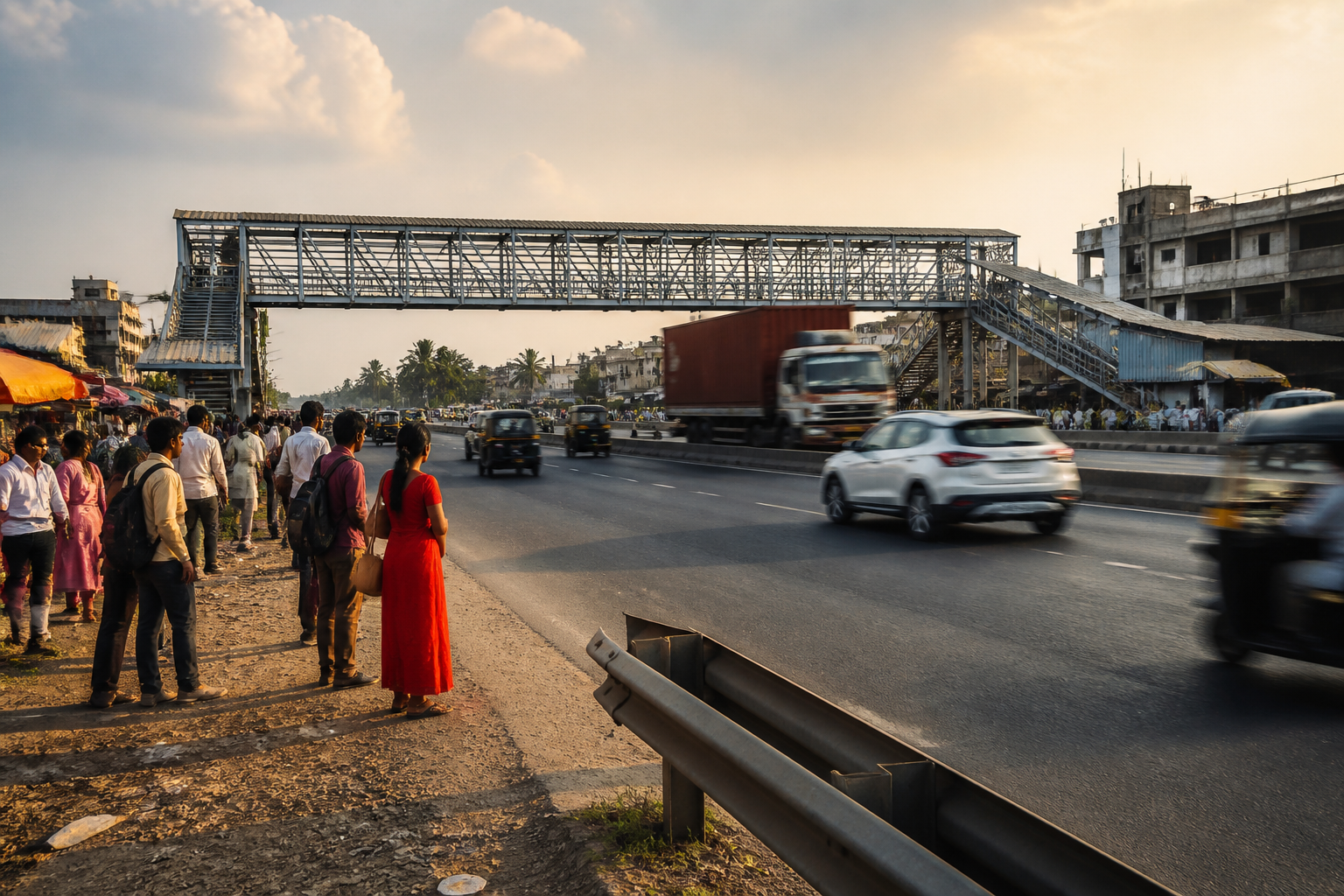
The Mumbai-Ahmedabad Highway will get six new pedestrian bridges between Versova and Talasari after repeated fatal accidents involving people trying to cross the busy highway, according to a report by Loksatta. The National Highways Authority of India has approved ₹9 crore for the project, with construction scheduled to begin in October and completion targeted within six months.
The proposed bridges will be built at key locations along the highway, including Sassoonvghar, Bapane, Khanivade, Nilgiri and Talasari. The report identifies these locations as priority crossing points, although it names five areas for six bridges. The highway connects Mumbai, Thane, Vasai-Virar, Mira-Bhayandar and Palghar with Gujarat and carries heavy traffic throughout the day.
Roadside villages, hotels and industrial areas have developed on both sides of the highway. As a result, local residents, workers and schoolchildren regularly need to cross the carriageways. Vehicles travelling at high speeds make at-grade crossings particularly dangerous, especially where pedestrian movement has not been matched by dedicated crossing infrastructure.
Police data cited in the report shows that 81 people died in accidents on the stretch between the Versova bridge and Virar. More than half of those killed were pedestrians. The reported incidents included deaths at the scene as well as cases resulting in permanent disabilities.
The proposed construction follows directions from the district administration to the National Highways Authority of India to take immediate steps to improve pedestrian safety. The intervention is intended to provide grade-separated crossings and reduce the need for residents to move directly across traffic lanes.
The highway’s safety problem reflects a wider infrastructure challenge along high-speed corridors that pass through settled areas. Road design may prioritise uninterrupted vehicle movement, while daily life on either side continues to generate demand for frequent crossings. In such locations, the presence of communities, workplaces and schools can make pedestrian access a regular transport requirement rather than an occasional movement.
The approved allocation covers six bridges, but the report does not provide details on their individual designs, accessibility features, lighting, lifts or ramps. It also does not specify whether fencing, service roads, approach paths or enforcement measures will be introduced alongside the structures. These details will determine how easily residents can use the facilities once they are built.
According to the reported schedule, work is expected to start in October and all six bridges are to be completed within six months. The next milestone is the commencement of construction at the identified locations.
