


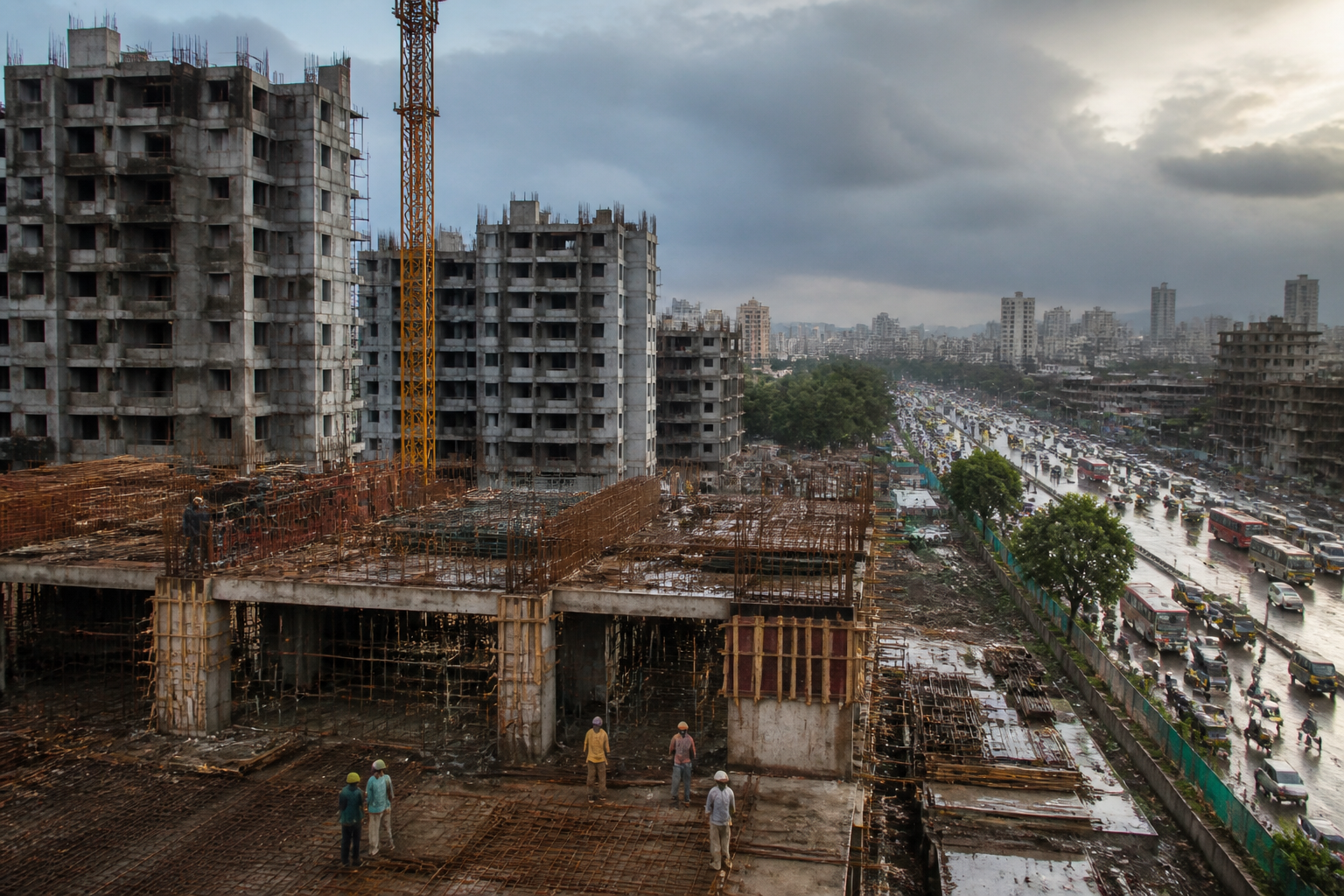
MHADA’s decision to reissue tenders for homes for Mumbai’s mill workers and their heirs is not simply an administrative reset after a weak developer response. It exposes the central difficulty in delivering a housing promise made on the land of the city’s former textile industry: the number of eligible households remains far larger than the land and project options currently available within Mumbai and its metropolitan region.
The Mumbai Board of the Maharashtra Housing and Area Development Authority had invited expressions of interest from private developers to identify land and construct homes for mill workers in Borivali, Thane, Mira-Bhayandar and Ulwe. According to a report by Loksatta, the tender received only one submission, well below the response expected by the authority. The state government is now changing the tender terms and conditions before a fresh process is launched.
That sequence matters because the tender was not for a conventional private housing project. It was an attempt to use private development capacity to address a public housing obligation involving more than one lakh people. The state and MHADA must therefore align land, construction economics, eligibility rules, location and the expectations of worker organisations. A tender that attracts little market interest suggests that at least one part of that structure is not yet workable for developers, applicants or both.
The scale of the unresolved demand is visible in MHADA’s own application and eligibility figures reported by Loksatta. Nearly 1.75 lakh applications were submitted for homes connected to the mill workers’ housing decision. So far, only about 16,000 mill workers have been provided homes in Mumbai. Among the more than 1.5 lakh remaining mill workers, 1.09 lakh workers and heirs have submitted applications for eligibility determination. Of these, 1.01 lakh have been found eligible, while scrutiny of the remaining applications continues.
These numbers describe more than a waiting list. They show how a housing entitlement can become administratively layered over time. The original promise is tied to mill land and permanent ownership housing, but the applicants include heirs and households whose eligibility must be determined through documentation and scrutiny. The process must therefore establish who qualifies even as the government searches for places where homes can actually be built. Eligibility and delivery have become separate tracks, and progress on one does not automatically create progress on the other.
The shortage of suitable land is the most direct constraint identified in the report. More than one lakh mill workers and heirs are still waiting, while the government faces difficulty finding land in Mumbai for their homes. The issue is not only the number of units. Location determines whether a proposed settlement can function as housing in practical terms, with access to employment, transport, schools, healthcare and established social networks. The available report does not provide details of the proposed sites’ infrastructure capacity or travel connections, but the disagreement over locations shows that place is already central to the policy.
The state has formed a high-level committee to examine different options. One such decision was to construct 81,000 homes through a private developer at Vangani and Shelu. However, some worker organisations have opposed homes at both locations and rejected the proposal, while some organisations are willing to accept homes at Shelu. This divide makes the housing programme a negotiation over urban location as much as a construction exercise.
Vangani and Shelu are not interchangeable with established mill neighbourhoods in central Mumbai. Moving eligible households to locations outside the city’s traditional industrial areas can alter access to work, family support and community institutions. At the same time, the report establishes that the government believes it cannot find enough land in Mumbai to house the remaining beneficiaries. The policy is therefore caught between a legitimate demand for homes close to the city and the physical limits of available land.
This is where the tender’s weak response becomes significant. The Mumbai Board’s invitation covered Borivali, Thane, Mira-Bhayandar and Ulwe, indicating an effort to search across the wider metropolitan area rather than rely only on central Mumbai land. Yet only one tender was received. The available report does not identify the bidder, explain the commercial terms, or specify which tender conditions are being revised. It is therefore not possible to conclude whether the problem was land pricing, construction viability, development rights, location, eligibility risk or the terms of the housing obligation. What is clear is that the first tender did not generate the competition MHADA expected.
The state’s decision to revise the terms acknowledges that the programme cannot move forward on administrative intent alone. Private developers will need a viable project structure, while the government must protect the purpose of the housing commitment. Changes to the conditions may improve participation, but they will also need to preserve the beneficiaries’ rights and ensure that a change in project geography does not quietly become a change in the promise itself. The source report does not specify the proposed revisions, so their effect remains to be assessed after the new tender is issued.
The programme also illustrates the institutional complexity of redevelopment-linked housing. The commitment emerged from a decision to provide permanent ownership homes to mill workers and their heirs on mill land. MHADA’s Mumbai Board is handling the tender process, the state government is changing the conditions and a high-level committee is examining alternatives. Worker organisations are influencing the acceptability of proposed locations. No single institution controls the entire outcome. Land policy, eligibility verification, development procurement and beneficiary consent are moving together, but not necessarily at the same speed.
The numerical gap remains stark. Against nearly 1.75 lakh applications, only about 16,000 workers have received homes in Mumbai. Even the 81,000 homes proposed at Vangani and Shelu would not, on the figures reported, resolve the entire identified demand. The report says more than one lakh workers and heirs remain in the queue, while eligibility scrutiny is still under way for some applicants. This means the final number of households requiring housing may continue to change as the verification process progresses.
That gap also explains why the programme cannot be judged only by the number of homes announced. Announced capacity, eligible applicants and completed or allotted homes are different measures. The 81,000-home proposal represents a planned supply response, not completed delivery. The 16,000 homes provided in Mumbai represent delivered housing, but not the full entitlement. The 1.01 lakh eligible applicants represent an administrative determination, not a construction pipeline. Keeping these categories separate is essential to understanding whether the policy is progressing.
For Mumbai, the larger question is how the city handles housing claims created by redevelopment and industrial land transformation. The mill workers’ demand is rooted in a specific historical promise, but the delivery problem reflects wider urban pressures: scarce land, high development costs, competing uses and the distance between where households have lived and where new housing can be built. When land becomes unavailable in the original city, housing programmes tend to move outward. That can solve a construction problem while creating a mobility and social-infrastructure problem, although the supplied report does not provide evidence on the infrastructure conditions at the proposed sites.
The next stage will reveal whether changes to the tender conditions can attract more developers and whether the revised locations are acceptable to the affected organisations. It will also show whether MHADA can convert a broad search for land and homes into a transparent pipeline with clear numbers for eligible households, proposed units, locations and delivery milestones. Until then, the tender failure remains a warning that the mill workers’ housing promise is constrained not by demand but by the difficult institutional and spatial mechanics of building at scale in the Mumbai region.
