


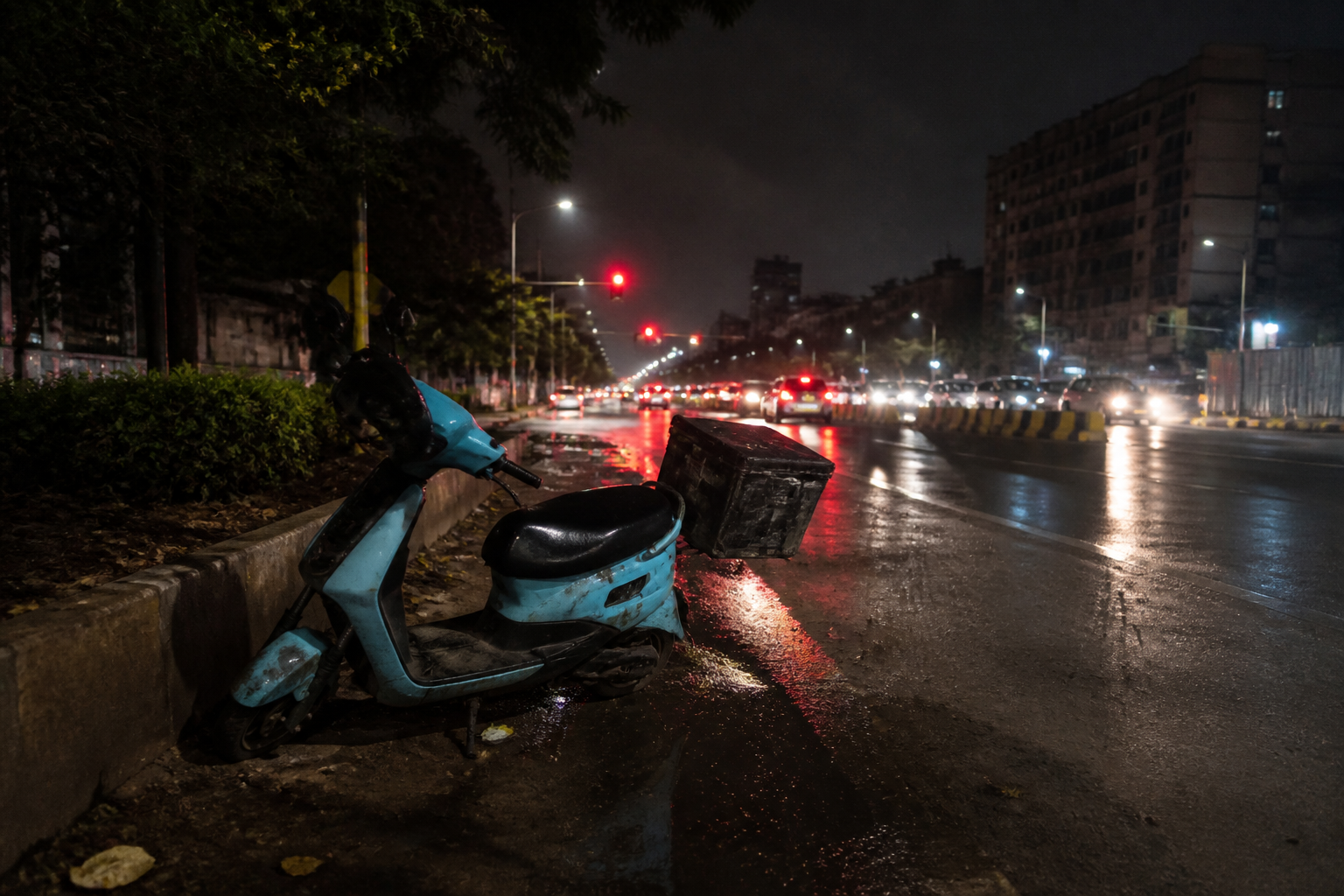
The death of a 48-year-old Zepto delivery worker nearly 50 days after he was struck by an unidentified vehicle in Santacruz has turned one road crash into a wider account of how urban road violence can continue long after the collision. The case, registered by Bandra Kurla Complex police after the victim’s death, also shows how medical costs, delayed investigation and the loss of a household’s sole earner can converge around a single traffic incident.
Mansoor Chopdawala was riding an electric scooter while delivering food when he was hit between 10.30 pm and 11 pm on July 29 near Mumbai University in Santacruz East, according to the report by Times of India. Police said the vehicle was travelling at high speed and that its driver fled without providing medical assistance. Chopdawala sustained severe injuries to his head, leg, ear and eyes.
He was first admitted to Bhabha Hospital in Kurla after a Zepto driver informed his family about the crash. He was shifted to a Chembur hospital on August 1 and later admitted to Sion Hospital. Doctors declared him dead at 5 pm on September 17. Police have sought CCTV footage from the night of the incident to identify the vehicle, but no arrest had been reported when the case was published.
The sequence matters because it separates a road crash into several institutional stages: the collision itself, emergency assistance, hospital transfers, prolonged treatment, the family’s ability to finance care, and the investigation needed to identify the vehicle and driver. In Chopdawala’s case, each stage extended the consequences of the original impact. The report does not establish why the complaint was filed only after his death, but his wife said she was occupied with arranging treatment and medicines during the intervening period.
Reshma Chopdawala, a homemaker, told Times of India that she sold gold ornaments and borrowed money from relatives and friends to pay for her husband’s treatment. She said he required two injections costing Rs 5,000 each day to revive his brain. The injections were provided after she produced her Aadhaar card, according to the report. The family’s account illustrates how a traffic injury can rapidly become a household financial crisis when treatment continues for weeks and the injured person is the primary income earner.
The family’s position was particularly exposed because Mansoor was described as the sole breadwinner. His 18-year-old daughter, Zahra, was still struggling with his death, while Reshma said she did not know whether the company where her husband worked had offered financial assistance. The supplied report does not establish the terms of his employment, whether he was covered by insurance, or whether any platform-linked accident protection was available to him.
That missing information is important to understanding the urban economy behind the crash. Food delivery depends on workers moving through the city late at night, often on two-wheelers and electric scooters. The report identifies Chopdawala as a delivery worker, but it does not provide data on how many similar workers operate in Mumbai, how frequently they are injured, or what formal protections apply to them. Those questions cannot be answered from this case alone. They are nevertheless central to assessing what happens when a worker’s mobility is essential to a service but the risks of that mobility fall largely on the worker and family.
The investigation also reveals the practical importance of street-level evidence. Police have sought CCTV footage to trace the vehicle, making surveillance recordings a potentially decisive link between the crash and the person responsible. The report does not say whether cameras covered the exact location, whether footage remained available after 50 days, or whether witnesses had been identified. These gaps leave the case dependent on evidence whose availability may diminish with time.
The delay between the crash and the death adds another layer of complexity. A case involving an unidentified vehicle may initially be treated as an investigation into a road collision, while the later death changes the consequences of the incident for the family and the criminal process. In this case, the police registered the hit-and-run case after Reshma filed a complaint on Friday, following her husband’s death on September 17. The supplied report does not specify the legal sections invoked or describe the police’s next procedural steps beyond the search for CCTV footage.
The treatment journey also highlights how urban trauma care is experienced across institutions. Chopdawala moved from Bhabha Hospital in Kurla to a Chembur hospital and then to Sion Hospital. The report does not indicate the clinical reasons for each transfer, the total treatment cost, or whether the family received assistance from any public scheme. What it does document is the burden of navigating multiple hospitals while arranging medicines and borrowing money. For families dealing with serious injuries, the administrative task of sustaining treatment can become as immediate as the medical emergency itself.
A road safety discussion often concentrates on the point of impact: vehicle speed, road design, lighting, enforcement or driver behaviour. The Chopdawala case shows that the urban consequences extend beyond those factors. The alleged failure to stop and provide assistance left the family trying to identify what had happened, while the absence of a known accused vehicle complicated the investigation. The victim’s prolonged hospitalisation then transferred the financial impact of the crash to the household.
The location is also relevant. Chopdawala was travelling near Mumbai University in Santacruz East while performing a delivery late at night. The report does not describe the road design, traffic volume, lighting or presence of pedestrian and two-wheeler infrastructure at the site, so no conclusion can be drawn about the physical conditions that contributed to the crash. But the location and timing underline the dependence of delivery work on movement across roads outside conventional office hours.
For Mumbai’s urban administration, the immediate responsibilities in such a case are distributed across multiple actors. Police must identify the vehicle and establish what happened. Hospitals handle emergency and continuing care. The employer or platform may have a role depending on the worker’s contractual and insurance arrangements. The family bears the immediate consequences when assistance is delayed or uncertain. The report does not establish how these responsibilities were coordinated in Chopdawala’s case.
The case therefore cannot, on the evidence supplied, be used to claim that Mumbai’s entire road safety or delivery-work system is failing. It does establish a specific chain of vulnerability: an unidentified vehicle, a seriously injured worker, prolonged treatment, heavy out-of-pocket spending, the death of a sole earner and an investigation still dependent on CCTV after nearly 50 days. Each link affected the family differently, but together they made the crash a continuing urban crisis rather than a single-night incident.
The next test is whether the police can use available CCTV footage and other evidence to identify the vehicle and driver. For the Chopdawala family, the case also remains tied to unresolved questions about financial assistance, treatment costs and support after the loss of the household’s primary earner. The investigation’s progress will determine whether the incident moves from an account of an unidentified hit-and-run to an established prosecution record.

