


Karnataka’s first Cabinet meeting held in the coastal region has approved proposals worth ₹32,611 crore, including more than ₹16,000 crore in projects for coastal development. The decisions place tourism, fisheries, ports, aviation, healthcare and marine biotechnology within one regional development agenda, but they also expose the central challenge facing the coast: how to expand economic activity without weakening the ecosystems and livelihoods on which that economy depends.
The Cabinet approved the Coastal-Malnad Karnataka Tourism Policy 2026, which is intended to create tourism infrastructure, generate local employment and organise development across the coast and the Western Ghats. The policy identifies a series of tourism circuits, including a blue-green circuit from the coast to the hills, pilgrimage and heritage circuits, beach and surfing destinations, cruise and backwater routes, coastal and inland food routes, coffee and plantation routes, Western Ghats ecology and adventure routes, monsoon tourism and ancient heritage destinations.
This is a significant shift from treating coastal tourism as a collection of individual beaches or resorts. The proposed circuit approach links different landscapes and activities into a regional tourism network. In principle, that can spread visitor activity beyond a few established destinations. In practice, it will require coordination between tourism agencies, local governments, transport authorities, environmental regulators and communities whose land and livelihoods are part of the proposed visitor economy.
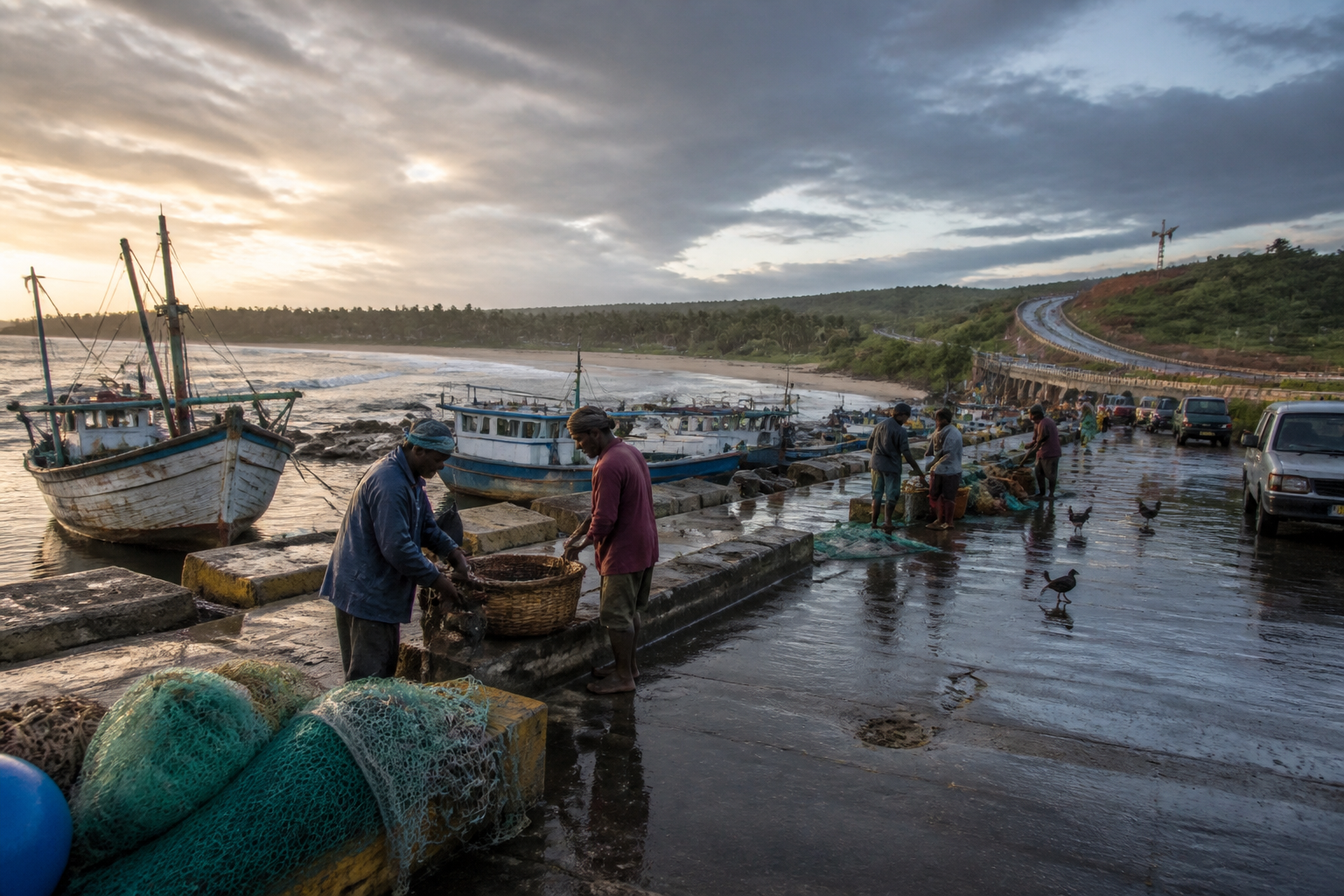
The Cabinet’s decisions also place fisheries at the centre of the coastal economy. The shorelines of Dakshina Kannada, Udupi and Uttara Kannada are to be notified as a Special Marine Zone to expand fisheries-related economic activity. The government has also decided to establish a Special Processing Zone at Balkunje in Dakshina Kannada, on 150 acres reserved for a fisheries park, at a cost of ₹30 crore. The stated objectives are investment, manufacturing, value addition and sustainable resource management.
The processing zone matters because fisheries development is not limited to boats and harbours. It also includes cold storage, processing, packaging, transport, marketing and skills. Locating more of that value chain within the region could support local employment and reduce the loss of value that occurs when raw products leave coastal districts for processing elsewhere. The Cabinet’s approval, however, establishes an administrative decision rather than an operational outcome. Land use, environmental permissions, financing, infrastructure connections and access for small fishing communities will determine how the zone functions.
The government has simultaneously decided in principle to upgrade Mangaluru Fisheries College into a fisheries university and increase student admissions from 60 to 200. It has also approved the creation of the Karnataka Institute of Marine Biotechnology and Blue Economy at the government fisheries college in Mangaluru. Together, these decisions indicate an attempt to build institutional capacity around the blue economy rather than rely only on physical infrastructure.
That institutional emphasis is important because the proposed programme covers activities with different regulatory requirements and different risks. Fisheries, marine biotechnology, port development, tourism and coastal construction cannot be managed through a single investment department. They involve the fisheries, tourism, ports, environment, higher education and local administration systems. The expansion of education and research capacity could help supply expertise, but the source material does not establish the university’s final legal structure, funding model, academic scope or implementation timetable.
Environmental governance is already part of the Cabinet’s coastal agenda. The government has decided to amend the Coastal Zone Management Plan 2019 after objections were raised in all three coastal districts. The source does not specify the nature of each objection or the provisions that will be changed. That makes the amendment a major point for public scrutiny, particularly because the same package proposes resorts, beach-front facilities, a multipurpose port and shipbuilding centre, aviation expansion and other forms of investment.
A coastal management plan determines how development permissions, environmental protection and hazard-sensitive land use are interpreted. Any amendment will therefore have consequences beyond a technical planning document. It could affect the location and design of tourism facilities, fisheries infrastructure, settlements and industrial activity. The Cabinet’s decision is clear on the intent to revise the plan, but the evidence supplied does not yet establish the revised boundaries, environmental safeguards, approval process or public consultation schedule.
The approved tourism projects show the scale and character of the proposed development model. A riverfront wellness resort at Kodikal in Dakshina Kannada is planned on 16.5 acres at a cost of ₹73 crore. A beach-front eco-friendly glamping and luxury resort, along with a sea experience centre and expo zone, is proposed at Tannirbhavi on 4.97 acres for ₹53 crore. A resort, adventure and entertainment zone is proposed at Trasi-Maravanthe in Udupi district on 7.07 acres for ₹48 crore. An eco-tourism resort at Ravooru in Chikkamagaluru district is estimated at ₹64 crore. These four projects are to be implemented through private partnership.
The projects illustrate how the tourism policy connects the coast with the wider Malnad and Western Ghats region. They also raise the question of what “eco-friendly” or “eco-tourism” will mean in regulatory and operational terms. The supplied announcement does not provide carrying-capacity assessments, water-use plans, waste-management arrangements, access-road details or the terms under which private partners will develop and operate the facilities. Those details will determine whether the projects create a more distributed tourism economy or simply add new pressure to sensitive landscapes.
Connectivity is another major part of the Cabinet package. The government has approved the development of Karwar airport with runway expansion and revised its development cost from ₹98.24 crore to ₹250 crore. It has also given in-principle approval to a water metro project connecting 12 centres from Mangaluru to Karwar. A separate approval covers a multipurpose port and shipbuilding centre at Manki, estimated at ₹6,925 crore.
These proposals represent different levels of maturity. An administrative approval for a revised airport cost, an in-principle approval for a water metro and an approval for a large port and shipbuilding centre do not carry the same implementation status. The next stages will require detailed project reports, land and environmental clearances, financing arrangements, tendering and institutional responsibility. The source does not provide timelines for these steps.
The proposed water metro is particularly notable because it would connect a chain of coastal centres rather than serve a single urban corridor. Such a system would depend on navigable waterways, terminals, vessels, maintenance facilities, safety arrangements and reliable integration with road transport. Without those details, the Cabinet decision establishes a regional mobility ambition but not yet a functioning transport network. Its significance will eventually be measured by whether it serves everyday movement as well as tourism.
The package also includes urban and social infrastructure. Branches of Kidwai and Jayadeva hospitals have been approved in Mangaluru. Government Wenlock Hospital is to receive an additional 200 beds, staff and equipment and be developed as a regional centre. A government medical college and hostel in Puttur have been sanctioned ₹425 crore. These decisions broaden the meaning of coastal development beyond tourism and industry. Regional growth requires healthcare capacity that can serve residents, workers and visitors, particularly when new infrastructure increases the movement of people across district boundaries.
The fisheries and tourism measures are accompanied by a Karnataka Marine Biotechnology Policy 2026-31 and a ₹20 crore handicrafts cluster in Karkala under the central government’s MSE-CDP scheme. The cluster is intended to support five forms of handicraft. This combination suggests that the government is seeking to connect large infrastructure and investment with smaller-scale economic activity, including processing, craft production and local employment.
The Cabinet has also decided to give Tulu the status of an additional administrative language, limited to Dakshina Kannada and Udupi districts. The decision follows an earlier committee report and a study of the criteria and procedures used for recognising an additional official language in Andhra Pradesh. The Chief Minister said the move reflected the sentiment of people in the region. Its practical significance will depend on how government offices, forms, services, recruitment, translation and digital systems implement the decision.
Another approval concerns local elections. Since the government intends to conduct zilla panchayat, taluk panchayat and gram panchayat elections by December, it has approved ₹151.31 crore to purchase 70,000 additional ballot boxes. The Cabinet said 40,000 boxes were already available and approximately 1.20 lakh would be required in total. Although separate from the coastal investment programme, the decision demonstrates the administrative scale of delivering regional governance: development commitments and routine institutional functions compete for attention and public funds within the same government system.
Taken together, the Cabinet decisions reveal three overlapping strategies. The first is to expand the coastal economy through tourism, fisheries processing, ports, shipbuilding and aviation. The second is to build supporting institutions through higher education, marine biotechnology, healthcare and administrative reforms. The third is to connect coastal places with one another and with the Western Ghats through tourism circuits and proposed transport infrastructure.
The central policy question is whether these strategies will be governed as one regional system or implemented as separate projects. A resort, a port, a fisheries park, an airport and a water metro may each be presented as economic opportunities, but they share land, water, roads, labour markets and environmental risks. The Cabinet’s decision to amend the coastal management plan makes this coordination even more important. The plan’s revised provisions, the terms of private participation and the allocation of responsibilities between state agencies and local governments will be key evidence of how the policy is being put into practice.
The available information confirms the scale of the government’s ambition and identifies the sectors it wants to prioritise. It does not yet establish project-level timelines, financing structures, environmental conditions, land acquisition requirements or mechanisms for measuring local employment and community benefit. Those details will determine whether the package becomes a coordinated coastal development programme or a collection of approvals. The next milestones are the notification of the Special Marine Zone, the proposed amendments to the Coastal Zone Management Plan 2019, detailed planning for the major infrastructure projects and the public process on the proposed renaming of Dakshina Kannada district as Mangaluru district.
